Why WordPress security becomes a business decision
The best WordPress security plugins can help protect a website against malware, brute-force attacks, suspicious requests, unauthorized access, and other common threats. However, installing a security plugin is only one part of protecting a commercially important WordPress website.
Consider a US professional services firm whose website generates consultation requests, a nonprofit that accepts online donations, or an ecommerce company running paid campaigns to a WooCommerce store. If the website is compromised, the consequences can extend beyond a few unavailable pages. Lead generation can stop, customer confidence can fall, advertising spend can be wasted, and recovery can take considerably longer than expected.
That is why security should be considered during WordPress website development, rather than treated as something to add after launch.
What should a WordPress security plugin actually protect?
Before comparing the best WordPress security plugins, identify the threats and operational problems your website is most likely to face.
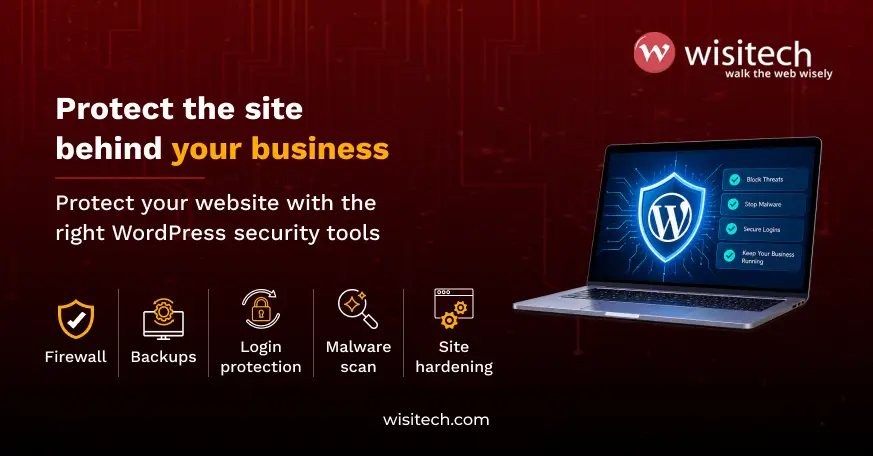
A sensible security setup should address several areas:
- Malware and suspicious-code detection
- Brute-force and login protection
- Two-factor authentication
- Firewall and malicious-request filtering
- File and WordPress core integrity monitoring
- Security activity and administrator logs
- Vulnerability notifications
- Backup and recovery procedures
- WordPress hardening
The important point is that more features do not automatically mean better protection. A small consulting firm’s website may need a different security setup from a WooCommerce store processing hundreds of transactions or a membership platform with several levels of user access.
Best WordPress security plugins by business requirement
Wordfence for detailed threat visibility
Wordfence is a strong option for businesses that want extensive visibility into WordPress security activity. Its firewall, malware scanning, login protection, IP blocking, and monitoring capabilities make it useful when someone on the team can review alerts and respond to them.
For a growing US company with an internal marketing or technical team, that visibility can be valuable. The tradeoff is that security information still needs to be interpreted and acted upon.
Sucuri for broader website protection
Sucuri is worth considering when a business wants protection that extends beyond conventional WordPress plugin functionality. Its security offering includes website monitoring, malware protection, firewall capabilities, CDN functionality, and malware removal services.
This can make sense for websites where availability and recovery are particularly important. A business that depends heavily on its website for leads, transactions, or customer access may place greater value on a broader security service than on a plugin alone.
MalCare for simpler malware management
MalCare focuses heavily on malware detection and removal, with an emphasis on making the process accessible to website owners who may not want to investigate infected files manually.
For a small business without an in-house developer, that simplicity can matter. If the website generates leads or revenue, having a straightforward path from detection to remediation can be more useful than a dashboard filled with technical information.
Solid Security for login protection and hardening
Solid Security, formerly known as iThemes Security, focuses on WordPress hardening, login protection, two-factor authentication, and access management.
It can suit businesses primarily concerned with reducing common WordPress configuration and account-security risks. Strong administrator controls become increasingly important as more employees, contractors, and agencies receive access to the website.
All-In-One WP Security for cost-conscious websites
All-In-One WP Security and Firewall is an option for businesses looking for a broad range of security controls without immediately committing to a premium security service.
Its visual approach can make security settings easier for non-developers to understand. For a straightforward business website, it can be a practical starting point, provided the rest of the security process is properly managed.
Security Ninja for security testing
Security Ninja takes a testing-oriented approach, checking WordPress configurations, files, and other areas for potential weaknesses.
This makes it useful for website owners who want to identify security issues before they become incidents. Scheduled testing can also form part of a wider maintenance process.
Defender for businesses using the WPMU DEV ecosystem
Defender provides security hardening, two-factor authentication, file scanning, IP lockout notifications, and security reporting.
It can be particularly convenient for businesses already using other WPMU DEV tools and looking for security capabilities within the same ecosystem.
A security plugin cannot fix a weak WordPress foundation
One of the biggest mistakes businesses make is treating a security plugin as the complete security strategy.
A plugin cannot compensate for an outdated WordPress installation, weak administrator credentials, unnecessary plugins, poor hosting configuration, unreliable backups, or insecure custom code.
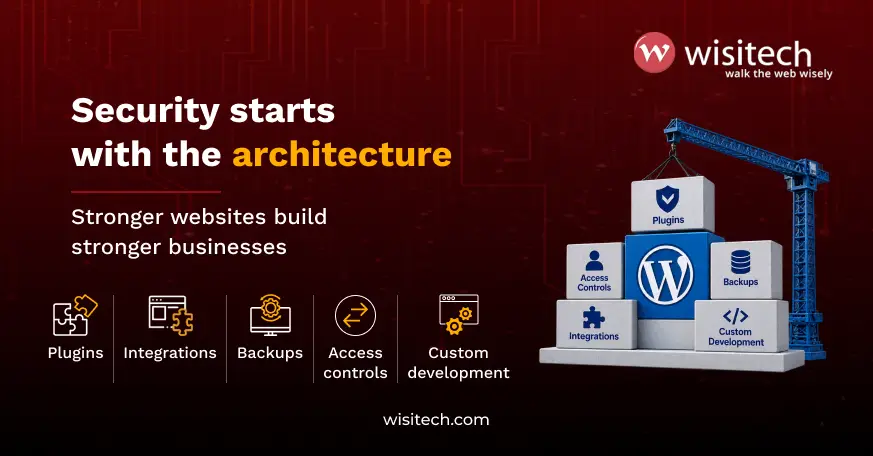
This becomes particularly important when a website has evolved over several years. A US business may have accumulated a page builder, analytics tools, CRM integrations, forms, ecommerce extensions, membership functionality, and custom plugins. Every additional component creates another dependency that needs to be maintained.
This is where custom WordPress development services can make a practical difference. Security decisions can be incorporated into the architecture, plugin selection, custom functionality, integrations, and deployment process instead of being handled separately.
Wisitech’s custom WordPress development services cover custom plugin architecture, proprietary workflow automation, third-party API integrations, CMS structures, security hardening, performance improvements, and ongoing WordPress maintenance.
When custom WordPress development makes more sense
A business can reach a point where installing another plugin is no longer the best solution.
Suppose a membership organization needs custom user permissions. A healthcare company needs carefully controlled integrations. A nonprofit requires a donation workflow connected to its CRM. Or an ecommerce company needs custom product logic that several off-the-shelf plugins cannot handle cleanly.
Adding several plugins to force those requirements into a standard WordPress installation can increase maintenance and security risk.
With custom WordPress development, functionality can be designed around the actual business process. That does not eliminate security risks, but it gives the development team greater control over what the website does, what code is running, and which third-party dependencies are genuinely necessary.
Security and website performance need to work together
Security and performance should be evaluated together.
Some security tools perform regular scans, monitor files, log activity, or filter requests. Depending on configuration and available server resources, those processes can affect performance.
For a business that depends on organic search, Google Ads, or high-converting landing pages, a slow website has a commercial cost. Wisitech’s WordPress speed optimization service covers Core Web Vitals audits and fixes, image optimization, database cleanup, caching, server-side performance, code minification, and plugin-bloat removal.
When reviewing the best WordPress security plugins, therefore, ask how the security setup will interact with caching, hosting, traffic levels, and the rest of your WordPress stack.
What does a secure WordPress project cost?
Security should be considered alongside the overall development budget rather than treated as a separate emergency expense.
Wisitech’s current WordPress development pricing starts at $4,000. A straightforward custom WordPress corporate website typically costs $4,000 to $8,000. WooCommerce builds and membership platforms with complex integrations typically range from $10,000 to $25,000, depending on scope. Custom web applications involving third-party API integrations, multilingual requirements, or advanced user-role structures can cost more.
These are Wisitech’s published WordPress development ranges, rather than generic industry estimates. We provide a fixed-price quote after a discovery call, with the project scope and requirements established before development begins.
For a business considering a redesign or new WordPress build, this distinction matters. Security should be accounted for during architecture, development, integration, testing, and launch rather than added as an afterthought.
How to choose the right security setup
There is no universal winner among the best WordPress security plugins.
A small professional services website may need strong login protection, two-factor authentication, backups, and sensible hardening. A WooCommerce business may need more extensive malware monitoring, firewall protection, tested recovery procedures, and tighter control over integrations. A membership platform or web application may require a security strategy designed around custom functionality and user permissions.
The better approach is to start with the website’s business role, identify the consequences of compromise, review the technology stack, and then select the security tools that fit that environment.
That approach is more reliable than installing several plugins simply because they appear on a popular list.
Conclusion
The best WordPress security plugins can provide valuable protection, but the plugin itself should never become the entire security strategy. Wordfence, Sucuri, MalCare, Solid Security, All-In-One WP Security, Security Ninja, and Defender can all be appropriate depending on the website and the team managing it.
For US businesses, the more important question is whether the underlying WordPress installation is being developed and maintained with security in mind. Updates, access controls, backups, integrations, performance, and recovery all need clear ownership.
If your WordPress site has become too important to leave to an ad hoc collection of plugins and occasional updates, we can help you review the underlying architecture and determine what needs to change.
Build security into the WordPress foundation before a plugin becomes your emergency plan. Talk to us about what your existing website actually needs.