

Outline
I. Introduction
- Context: The shift from keyword SEO to AI-driven search
- Why Google AI Mode matters for businesses in 2025 and beyond
- How Wisitech helps brands adapt
II. What Is Google AI Mode?
- How it works technically (overview in plain terms)
- Integration with Chrome and generative search
- Why it changes user intent and content interpretation
III. Google AI Mode vs. Traditional SEO
- Direct comparison (keywords vs. context, ranking vs. comprehension)
- Why AI-structured content is now crucial
- The rise of GEO and AEO as core strategies
IV. How Google AI Mode Impacts Businesses
- New rules for visibility
- Voice and conversational optimization
- Data collection & AI-powered analytics
- Browser-based AI behavior tracking
V. Key Strategies for Business Owners
- Generative Engine Optimization (GEO)
- Answer Engine Optimization (AEO)
- Chrome AI Mode – What is it?
- Agentic AI Integration
- Each sub-section includes “Action Steps,” “Pro Tips,” and “Wisitech Implementation Angle”
VI. Multimodal & Entity-First Optimization
- How AI understands text, images, video, and audio
- The importance of entities and semantic connections
VII. Advanced AI Marketing Techniques
- AI marketing automation
- Conversational AI commerce
- Enterprise AI integration
VIII. Measuring Success in Google AI Mode
- Metrics and KPIs for AI visibility
- How to use analytics and GEO/AEO calculators
IX. Future-Proofing Your Business
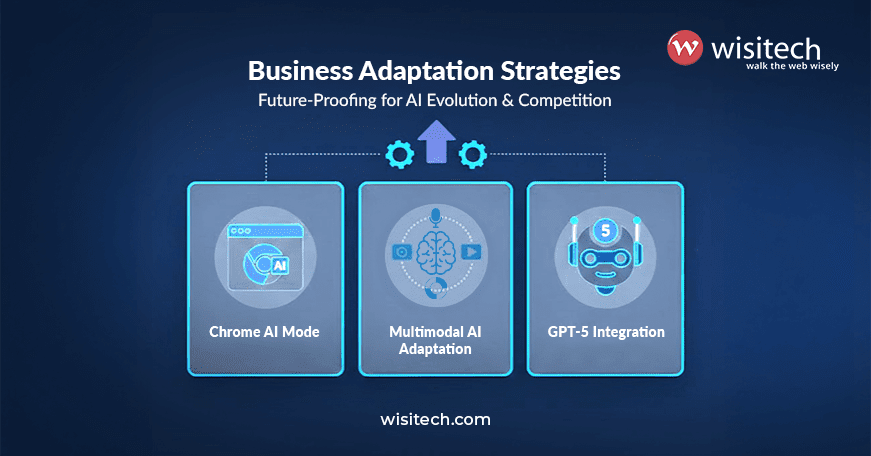
- Chrome AI Mode marketing trends
- Preparing for multimodal and agentic automation
- Adapting to GPT-5 and beyond
X. Step-by-Step Action Plan for Business Owners
- Comprehensive roadmap (audit → optimize → integrate → measure → scale)
XI. Resources & Checklists
- AI ROI Frameworks
- Structured Data Best Practices
- AI Readiness Checklist
- AI Integration Roadmap
XII. Conclusion
- Key takeaways
- Invitation to partner with Wisitech for AI-first growth
I. Introduction
The digital landscape is undergoing one of the most significant transformations in recent history. For decades, businesses have relied on search engine optimization (SEO) to drive visibility and attract potential customers. Keyword research, backlinks, and meta descriptions – these were the tools of the trade. However, 2025 marks a turning point: Google AI Mode is changing the way information is discovered, processed, and presented to users online.
Google AI Mode is not just another algorithm update. It represents a paradigm shift in how search engines interpret content. Traditional SEO focused on matching keywords with search intent. Google AI Mode, by contrast, understands content contextually, interprets meaning, and delivers answers rather than a list of links. For business owners, this creates both a challenge and a massive opportunity. Businesses that adapt to AI-driven search now will enjoy higher visibility, better customer engagement, and measurable ROI. Those that rely solely on legacy SEO techniques risk being left behind.
Why Google AI Mode Matters
Understanding Google AI Mode is essential because it fundamentally changes how businesses should create content, structure their websites, and interact with potential customers. The AI-driven search ecosystem doesn’t just reward popular pages; it evaluates content clarity, semantic structure, entity relationships, and user satisfaction. In other words, the quality of your answers and your ability to be AI-readable are more important than ever.
Business owners need to move beyond simply ranking for keywords and focus on ensuring their content is clearly understood by AI. This strategy combines traditional SEO with Generative Engine Optimization (GEO) and Answer Engine Optimization (AEO). At Wisitech, we stay up to date with the latest developments in the digital space to help businesses thrive in an AI-driven search landscape.
II. What Is Google AI Mode?
Google AI Mode is a next-generation AI system integrated with Google Search and Chrome that interprets, synthesizes, and presents information in a way that mimics human understanding. Instead of scanning for isolated keywords or analyzing backlinks, the AI evaluates content meaning, context, and relevance, delivering answers that are both accurate and actionable.
In practice, Google AI Mode offers:
- Multimodal Understanding
Google AI Mode goes beyond traditional text-based analysis by integrating multiple data types, text, images, audio, and structured data, into a unified understanding. This multimodal approach allows the AI to interpret complex queries more effectively, drawing connections between visual cues, spoken language, and written context. As a result, the system delivers more accurate and contextually aware insights, enhancing how users interact with content and receive AI-driven responses.
- Contextual Personalization
Every search experience is shaped by the user’s unique context. Google AI Mode takes into account factors such as search history, device type, location, and browsing behavior to deliver personalized results. By understanding these nuances, it can predict intent more accurately and provide recommendations or answers that truly match individual preferences and needs, creating a search experience that feels intuitive, adaptive, and highly relevant.
- Generative Answer Capabilities
Rather than simply displaying a list of web pages, Google AI Mode uses generative AI to synthesize data from multiple reliable sources into clear, concise summaries. This capability transforms how users access information, offering direct, actionable insights that save time and reduce effort. The AI distills key points, provides context, and highlights practical takeaways, allowing users to grasp the essence of a topic instantly.
- Agentic Functionality
Google AI Mode moves beyond passive information delivery to active assistance. Users can perform tasks directly from the search interface, such as booking appointments, comparing products, or making purchases. Through intelligent, context-aware prompts, the system enables smooth transitions from inquiry to action, creating a seamless, end-to-end experience that blends information retrieval with automated task execution.
How Google AI Mode Works
The AI processes content in four main stages:
- Intent Analysis
Google AI Mode doesn’t just interpret the literal meaning of a query; it analyzes the user’s true intent behind it. By evaluating factors such as past search history, device type, browsing context, and even the phrasing of the query, the AI can better understand what the user is actually looking for. This deeper comprehension allows the system to anticipate needs and deliver results that are both contextually relevant and precisely aligned with user expectations, even when the search terms themselves are ambiguous or open-ended.
- Content Evaluation
To generate accurate responses, the AI continuously scans and evaluates billions of web pages, databases, and structured data sources. It assesses semantic relationships, topical authority, and contextual depth to determine which pieces of content are most relevant and trustworthy. This process involves not just keyword matching but also an understanding of meaning, tone, and intent, ensuring that the chosen content directly satisfies the user’s query with credibility and precision.
- Answer Synthesis
Rather than simply presenting a list of blue links, the AI synthesizes information from multiple verified sources into a single, coherent response. It crafts summaries that read naturally, providing users with clear, human-readable explanations supported by citations and references. This approach turns fragmented online data into unified insights, offering users accurate, contextual, and actionable information that enhances decision-making and comprehension.
- Action Recommendation
Google AI Mode extends beyond information retrieval to enable intelligent next steps. Based on user consent and available data, it can suggest or even initiate actions such as scheduling appointments, completing purchases, or generating reports. These AI-driven recommendations transform search interactions into task-oriented experiences, streamlining workflows and enabling users to accomplish goals directly within the search environment.
This system demands that businesses structure content for AI comprehension, rather than traditional ranking metrics. Wisitech guides companies through these changes by integrating schema markup, AI-friendly content structuring, and entity-based optimization.
The Business Implications of Google AI Mode
The shift to AI-driven search transforms how businesses reach customers. It’s no longer sufficient to simply “show up” on page one of Google. AI Mode evaluates credibility, clarity, and context, meaning businesses must rethink their digital strategies.
Key impacts include:
- Search Visibility
In the era of AI-driven search, visibility depends on how well content is optimized for machine understanding. Only content that is structured, semantically clear, and contextually relevant is selected for inclusion in synthesized AI answers. This means businesses must focus on creating material that aligns with how AI models interpret and prioritize information. Doing so ensures your brand appears prominently where users are receiving direct, AI-generated insights, maximizing exposure and authority in organic search results.
- Customer Experience
Google’s AI Mode emphasizes clarity and utility over volume. Instead of presenting users with generic or repetitive information, it delivers concise, actionable responses that address specific needs. This shift enhances user engagement by reducing friction; people find answers faster, understand them more easily, and feel more confident in taking the next step. For businesses, this translates to higher satisfaction rates, improved trust, and stronger long-term customer relationships.
- Content Strategy
To thrive in an AI-first search environment, businesses must rethink how content is created and structured. AI systems value data that is semantically rich, well-organized, and contextually aligned with user intent. This includes optimizing headings, metadata, and contextual relationships between topics. By building AI-friendly content, brands can improve comprehension, increase ranking potential, and ensure their messaging resonates effectively with both algorithms and audiences.
- Data Analytics
AI Mode unlocks a deeper layer of insight into how users interact with content. Beyond basic metrics like clicks and impressions, businesses gain access to behavior patterns, engagement signals, and contextual trends derived from AI analysis. These insights empower organizations to refine strategies, optimize messaging, and measure performance more accurately, turning raw data into actionable intelligence that drives continuous improvement.
III. Google AI Mode vs. Traditional SEO
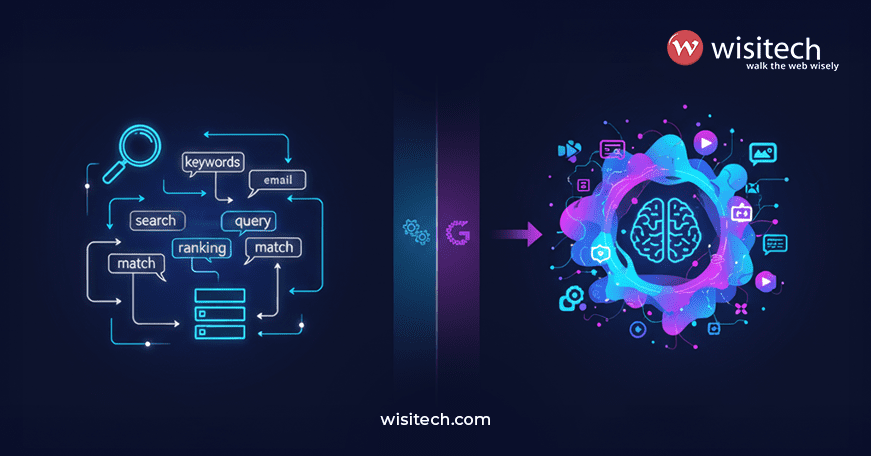
To understand the implications, consider how AI Mode differs from traditional SEO.
| Feature | Traditional SEO | Google AI Mode |
|---|---|---|
| Focus | Keywords, backlinks | Context, meaning, entities |
| Goal | Rank on SERPs | Appear in AI-generated answers |
| Content | Keyword-rich, static | Conversational, structured, AI-readable |
| User Interaction | Click-based | Action-oriented (voice, AI suggestions) |
| Analytics | Page views, CTR | AI engagement metrics, user satisfaction |
Why This Matters for Businesses
Traditional SEO techniques such as keyword optimization, backlinks, and meta tags remain important, but they no longer guarantee visibility. Google AI Mode evaluates how well content answers questions, not just how well it repeats keywords. Businesses must focus on:
- Structured Content
Clear headings, subheadings, and entity relationships. - Semantic Relevance
Providing content that aligns with user intent. - Multi-format Accessibility
Ensuring text, images, and video are AI-readable.
For instance, a blog post that clearly answers a common customer question, includes structured schema markup, and uses relevant entities will outperform a page that simply repeats keywords. Wisitech integrates GEO and AEO strategies to ensure content is AI-first ready.
Real-World Implications
- Content Creation
In the age of AI-driven search, traditional keyword-heavy writing is no longer enough. Businesses must shift toward AI-focused content frameworks that emphasize clarity, meaning, and contextual depth. The goal is to make content easily interpretable by both humans and machines, using natural language, structured formatting, and semantically rich data. By focusing on relevance and intent rather than keyword repetition, brands can ensure their content aligns with how Google’s AI processes and prioritizes information.
- Website Architecture
A strong, well-organized site structure is essential for AI comprehension. Websites should use a clear hierarchical layout, supported by internal linking that logically connects related pages. Incorporating schema markup and entity-based relationships helps AI systems understand the context, relationships, and purpose of each page. This architecture not only improves crawlability and visibility but also allows search engines to interpret and present content more effectively in AI-generated summaries. - Voice and Conversational Search
Google AI Mode increasingly relies on natural, conversational interactions to deliver results. Users are phrasing queries as full questions or spoken commands rather than short keywords. Businesses must therefore optimize content for these conversational patterns, focusing on how real people speak and ask questions. This means integrating FAQ formats, natural sentence structures, and context-aware phrasing to ensure visibility in voice and AI-powered searches. - Conversion Optimization
With AI Mode shifting from providing information to enabling action, websites must be built for interaction. This includes integrating AI-actionable elements such as structured product data, booking systems, service request forms, and interactive CTAs. When content is formatted for AI interpretation, these elements can be surfaced directly within AI responses, allowing users to complete transactions, schedule services, or request quotes seamlessly, turning AI-driven visibility into measurable business outcomes.
IV. How Google AI Mode Impacts Businesses
Google AI Mode marks a fundamental shift in how businesses approach visibility, engagement, and conversion online. By merging generative AI, semantic understanding, and action-based responses, it redefines the traditional rules of search marketing, turning static web content into dynamic, AI-interpretable assets. This change affects every stage of the digital experience, from how users find brands to how they interact and take action.
1. Visibility Through Context, Not Ranking
With Google AI Mode, traditional SEO metrics like keyword density and backlink count are no longer the primary drivers of visibility. Instead, the AI prioritizes contextual relevance: how well your content aligns with the user’s intent, semantic structure, and overall meaning. This means even a lower-ranked page can surface prominently in AI-generated summaries if it provides precise, well-structured, and contextually rich answers.
Businesses that adapt to this model gain a competitive edge by appearing in AI-synthesized answers, where users engage most actively. Wisitech enables this transformation through multi-layered AI visibility strategies, including:
- Generative Engine Optimization (GEO)
Structuring content for AI comprehension and synthesis. - Answer Engine Optimization (AEO)
Ensuring your brand appears in AI-generated summaries and quick answers. - Chrome AI Mode Integration
Making your site’s content accessible and actionable directly within the AI-enhanced browser environment.
2. Dominance of Voice and Conversational Search
AI Mode accelerates the rise of conversational and voice-driven search. Instead of typing fragmented keywords, users now speak or type complete questions, like “Which accounting software integrates AI analytics for SMBs?” These natural language queries demand content that mirrors human speech patterns and intent.
For businesses, this means moving beyond keyword targeting to ‘intent mapping,’ crafting content that answers specific conversational prompts and follows the logical flow of how people ask and think. Wisitech helps brands reformat their digital assets to align with voice-driven, AI-interpreted search environments, ensuring higher inclusion in real-time, generative responses.
3. Real-Time AI Analytics
Google AI Mode brings a new level of analytical sophistication. Rather than relying solely on surface metrics like clicks, impressions, or time on page, AI now monitors engagement at semantic and behavioral levels, understanding why users interact with specific content and how they navigate decision pathways.
This real-time intelligence allows businesses to see which messages resonate, how intent evolves, and where engagement turns into action. It shifts performance tracking from static reporting to continuous learning, enabling agile content optimization that keeps pace with user behavior and AI-driven trends.
4. Browser-Based AI Behavior Tracking
As Chrome integrates deeper AI capabilities, behavior tracking extends beyond websites into the browser environment itself. Chrome AI Mode can interpret user intent, consumption habits, and interaction sequences in real time, essentially building a more complete understanding of how audiences engage with content across contexts.
For businesses, this creates opportunities to refine strategies based on real behavioral data rather than assumptions. Optimizing for Chrome AI means ensuring your content is structured, linked, and formatted for discoverability, interactivity, and AI-triggered actions, making your brand more accessible within the evolving AI ecosystem.
5. From Passive to Agentic Marketing
Google AI Mode transforms marketing from a passive, reaction-based model into an agentic one, where AI systems actively help users complete tasks and make decisions. Instead of waiting for visitors to browse and click, businesses can now empower AI to initiate actions such as booking appointments, requesting demos, or completing purchases.
Wisitech prepares brands for this paradigm through agentic AI frameworks that merge content, design, and functionality. These frameworks make websites “AI-actionable,” allowing Google’s systems to interpret and execute tasks on behalf of users, turning engagement into immediate conversions and positioning businesses for success in an automated, intent-driven future.
V. Key Strategies for Business Owners
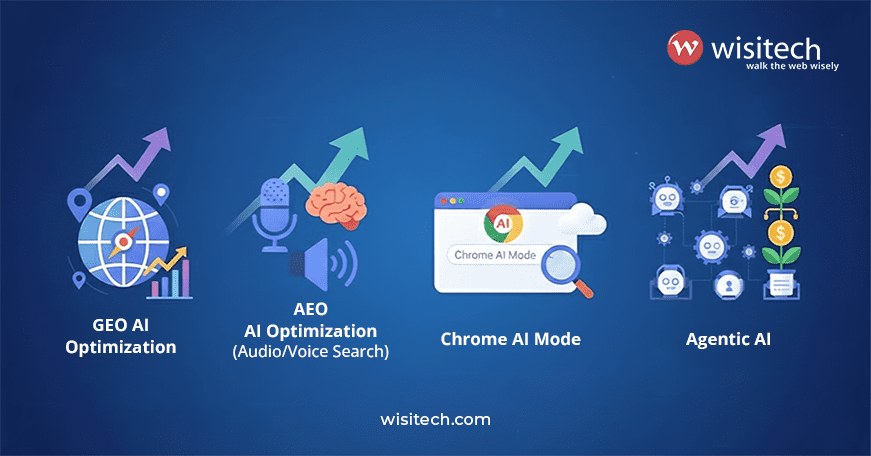
Understanding Google AI Mode is the first step; the next is implementing actionable strategies that ensure your business thrives in this AI-first ecosystem. Wisitech recommends a four-pronged approach that combines generative, answer, and agentic AI optimization with Chrome-specific tactics.
1. Generative Engine Optimization (GEO)
Generative Engine Optimization (GEO) is about making your content AI-comprehensible while enhancing its value in generative responses. Unlike traditional SEO, GEO focuses on structured meaning, entities, and predictive AI relevance.
How GEO Works
- Semantic Structuring
Organize content into clear hierarchical sections using H1–H4 headers. This helps AI understand topic clusters and relationships within your content. - Entity Mapping
Naturally include key entities like people, places, products, and services. AI recognizes these entities and links them to your brand for credibility. - Citation Optimization
Use credible sources, internal links, and authoritative references. This signals trustworthiness and boosts AI confidence in your content. - Content Formatting
Utilize bullet points, tables, and numbered lists for clarity.
Structured formatting improves AI comprehension and content summarization.
GEO Best Practices for Businesses
- Audit Existing Content
Review pages to identify which clearly answer user intent and which are keyword-heavy but context-poor. This ensures your content aligns with AI comprehension and relevance standards. - Implement Structured Data
Apply schema markup for products, FAQs, reviews, events, and services. Structured data helps AI accurately understand and index your content. - Semantic Enrichment
Incorporate synonyms, related phrases, and contextual definitions throughout content. This enhances AI understanding and improves content discoverability. - Content ROI Tracking
Measure engagement on GEO-focused pages using AI analytics dashboards.
Tracking performance allows continuous optimization and data-driven decisions.
2. Answer Engine Optimization (AEO)
While GEO focuses on understanding generative AI, Answer Engine Optimization (AEO) ensures your business appears in AI-powered direct answers. This is especially critical for conversational search and voice queries.
Key AEO Tactics
- Question-Based Content
Organize content around common user questions and natural language queries. This makes it easier for AI to identify and surface relevant answers. - Featured Snippet Readiness
Optimize paragraphs of 40–60 words with clear, concise answers. This increases the chances of appearing in AI-generated snippets and summaries. - Local AEO
Add location-specific information to target regional searches for small businesses. AI uses this data to provide precise, locally relevant answers. - Conversational Formatting
Write in a first-person, conversational tone suited for voice search. This helps AI deliver responses that feel natural and user-friendly.
Measuring AEO Performance
- Snippet inclusion rate
Track the percentage of your pages appearing in AI summaries. - Voice search engagement
Monitor queries initiated via AI voice responses. - Conversion tracking
Map actions taken after AI provides answers, such as form submissions or service inquiries.
3. Chrome AI Mode Optimization
Chrome AI Mode leverages the browser to deliver AI insights and actions directly to users. Businesses can optimize for Chrome AI in three main ways:
- Contextual Webpage Analysis
Ensure pages are rich in context. AI should easily extract meaning from headings, meta descriptions, and structured data. - Query Fan-Out Technique
Expand content to answer not just the main query but related sub-questions. - Browser Integration
Create pages that support AI features like autofill, recommendation cards, and interactive prompts.
Action Steps
- Conduct Chrome AI readiness audits to identify gaps in structured data.
- Optimize internal linking to help AI navigate topic clusters.
- Integrate interactive elements (calculators, chat prompts) that AI can surface in generative answers.
4. Agentic AI Integration
Agentic AI enables your content to not only inform but also act autonomously on behalf of users. For businesses, this is the next frontier in automation and customer engagement.
Implementation Strategy
- AI Agents for Service
Automate customer service, appointment booking, and lead qualification. - GPT-5 Codex Integration
Use enterprise AI models to generate responses and handle complex queries dynamically. - Marketing Automation
Link content with AI-driven campaign triggers and personalization.
Benefits
- Reduces manual intervention while increasing engagement.
- Enhances conversion by delivering immediate, AI-optimized actions.
- Supports scalable business growth in AI-first ecosystems.
VI. Multimodal & Entity-First Optimization
Google AI Mode goes beyond traditional text analysis; it can interpret images, video, audio, and structured data all at once, understanding the relationships between different types of content to generate richer, more accurate insights. For businesses, this means that optimizing solely for keywords is no longer enough. By adopting a multimodal content strategy, including alt text for images, metadata for videos, audio transcripts, and structured data markup, brands can ensure their content is fully AI-comprehensible. This holistic approach not only improves visibility in AI-generated answers but also positions businesses to engage users across multiple formats, gaining a competitive edge in an increasingly AI-driven search landscape.
Multimodal Content Strategy
- Image SEO
Use descriptive filenames, alt text, and AI-friendly captions. - Video Optimization
Add transcripts, structured data, and context summaries. - Audio Content
Include text alternatives and semantic tagging. - Cross-Modal Linking
Ensure content across media types references related entities for AI coherence.

Entity-First Optimization (EFO)
Entities are the building blocks of AI comprehension. Businesses need to structure content around entities like products, services, locations, and people.
- Knowledge Graph Optimization
Knowledge Graph Optimization involves connecting key entities, like products, services, people, or locations, through internal links and authoritative external references. By clearly defining relationships between these entities, businesses help AI understand how different pieces of content relate to each other and to the wider web. This not only boosts credibility but also increases the chances of appearing in AI-generated answers, rich results, and other enhanced search features, giving your content greater visibility and trustworthiness. - Semantic SEO
Semantic SEO focuses on organizing content around meaning and context rather than just keywords. Using natural language and creating topic clusters that demonstrate relationships between subtopics allows AI to interpret your content’s intent accurately. This ensures that search engines can deliver precise, contextually relevant answers to user queries, improving both visibility and engagement. Structured semantic content also enhances content authority by showing depth and comprehensive coverage of a topic.
- Local Entity Focus
Optimizing for local entities means including detailed, accurate information about your business, such as physical addresses, phone numbers, operating hours, and region-specific products or services. AI uses this data to provide precise results for location-based queries, improving your presence in local search and “near me” recommendations. By clearly linking your business to local context, you make it easier for AI to recognize relevance and connect nearby users with your offerings. - E-A-T Enhancement
E-A-T (Expertise, Authority, Trustworthiness) is critical for AI confidence in your content and entities. By producing well-researched, factually accurate, and well-sourced content, businesses demonstrate subject-matter expertise and credibility. High-quality references, citations, and transparent authorship signal authority, while consistent accuracy and reliability build trust. Strengthening E-A-T helps AI prioritize your content in synthesized answers and high-value search results, improving both visibility and user confidence.
VII. Advanced AI Marketing Techniques
Once foundational AI optimization is in place, businesses can move beyond basic visibility and start leveraging advanced AI marketing strategies for significant growth. These strategies allow companies to automate complex workflows, delivering personalized experiences at scale.
AI-driven marketing can predict customer behavior, enabling timely and relevant interactions across channels. Businesses can integrate conversational AI commerce, predictive analytics, and dynamic content generation to maximize engagement.
Ultimately, advanced AI marketing transforms digital presence into a scalable, revenue-generating system that adapts to evolving user needs.
1. AI Marketing Automation
AI Marketing Automation leverages advanced analytics and machine learning to streamline and enhance marketing efforts across all channels. Key capabilities include:
- Predictive Customer Journey Mapping
AI analyzes historical data and user behavior to anticipate each customer’s path, from awareness to conversion. Businesses can proactively deliver the right message at the right moment, improving engagement and reducing drop-offs. - Real-Time Personalization
By interpreting user interactions instantly, AI tailors content, offers, and recommendations in real time. This ensures that every touchpoint feels relevant and individualized, enhancing customer satisfaction and brand loyalty. - Automated Campaign Generation Based on AI Analytics
AI can design, schedule, and execute marketing campaigns automatically, using insights derived from performance data. This reduces manual effort, speeds up campaign deployment, and allows continuous optimization based on live results.
2. Conversational AI Commerce
Conversational AI Commerce transforms how businesses interact with customers, shifting from static e-commerce to interactive, AI-driven experiences:
- AI Chatbots That Drive Sales
Intelligent chatbots engage users through natural conversation, answering questions, recommending products, and facilitating purchases. They operate 24/7, improving conversion rates and customer satisfaction. - Voice Commerce Integration
With the rise of voice-activated devices, AI enables customers to search for, compare, and buy products using natural spoken language, providing a seamless, hands-free shopping experience. - Personalized Product Recommendations via Natural Language Processing (NLP)
AI analyzes user intent and preferences through conversational inputs, delivering highly relevant product suggestions that feel tailored to individual needs.
3. Enterprise AI Integration
Enterprise AI Integration allows large organizations to embed advanced AI capabilities directly into their existing business workflows and systems:
- GPT-5 Custom Implementation for Business-Specific Workflows
Businesses can deploy GPT-5 models fine-tuned for unique operational requirements, automating tasks such as report generation, customer support, and knowledge management. - AI API Integration for Legacy Systems
AI can be connected to older enterprise software via APIs, enabling seamless access to AI insights without requiring complete system overhauls. - Continuous Performance Optimization and Compliance Tracking
Integrated AI systems monitor their own performance, adjusting in real time for accuracy, efficiency, and compliance with industry regulations, ensuring reliability and reducing operational risk.
VIII. Measuring Success in Google AI Mode
With Google AI Mode, the traditional metrics of SEO, like page rank or raw traffic, are no longer sufficient to gauge performance. Businesses now need to track AI-specific engagement and action metrics that reflect how effectively content is being interpreted, surfaced, and acted upon by AI systems. Key areas to focus on include:
- AI Visibility
This measures how frequently your content is included in AI-generated answers and summaries. Tracking AI visibility helps businesses understand the reach of their content in an AI-first search environment. Frequent inclusion indicates that the AI recognizes your content as contextually relevant and authoritative, which can drive higher exposure to users who may never scroll past synthesized results.
- Action Metrics
These metrics track the tangible outcomes generated by AI-driven interactions, such as conversions, form submissions, demo requests, and other user actions. Unlike traditional clicks, action metrics provide insight into the real-world effectiveness of AI-optimized content, showing whether users are engaging meaningfully and completing desired tasks as a result of AI recommendations.
- Engagement Quality
Engagement quality measures how users interact with AI-synthesized content, including time spent reading or interacting, scroll depth, and repeated engagement. Higher engagement signals that content is clear, relevant, and actionable. It also indicates that the AI successfully interpreted your content and presented it in a way that resonates with users, creating opportunities for stronger brand trust and retention. - ROI Analysis
Return on investment in AI optimization can be measured using tools like Generative Engine Optimization (GEO) and Answer Engine Optimization (AEO) calculators. These tools help quantify the financial impact of AI-specific visibility and engagement efforts. By linking AI interactions to revenue, lead generation, or other business objectives, companies can evaluate the effectiveness of their AI strategies, prioritize high-impact content, and continuously refine their approach for maximum ROI.
IX. Future-Proofing Your Business
As Google AI Mode continues to evolve, staying ahead requires proactive adaptation rather than reactive tweaks. Business owners must anticipate future AI search behaviors, multimodal integrations, and agentic capabilities to remain competitive.
1. Anticipating Chrome AI Mode Trends
Chrome AI Mode is likely to expand its browser-level intelligence, providing:
- Predictive Query Suggestions
AI anticipates user questions before they are typed or spoken, using patterns from past behavior, context, and common search trends. This helps users find relevant information faster and allows businesses to appear proactively in the discovery phase.
- Actionable Search Summaries
AI delivers concise, synthesized answers that users can engage with directly. Rather than just providing links, these summaries often include interactive options, such as booking services, making purchases, or accessing additional resources, turning search results into actionable experiences.
- Cross-Device Continuity
AI maintains continuity across devices and sessions, remembering prior queries and interactions. This allows for a seamless user experience, where follow-up searches or actions feel intuitive and personalized, enhancing engagement and satisfaction.
Actionable Takeaways
- Ensure Multi-Device Consistency
Your content should be fully AI-readable and optimized across mobile, desktop, and tablet. Consistency ensures that users receive the same high-quality, contextually accurate experience regardless of the device they use, allowing AI to interpret and surface your content effectively across all platforms.
- Use Structured Data for Contextual Relevance
Implementing structured data helps AI understand the relationships between your content elements and their broader context. This ensures that your pages remain relevant and interpretable across a variety of query scenarios, improving visibility in AI-generated summaries and enhancing the precision of results delivered to users. - Implement Real-Time Content Updates
For fast-changing topics, products, or services, keeping content up to date is essential. Real-time updates allow AI to access the latest information, ensuring that users receive accurate, actionable answers and maintaining your brand’s credibility and authority in dynamic search environments.
2. Preparing for Multimodal & Agentic AI
AI is evolving rapidly, moving beyond traditional text-based analysis to interpret images, videos, audio, and interactive elements. At the same time, agentic AI is empowering systems to take autonomous actions on behalf of users, such as completing purchases, scheduling appointments, or initiating service requests. To stay ahead, businesses must prepare strategically for this next generation of AI interaction.
Future-Proof Steps:
- Multimodal Readiness
Ensure that every piece of content is AI-friendly across multiple formats. This includes providing high-quality images with descriptive alt text, video transcripts, audio captions, and metadata that clearly explain the content. Multimodal optimization ensures AI can understand and surface your content accurately in diverse search scenarios. - Agentic Integration
Design user journeys that allow AI to perform actions autonomously while fully respecting user privacy and consent. This involves mapping tasks where AI can assist or complete actions, creating seamless interactions that drive conversions without compromising trust. - Advanced Entity Mapping
Build a semantic network connecting all business entities, such as products, services, locations, and key personnel. Clear entity relationships enhance AI’s understanding of your brand, establish credibility, and improve the likelihood of appearing in AI-generated answers and recommendations.
3. Adapting to GPT-5 and Beyond
Enterprise-level AI models like GPT-5 are set to redefine how businesses approach search, automation, and customer engagement. These models not only enhance content generation but also enable sophisticated analysis, personalized marketing, and automated workflows. To stay competitive, businesses should adopt a strategic approach to integration and optimization:
- Integrate Custom AI Models
Deploy tailored AI solutions for customer interaction, marketing personalization, and data-driven analysis. Custom models can interpret business-specific contexts, provide actionable insights, and support scalable automation that aligns with organizational goals. - Monitor AI-Generated Content
Regularly review outputs to ensure accuracy, compliance, and brand alignment. AI-generated responses and content must reflect your brand voice, meet regulatory requirements, and maintain high-quality standards to preserve trust with users. - Continuously Test and Optimize
Implement a cycle of experimentation, monitoring, and refinement based on measurable KPIs. By evaluating the effectiveness of AI interventions, such as engagement rates, conversions, or process efficiency, businesses can fine-tune strategies and maximize ROI.
Future-proofing in an AI-driven landscape is not just about adopting the latest technology. It requires cultivating an adaptable, AI-first mindset across the organization. Businesses must embed AI into marketing strategies, operational workflows, and customer engagement processes, ensuring that every function can leverage AI capabilities effectively.
This holistic, forward-looking approach positions companies to maintain long-term competitiveness, respond rapidly to evolving AI-driven market trends, and consistently deliver enhanced value to customers in an increasingly automated digital ecosystem.
X. Step-by-Step Action Plan for Business Owners
Implementing Google AI Mode optimization can be transformative, but it requires a clear, structured roadmap to ensure adoption is smooth and effective. Businesses need to balance strategic planning, technical implementation, and ongoing evaluation to maximize AI-driven visibility and engagement without disrupting existing operations. Wisitech recommends a five-step framework designed to guide business owners through each stage of AI integration, from preparation to execution, ensuring measurable results and sustainable growth in an AI-first digital landscape.
Step 1: Audit and Assessment
- Evaluate current content for AI-readiness.
- Identify keyword-heavy pages vs. AI-optimized content.
- Map existing entities, schema markup, and multimedia assets.
Step 2: Optimize for GEO and AEO
- GEO – Restructure content for semantic clarity and generative AI comprehension.
- AEO – Ensure question-based content, conversational tone, and local relevance.
Key Actions
- Implement structured headers, tables, and bullet points.
- Include internal links that reinforce entity relationships.
- Optimize for voice and conversational search queries.
Step 3: Integrate Chrome AI Mode
- Ensure your website supports browser-based AI analysis.
- Expand content to answer related sub-questions (query fan-out).
- Incorporate interactive elements like calculators, chat prompts, or FAQ expansions.
Key Metrics
- AI inclusion rate in Chrome summaries.
- Interactive engagement metrics.
- Conversion rate from AI-driven prompts.
Step 4: Deploy Agentic AI Solutions
- Automate customer service interactions, lead qualification, and booking processes.
- Integrate GPT-5 or similar enterprise AI models for personalized engagement.
- Establish monitoring protocols to maintain accuracy and compliance.
Benefits
- Reduces manual workload.
- Delivers faster, actionable customer responses.
- Provides scalable AI-powered solutions for business growth.
Step 5: Measure, Iterate, and Scale
- Track AI engagement, conversion, and ROI metrics.
- Use dashboards for real-time insights.
- Continuously refine strategies based on AI behavior and user interaction trends.
XI. Resources & Checklists
Businesses need practical tools, frameworks, and ongoing support to successfully implement and sustain AI-first strategies. Wisitech provides comprehensive guidance by offering actionable insights, step-by-step frameworks, and expert assistance, helping businesses navigate AI optimization, integrate agentic workflows, and continuously refine their content and processes for maximum AI-driven impact.
Essential Resources
- AI ROI Frameworks
AI ROI frameworks help businesses measure the true impact of AI-driven strategies by focusing on three key areas: visibility, engagement, and growth potential. Visibility tracks how often your content appears in AI-generated answers and recommendations. Engagement evaluates user interactions, including time spent, actions taken, and repeated visits. Growth potential measures how AI optimization contributes to revenue, lead generation, or market expansion. Together, these metrics provide a holistic view of AI effectiveness, enabling companies to prioritize high-impact initiatives and demonstrate tangible value from AI investments.
- Structured Data Best Practices
Structured data is essential for helping AI understand the relationships and context within your content. Best practices include standardizing schema markup, using relevant entity tags, and ensuring data consistency across web pages. By implementing structured data correctly, businesses improve their chances of appearing in AI-synthesized answers, rich results, and enhanced search features. This not only boosts search performance but also strengthens credibility and discoverability in an AI-driven ecosystem.
- AI Readiness Checklist
An AI readiness checklist allows businesses to evaluate how well their digital assets are prepared for AI-driven platforms. This includes assessing content clarity, semantic organization, structured data implementation, and technical infrastructure. By systematically reviewing each element, companies can identify gaps, prioritize improvements, and ensure that websites, applications, and marketing materials are fully optimized to interact with evolving AI capabilities.
- AI Integration Roadmap
An AI integration roadmap guides businesses in incorporating automation and agentic workflows into their overall strategy. This involves identifying processes that can benefit from AI, integrating AI tools into existing systems, and establishing frameworks for continuous monitoring and optimization. By following a structured roadmap, companies can gradually scale AI capabilities, improve operational efficiency, enhance customer experiences, and achieve measurable business outcomes while staying aligned with emerging AI technologies.
XII. Conclusion
Google AI Mode is far more than just a new search feature. It signifies a fundamental transformation in how businesses connect with and engage their customers. Traditional SEO metrics like page rank and keyword density are no longer the primary drivers of visibility. Instead, success now hinges on factors such as semantic clarity, entity relevance, multimodal optimization (text, images, video, and structured data), and agentic AI integration, which enables AI systems to take action on behalf of users.
Businesses that embrace this shift early stand to gain a substantial competitive advantage, including:
- Higher AI-Driven Visibility
Businesses gain exposure by appearing in AI-generated answers, summaries, and recommendations, even in highly competitive markets where traditional SEO might fall short. Optimizing for AI ensures that content is contextually relevant and semantically rich, increasing the likelihood of being featured in synthesized results, voice search, and generative outputs. This visibility reaches users who may never scroll through standard search results, giving businesses a strategic advantage in discovery and brand recognition.
- Improved Engagement and Conversions
By delivering concise, relevant, and actionable content, businesses can drive meaningful interactions with potential customers. AI-optimized content helps users quickly find solutions, make informed decisions, and engage with services or products. Clear guidance, structured information, and AI-actionable pathways, like booking forms or product demos, enhance user satisfaction and encourage conversions, turning engagement into measurable business outcomes.
- Scalable, Automated Customer Interaction
AI enables businesses to automate routine tasks, respond to queries in real time, and facilitate transactions without constant human intervention. This frees internal resources to focus on higher-value activities such as strategy, creative development, and relationship-building. Scalable AI-driven interactions allow businesses to handle larger volumes of customer engagement efficiently, ensuring consistent, high-quality experiences across multiple channels and touchpoints.
Wisitech helps businesses navigate this transformation with a comprehensive, end-to-end approach. From auditing existing content and optimizing it for AI comprehension to deploying agentic AI workflows, Wisitech ensures that each step aligns with measurable business outcomes. This strategy allows companies to maximize the impact of AI on growth, engagement, and operational efficiency.
By implementing these AI-driven strategies, businesses can future-proof their digital presence. They will be better equipped to adapt to emerging AI technologies, maintain a competitive edge, and achieve sustainable growth. In this AI-first era, companies that proactively optimize for semantic understanding, multimodal content, and agentic interactions position themselves to maximize long-term ROI while delivering superior experiences for their customers.