
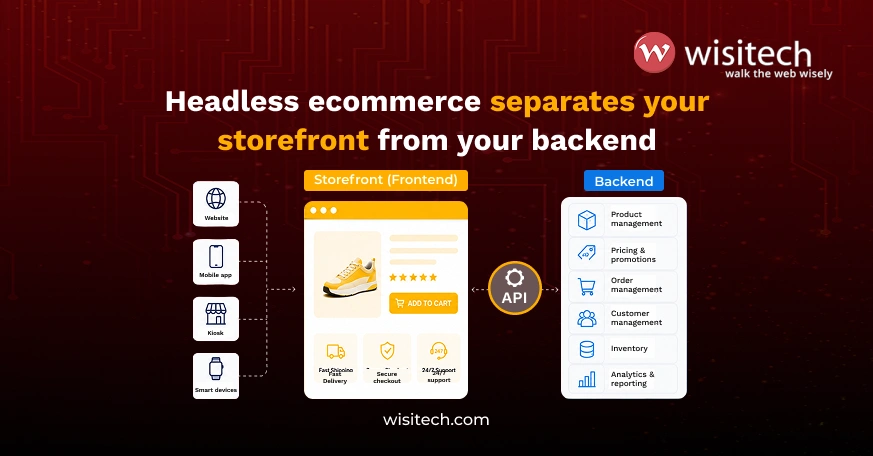
If your online store already does solid revenue but every new campaign, integration, or redesign takes weeks longer than it should, the problem probably isn’t your marketing. It’s your architecture. Headless ecommerce is the approach that decouples your storefront, what shoppers actually see, from your backend, where products, pricing, and orders live. For a brand with real, established revenue, that separation is what lets you launch a new landing page, test a new checkout flow, or plug in a CRM without waiting on a full platform rebuild.
This isn’t a concept for businesses just starting out. It’s a fix for businesses that have outgrown the limitations of a standard Shopify or WooCommerce setup and are now dealing with poor conversion rates, a slow site, patchwork integrations, or a platform that simply cannot scale with demand.
How headless ecommerce fixes what’s actually slowing you down
Most brands don’t go looking for headless ecommerce out of curiosity. They get there because something specific broke. Sales plateaued even though traffic held steady. Paid ads stopped converting the way they used to. The dev team spends more time patching integrations than shipping features. Sound familiar?
In a traditional setup, your storefront and backend are tightly coupled. Every change to how a page looks or behaves has to go through the same system that manages your inventory, pricing, and orders. That coupling is exactly what causes the bottlenecks: a simple checkout redesign can take months, a new CRM integration breaks something unrelated, and every platform update carries the risk of downtime on your highest-traffic pages.
An ecommerce website development company that builds a headless setup separates these layers. Your frontend team can rebuild the storefront, run experiments, or launch a new mobile experience, and none of it touches the backend systems processing your orders. For a business already generating real revenue, that speed difference is the entire point.
What headless commerce actually means for your stack
Technically, ecommerce development involves two software layers. One lives on your hosting environment and handles the logic: pulling product data, processing orders, managing inventory, calling APIs from payment gateways, shipping providers, and other services. The other is the frontend, the layer that renders all of that into the storefront your customer actually browses.
In a traditional build, these two layers are bundled into one system, usually tied to a specific theme or template. Headless commerce removes that bundling. There is no fixed “head” designed for one platform. Instead, your backend exposes its data through APIs, and any frontend – a website, a mobile app, a kiosk, a smart device – can pull from it independently.
For a technical decision-maker evaluating vendors, this is the distinction that matters most: a headless build isn’t a redesign; it’s a change in how your systems talk to each other. That’s why working with an experienced ecommerce web development company matters more here than in a standard template build. Getting the API layer wrong creates the same rigidity you were trying to escape.
How headless ecommerce helps you scale without rebuilding everything
Once your storefront and backend are decoupled, your business stops being limited to one type of screen. Content and product data can be delivered to a mobile app, a smart display, a marketplace integration, or an in-store kiosk, all pulling from the same backend without duplicate systems to maintain.
This matters directly for the integrations growth-stage brands are usually chasing: a CRM that needs live order data, an ERP system managing multi-warehouse inventory, or a logistics platform that needs real-time shipping status. In a headless architecture, these connect through APIs without forcing a rebuild of your storefront every time you add a new tool. That’s the difference between a system that grows with you and one you outgrow every 18 months.
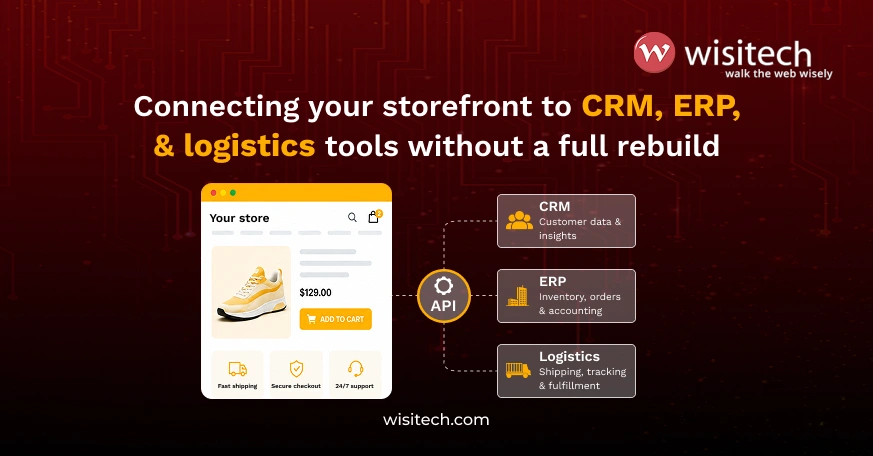
Headless ecommerce isn’t the right call for every business, and being upfront about that is part of doing this properly. If you’re launching your first store on a limited budget, a standard Shopify or WooCommerce build will usually serve you better and faster. Headless makes sense once you’re past that stage: you have real traffic, real revenue, and a specific bottleneck, whether that’s conversion, speed, or a backend that can’t keep up with your integrations.
This is also why an ecommerce migration shouldn’t be treated as a development task alone. The businesses that get the most out of headless are the ones that treat it as a business systems decision first, worked through with proper ecommerce consulting services before a single line of code changes, so the architecture is built around where the business is actually headed, not just where it is today.
The real question isn’t what headless is; it’s whether you need it
Headless ecommerce isn’t a trend; it’s an architectural decision that removes the ceiling a traditional platform puts on speed, integrations, and scale. For a business that has already proven its product and demand, it’s often the difference between a storefront that keeps up with growth and one that keeps getting in its way.
Tell us your current platform and where it’s slowing you down, and we’ll tell you honestly whether a headless build is the right move for your stage or if there’s a faster fix first. Get a free consultation with Wisitech’s ecommerce team.