
If you have priced out a Shopify store recently, you already know the numbers you find online rarely match what you are quoted. That gap is not a sales tactic. Shopify development cost in the USA genuinely varies because a five-page starter store and a multi-integration store with custom theme work are not the same project, even though both run on the same platform. The real question is not “what does Shopify cost” but “who should build mine, and what am I actually paying for.” This post walks through the three paths US businesses typically choose between: doing it yourself, hiring a freelancer, and working with a Shopify development company, so you can match the choice to what your store actually needs.
Why Shopify development cost in the USA varies so much
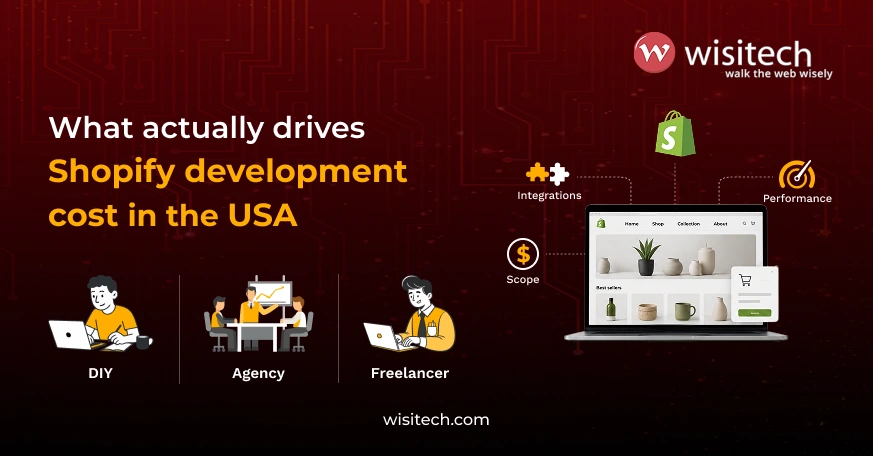
Shopify’s own subscription fee is a small, predictable part of the equation. The variable cost comes from everything wrapped around it: theme customization, third-party integrations, payment gateway configuration, page speed work, and post-launch support. A store selling twenty products with one payment gateway costs less to build than a store selling across multiple currencies with inventory syncing, subscription billing, and a custom checkout flow. Before comparing DIY, freelance, and agency routes, it helps to be honest about which category your project falls into, because that decision affects the outcome more than the builder you choose.
The DIY route
Shopify’s theme store and drag-and-drop editor make it genuinely possible to launch a simple store without writing code. This route works well for a single founder testing a product idea with a tight budget and a short timeline. The tradeoff shows up later: theme customization stays limited to what the theme allows, third-party integrations often need manual workarounds, and page speed and Core Web Vitals are rarely optimized because the builder is not thinking about search visibility while assembling product pages. DIY is a reasonable starting point, not a long-term ecommerce strategy for a brand planning to scale.
The freelancer route
A freelancer sits in the middle. Costs are typically lower than an agency because there is no team overhead, and for a narrowly scoped task like a single theme tweak or a payment gateway fix, that can be the right call. The risk shows up on larger builds: one person handling design, development, speed optimization, and integrations simultaneously means something usually gets less attention, and availability for post-launch support depends entirely on that individual’s schedule. There is also no structured handoff of a scope document, so change requests midway through a project can quietly expand the timeline and the price.
What determines Shopify development cost in the USA at an agency
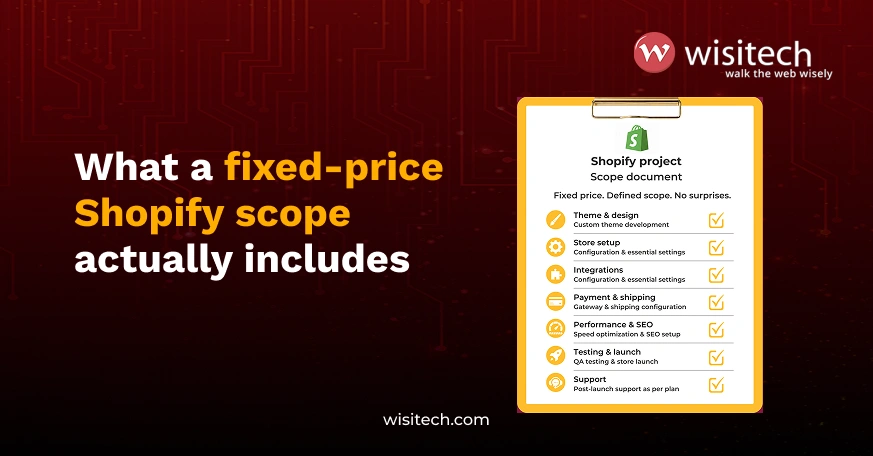
Working with a Shopify development company shifts the cost structure toward a defined scope rather than an hourly clock. Wisitech’s Shopify development pricing is fixed-price with a scope document agreed before development starts, so there is no hourly billing and no surprise invoices once work is underway.
- Starter, from $4,000: custom theme customization, store setup and configuration, payment gateway and shipping setup, mobile-first responsive design, and basic SEO configuration, delivered in 3 to 4 weeks. Best suited to new sellers and startups launching a first Shopify store.
- Growth, from $6,000: full custom theme development, up to three third-party integrations, page speed optimization, Core Web Vitals compliance, and one month of post-launch support, delivered in 5 to 7 weeks. Built for growing SMEs that need a branded, integrated store.
- Pro, from $9,000: advanced custom theme work, multiple integrations, heavy speed and SEO work, Shopify redesign services for existing stores, a training session, and three months of post-launch support, delivered in 7 to 10 weeks. Aimed at scaling businesses with complex inventory and integration needs.
- Ongoing support retainer, from $300/month: performance monitoring, Core Web Vitals maintenance, integration updates, Shopify version updates, and minor feature additions.
WooCommerce to Shopify migration is quoted separately based on store size and data complexity, since migration cost depends on how much product and order history needs to move cleanly.
| Build Route | Go with this if… | STAY AWAY if… |
| DIY | Revenue < $50k/year, standard catalog, < 50 SKUs, using stock Shopify OS 2.0 themes. | You need custom API integrations, complex variants, or B2B functionality. |
| Freelancer | Budget is $2k–$8k AND you already have complete Figma designs + full specs to hand off. | You don’t know how to project-manage developers or test cross-browser UI issues yourself. |
| Agency | Revenue > $250k/year, custom ERP/CRM sync needed, or you need full UI/UX design + dev combined. | You just need someone to tweak color schemes and swap out banner images. |
Choose the Shopify development route that fits your business, not just your budget.
What a full-scope build looks like in practice
The gap between a template store and a fully built one becomes clearest on a global, multi-market project. When The Humble Co., a sustainable oral care brand, needed a direct-to-consumer Shopify storefront, the brief went well beyond a themed product catalog. Wisitech built the store on Shopify with Ruby on Rails, added multi-language support across English, German, and French, enabled multi-currency checkout across markets, and integrated Amazon Pay, Google Pay, Klarna, Shopify Pay, PayPal, and Venmo so international customers could check out with the method they already trust. Fulfillment ran through a Deliverr integration to keep shipping times competitive, and the storefront was built to carry the brand’s eco-certifications and philanthropic messaging without slowing the shopping experience down. That is the kind of scope a template or a single freelancer’s bandwidth was never designed to absorb, and it is exactly where a Shopify ecommerce development company with design, development, and integration specialists working from one scope document earns its cost.
Matching the build to the budget
None of the three routes is universally right. DIY suits a founder validating an idea before committing budget to it. A freelancer suits a narrow, well-defined task with a clear deliverable. An agency suits a brand that needs integrations, speed optimization, and a store that still performs six months after launch, without the founder personally managing every moving part. The honest way to think about Shopify development cost in the USA is not “which option is cheapest” but “which option matches how complex my store actually needs to be, and what happens after launch if something breaks or needs updating.”
Hidden Year-1 Costs Nobody Talks About
Here is the break down of Total Cost of Ownership (TCO) for Year 1:
- App Stack Inflation: Modern stores stack up $400–$2,000/month in recurring app subscriptions (e.g., Gorgias, Yotpo, Triple Whale, Recharge).
- Post-Launch Bug Reserves: Reserve 15–20% of initial build budget for post-launch adjustments based on real customer usage data in months 1–3.
What the right number actually looks like for your store
Shopify development cost in the USA is really a question about scope, not platform fees. A DIY build keeps costs at zero but caps what the store can do. A freelancer works for a single, well-defined task. An agency working from a fixed-price scope, like Wisitech’s Starter, Growth, and Pro tiers, gives a growing brand a predictable number, a defined timeline, and support that continues after launch. The right choice depends on how much your store needs to do on day one, and how much room it needs to grow into.
Ready to find out where your store lands? Book a free consultation and get a fixed-price Shopify scope for your project, with no hourly guesswork, before you commit a dollar.