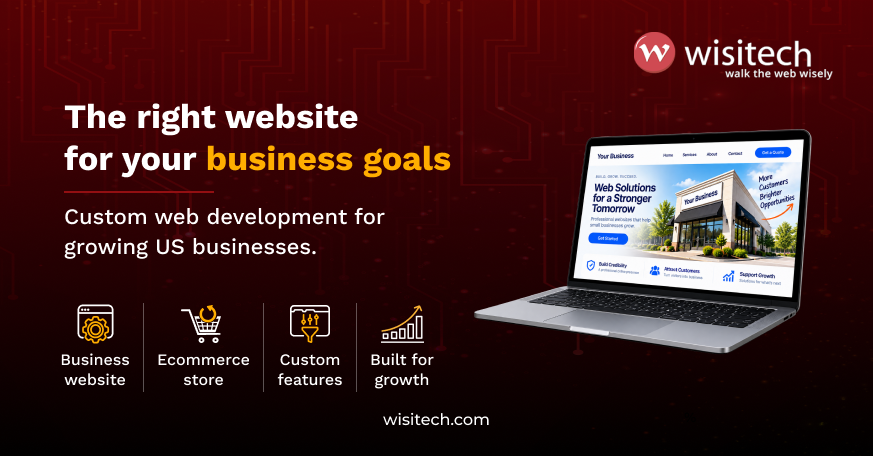
Web development services for small business can mean anything from a straightforward company website to a custom customer portal, ecommerce store, or business application. That range is exactly why choosing what you actually need can be difficult.
A small business does not automatically need every feature a developer can build. It needs the right technology for how customers find the business, evaluate it, contact it, book its services, or buy from it.
For web development services for small business, the better question is not, “What features can we add?”
It is:
“What does the website need to accomplish for the business?”
A professional services firm may need a fast, credible website that generates consultation requests. A contractor may need service pages, quote forms, project galleries, and location information. An online retailer needs an ecommerce system. A growing company may eventually need integrations, customer portals, or custom business logic.
The right scope depends on the business model, not the size of the agency selling the project.
Start with the outcome, not the feature list
One of the easiest ways to overspend on a website is to start with features.
A business owner might ask for a blog, chatbot, animation, customer login, booking system, ecommerce functionality, CRM integration, and dozens of pages before deciding what any of them are supposed to accomplish.
A better development process starts with the customer journey.
What does a visitor need to understand?
What could stop them from contacting you?
What action should they take?
What needs to happen after they submit a form?
What will the business need to manage after launch?
This is why web development services for small business should begin with discovery and requirements rather than jumping directly into design or coding.
A website is a business system, even when it looks simple on the surface. The homepage, service pages, forms, integrations, content management system, and technical architecture all influence what happens after someone lands on the site.
The core website is still the first investment
For most US small businesses, the first requirement is not a sophisticated application. It is a website that communicates clearly and works reliably.
At minimum, the core build should make it easy for visitors to understand:
- What the business does
- Who it serves
- What services or products it offers
- Why someone should trust it
- Where it operates when location matters
- What the visitor should do next
This is where small business website development services need to go beyond putting information into attractive page templates.
The structure should reflect how customers make decisions.
A service business, for example, may need individual pages for its major services rather than putting everything under one generic Services page. An ecommerce business needs a completely different information architecture because visitors need to browse, compare, select, and purchase.
The website should make the next step obvious without making the visitor work for it.
Your service pages are part of the development scope
Web development and content strategy should not be treated as two completely separate projects.
A website’s architecture determines how its important services are organized, how users navigate between them, and how search engines understand the site’s subject matter.
For web development services for small business, this means planning the page structure before development is complete.
A company offering commercial roofing, for example, may need separate pages for roof replacement, roof repair, inspections, and maintenance. Each page can then explain the service, establish credibility, answer relevant questions, and give the visitor a clear way to request an estimate.
The same principle applies to professional services, healthcare, home services, manufacturing, consulting, and other industries.
The objective is not to create more pages.
It is to create the right pages.
A website with 30 weak pages is not automatically better than one with 10 useful ones.
Mobile development is a baseline, not an upgrade
A website that works well on a desktop but becomes difficult to use on a phone has a basic development problem.
Mobile-first development should consider more than whether the layout technically responds to different screen sizes.
Buttons need to be easy to tap.
Forms need to be manageable.
Menus should not become frustrating.
Images should load efficiently.
Important information should not disappear below unnecessary visual elements.
Calls to action should remain easy to find.
For web development services for small business, mobile optimization should therefore be part of the core build rather than an optional enhancement added after launch.
The same applies to performance. A visually impressive site that takes too long to load can create friction before a customer even reads the first paragraph.
Good development considers performance during architecture, design, image handling, code implementation, and testing.
Your CMS should match how your business operates
A content management system is useful when a business needs to update its website without depending on a developer for every small change.
That could include:
- Updating service descriptions
- Adding new pages
- Publishing articles
- Changing images
- Updating team information
- Adding products
- Managing basic website content
But the platform should match the actual requirements.
A simple business website does not need the complexity of a large application architecture. An ecommerce company has different requirements from a professional services firm. A business with custom workflows may eventually outgrow the limitations of a standard setup.
This is where small business web development services should focus on fit rather than technology for its own sake.
The question is not whether a particular platform is popular.
The question is whether it gives the business the control, functionality, performance, security, and scalability it actually needs.
Lead generation features should remove friction
For many US small businesses, the website exists primarily to generate enquiries.
That makes lead capture a development decision.
A contact form is useful when it collects enough information to qualify an enquiry without turning a simple request into a lengthy application.
A quote form can be useful for contractors and service providers.
Appointment scheduling can make sense for businesses where booking is the primary conversion.
Click-to-call functionality can be important when customers prefer speaking with someone.
CRM integration can become valuable when lead volume increases and manual follow-up starts creating gaps.
This is an important part of web development services for small business because the form itself is only one part of the process.
What happens after submission?
Does the right person receive the enquiry?
Is the source tracked?
Does the lead enter the CRM?
Does the customer receive confirmation?
Can the team follow up efficiently?
A form that technically works but creates a manual mess is not a successful development outcome.
Ecommerce development is necessary when the website is the storefront
Not every small business needs ecommerce.
If customers need to call for a quote or schedule an appointment, adding a shopping cart may create unnecessary complexity.
But if the business sells products online, ecommerce development becomes central to the website.
That can include:
- Product catalogs
- Product variations
- Search and filtering
- Shopping carts
- Checkout
- Payment gateways
- Shipping
- Taxes
- Inventory
- Order management
- Customer accounts
- Marketing integrations
For web development services for small business, ecommerce should be scoped around how the business actually sells.
A small catalog with straightforward products may need a relatively simple setup. A business with thousands of products, complex variations, subscriptions, B2B pricing, multiple vendors, or custom fulfillment rules may need substantially more development.
Wisitech’s ecommerce work spans platforms such as WooCommerce, Shopify, and CS-Cart, as well as more customized builds for businesses with complex requirements. The useful takeaway is not that every business needs custom ecommerce. It is that the technology should follow the operational complexity.
When website redesign is the better option
Not every business needs a new website.
Sometimes the existing site has useful content, search visibility, backlinks, customer reviews, or established pages that should be preserved.
In those situations, website redesign services can be more appropriate than starting from zero.
A redesign can address problems such as:
- An outdated user experience
- Poor mobile usability
- Slow performance
- Confusing navigation
- Weak conversion paths
- Difficult content management
- Poor service-page structure
- Technical limitations
- Outdated integrations
The important question is what should be retained.
A good redesign does not automatically throw away everything that came before it. It identifies what is working, what is holding the business back, and what needs to change.
For web development services for small business, that distinction can affect both cost and risk.
A rebuild that ignores the existing website’s search equity can create unnecessary problems. A carefully planned migration can improve the experience while protecting valuable assets.
Custom development makes sense when the business has a specific problem
Custom development is often misunderstood.
Some businesses assume custom means better. Others assume a small business should never need it.
Both positions are too simplistic.
Custom development becomes valuable when the business has requirements that standard platforms, plugins, or SaaS products cannot handle properly.
That could include:
- Customer portals
- Member dashboards
- Vendor systems
- Custom calculators
- Internal workflow tools
- Complex booking logic
- API integrations
- CRM or ERP connections
- Custom product configuration
- Multi-vendor marketplaces
Wisitech’s custom web development work focuses heavily on these types of problems, including Laravel applications, complex WordPress implementations, portals, API architecture, system integrations, and legacy platform migrations.
The important lesson for a small business is simple:
Do not pay for custom development unless there is a business requirement that justifies it.
If a standard solution does the job reliably, use it.
If the business process itself is the differentiator, custom development may be worth the investment.
What small businesses should probably not build yet
Knowing what not to build can be just as valuable as knowing what to build.
A new small business may not need:
- A complex customer portal
- An advanced AI chatbot
- Dozens of integrations
- Custom dashboards
- Elaborate animations
- Multiple account types
- A mobile app
- A large resource center
- An ecommerce system when there is no online selling model
Features should earn their place.
If a business cannot explain what a feature will improve, it may not belong in the first version of the website.
This approach keeps web development services for small business focused on measurable business requirements instead of creating an impressive technical specification that customers never use.
It also makes the website easier to maintain.
How to choose the right development scope
Before requesting a proposal from a small business web developer, answer these questions.
1. What is the primary conversion?
Is it a phone call, consultation request, quote, appointment, store purchase, or something else?
2. What information does a customer need before converting?
This determines the content depth and page structure.
3. What does the business need to manage itself?
If staff need to update products, services, articles, or other content, the CMS should support that workflow.
4. What systems need to connect to the website?
Think about CRM, email marketing, payments, inventory, scheduling, accounting, or other systems.
5. What might change in the next two years?
The website should be able to accommodate realistic growth without requiring a complete rebuild every time the business adds a service or feature.
These questions produce a much more useful project scope than simply asking an agency how many pages it can build.
How much development does a small business actually need?
There is no universal page count or technology stack that works for every company.
A professional consultant may need a focused website with strong service pages, credibility signals, lead capture, and a manageable CMS.
A home services company may need location-specific content, quote requests, project galleries, and call-focused conversion paths.
A retailer may need ecommerce.
A growing B2B company may need a customer portal or CRM integration.
A company with complicated internal processes may eventually need a custom application.
That is why web development services for small business should be scoped according to business requirements rather than a prebuilt package.
Wisitech’s small business web development offering, for example, covers custom websites, WordPress, ecommerce, redesigns, integrations, performance, security, accessibility, and ongoing support. Its published small business projects start at $4,000, with the final cost depending on scope, complexity, and integrations.
The number matters less than what the investment buys.
A $4,000 website that generates qualified enquiries can be more valuable than a $2,000 website that simply exists online. A $20,000 build can also be wasteful if the business only needed a simpler solution.
The right question is always what the website needs to accomplish.
What to look for in small business web development services
When comparing providers, look beyond screenshots.
Ask how they approach:
- Discovery
- Information architecture
- UX
- Development
- Mobile performance
- Technical SEO
- Security
- Integrations
- Testing
- Migration
- Analytics
- Post-launch support
A good small business website development services provider should be able to explain the reasoning behind the proposed scope.
If every business receives the same package, ask how the solution is being customized around your business.
If an agency recommends an expensive custom application, ask what specific business problem requires it.
If a provider promises a fast launch, ask what happens to testing, redirects, integrations, security, and performance.
And if a developer talks only about design, ask what happens after someone clicks “Contact Us.”
Where Wisitech fits into the picture
At Wisitech, web development for small business starts with what you actually need from your website. That could mean a focused company site, an ecommerce store, a custom web application, or integrations with the tools you already use. We build around your goals instead of adding features simply because they are available.
Our team works across custom websites, WordPress, ecommerce platforms, web applications, and system integrations. This helps us recommend the right technical approach based on your requirements, workflow, and growth plans.
Custom development is not necessary for everyone. But when a standard website cannot handle a specific workflow or functionality, a tailored solution can give you the flexibility you need.
Our process covers discovery, design and architecture, development, integration, testing, launch, and ongoing support. The goal is a website that works as a useful part of your operations, not something that simply looks finished.