
A multi-channel digital marketing strategy is no longer a growth tactic reserved for enterprise brands. In 2026, it has become the baseline for any business that wants to stay visible, relevant, and competitive. Consumers interact with brands across an average of six touchpoints before making a purchase decision. Brands using three or more coordinated channels achieve a 287% higher purchase rate than single-channel approaches. Brands deploying five or more channels see 412% higher purchase rates. The data is unambiguous.
Yet most businesses treat their channels as silos. The paid search team does not talk to the organic team. The social media calendar does not connect to the email nurture sequence. The content team produces blog posts that paid acquisition never promotes. The result is a fragmented customer experience that wastes every dollar of marketing spend.
This guide covers how to build a coordinated multi-channel strategy from scratch, which channels to prioritize in 2026, how to measure what is actually working, and how AI search is changing the rules of visibility across every channel simultaneously.
What is a multi-channel digital marketing strategy?
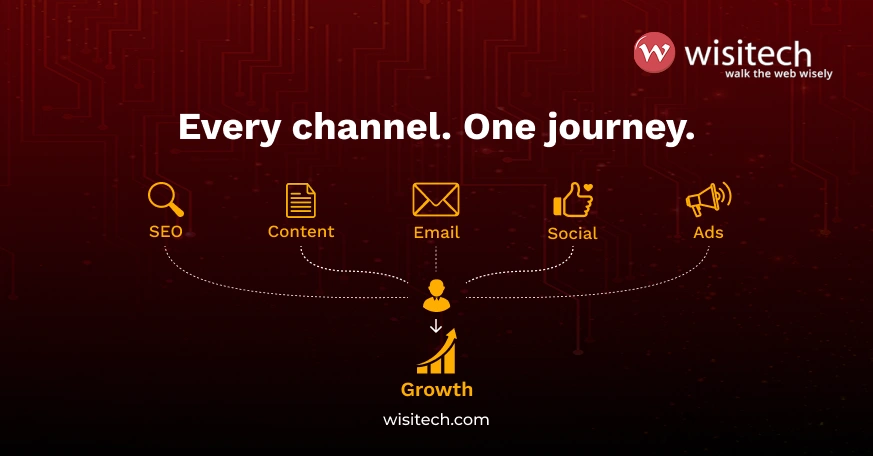
A multi-channel digital marketing strategy is the coordinated use of multiple digital marketing channels, including search, social media, email, paid advertising, and content, to reach and convert customers through consistent, connected messaging. The key word is coordinated. Multi-channel is not running campaigns on five platforms simultaneously. It is running campaigns where each platform reinforces the others, where the customer sees a coherent brand narrative regardless of where they encounter it, and where data flows between channels to improve each one.
Multi-channel differs from omnichannel in degree of integration. Multi-channel means presence across multiple touchpoints. Omnichannel means those touchpoints share data in real time to create a seamless, personalized customer journey. In 2026, most businesses should be operating at the multi-channel level and building toward omnichannel.
Why multi-channel marketing matters in 2026
- Brands using 3 or more channels achieve a 287% higher purchase rate than single-channel approaches
- Brands deploying 5 or more coordinated channels see 412% higher purchase rates
- 73% of consumers use multiple channels during the purchase journey
- Multi-channel B2B marketing campaigns generate 31% more leads than single-channel approaches
- 58% of marketers struggle to align messaging across channels, creating a significant competitive gap for those who do it well
- Website, blog, and SEO remains the number one ROI-generating channel in 2026 according to HubSpot State of Marketing
The 2026 multi-channel digital marketing strategy: which channels to prioritize
Not all channels deserve equal investment. The most common mistake businesses make when building a multi-channel digital marketing strategy is treating every platform as equally worth pursuing. Spreading budget and attention across ten channels produces mediocre results on all of them. The right approach is to master two to three primary channels where your audience actually spends time, then build outward deliberately.
1. SEO and organic search
Website, blog, and SEO is the number one ROI-generating channel in 2026 for both B2B and B2C businesses. The compounding economics are unique: content published today continues generating traffic and leads years later at zero incremental cost. SEO services for small business that target commercial-intent keywords build an organic presence that paid channels cannot replicate over a 24-month horizon.
Generative engine optimization (GEO) is now an essential layer of SEO strategy. Google AI Overviews, ChatGPT Browse, and Perplexity are answering commercial queries before organic links appear. Businesses that structure their content with FAQ schema, clear headings, and entity-based authority earn AI Overview citations that appear above traditional rankings. GEO is the highest-upside SEO investment available right now.
2. Content marketing
Content is the fuel every other channel runs on. Professional content writing services produce commercial-intent blog posts, case studies, buying guides, and landing page copy that strengthen SEO, provide assets for social media, support email nurture sequences, and improve paid ad landing page quality scores. Businesses with active blogs generate 68% more leads than those without. In 2026, the differentiator is depth and specificity, not volume.
AI has flooded the internet with generic content. The businesses winning in organic search and AI citations are those producing original data, specific industry expertise, and content that AI tools cannot generate from existing training data. Generic AI-produced content is penalized by both Google and buyers who recognize it.
3. Social media marketing
Social media in 2026 is a fragmented landscape. TikTok is the channel most marketers plan to invest in most in 2026, and 32% report it delivers consistently the highest ROI. LinkedIn drives approximately 80% of all B2B social media leads. Instagram dominates D2C and lifestyle ecommerce. The right channel depends entirely on where your buyers spend time, not where your team is most comfortable. Social media marketing services for small business that focus on two or three platforms consistently outperform those spread across six.
Organic reach has declined on most social platforms. The strategy that works is pairing organic content for community building with paid social for reach and retargeting. Running them as separate campaigns misses the compounding effect.
4. Paid search and Google Ads
Google Ads delivers immediate, intent-based traffic. Professional pay per click management services connect keyword targeting with dedicated landing pages to generate qualified leads faster than almost any other digital marketing channel. The CPC advantage in non-enterprise categories remains real in 2026 for businesses that build tightly themed ad groups and maintain active negative keyword lists.
Performance Max campaigns now account for a growing share of Google Ads spend. PMax gives Google’s AI full control over placement across Search, Display, YouTube, Gmail, and Maps. It requires clean conversion data to perform well. Accounts without offline conversion imports connected to their CRM are optimizing for form fills, not revenue.
5. Email marketing
Email marketing delivers $36 for every $1 spent, making it the highest-ROI channel in digital marketing by a significant margin. 42% of businesses say it is their most important lead generation channel. Email copywriting services that segment by buyer stage, intent, and behavior consistently outperform batch-and-blast campaigns by 15 to 30% in open rate and 2 to 5 times in conversion rate.
First-party data is now the currency of effective email marketing. With third-party cookies largely deprecated, businesses that have built owned email lists with proper consent architecture are at a structural advantage over those that relied on third-party audience targeting.
6. AI search and GEO
Google AI Overviews, Perplexity, ChatGPT Browse, and Microsoft Copilot now answer commercial queries directly in ways that intercept organic search clicks. Answer engine optimization is the practice of structuring content so AI systems extract, cite, and summarize your brand in generated answers. Businesses that implement FAQ schema, clear structured headings, and entity-based authority earn citations that appear before traditional organic results. This is the newest and fastest-moving layer of a modern multi-channel strategy.
| Channel | Best for | 2026 ROI profile | Top priority action |
| SEO / GEO | Long-term organic growth | Compounds, highest 24-month ROI | Add FAQ schema + GEO content layer |
| Content marketing | Authority, leads, all channels | Multiplier on every other channel | Produce original data and specific expertise |
| Social media | Brand, community, retargeting | Variable; TikTok highest ROI in 2026 | Pair organic with paid for compounding reach |
| Google Ads / PPC | Immediate qualified leads | Fast but stops when budget stops | Connect CRM for offline conversion import |
| Email marketing | Retention, nurture, reactivation | $36 per $1 spent, highest ROI | Segment by buyer stage and intent |
| AI search / GEO | Pre-click AI Overview citations | Emerging, growing fast | Implement FAQ schema on all key pages |
How to build a multi-channel digital marketing strategy in 2026
Building a multi-channel digital marketing strategy that actually works requires starting with audience clarity, not channel selection. Most businesses make the mistake of choosing channels first. The right sequence is:
Step 1: Define your ICP and buyer journey
Who is your buyer? What are they searching? Where do they spend time? What triggers their decision to purchase? Map the buyer journey from awareness to purchase to retention before selecting a single channel. Your ICP determines which channels matter, not industry trends.
Step 2: Choose two to three primary channels
Select two to three channels where your audience is most active and where your business can produce consistent, high-quality content. Depth on two channels always outperforms shallow presence on six. Most B2B businesses should start with SEO and email. Most B2C brands should start with social media and email. Most lead-generation businesses should start with Google Ads and SEO running in parallel.
Step 3: Build a content system that feeds all channels
Produce one long-form pillar piece per month that targets a high-value commercial keyword. From that pillar piece, extract social posts, email content, ad copy, and short-form video. This content repurposing system means one investment produces assets for every channel. B2B content marketing services built around this hub-and-spoke model compound faster than those that treat each channel as a separate production workstream.
Step 4: Connect your data
The biggest weakness in most multi-channel programs is siloed data. GA4 connected to Google Ads connected to your CRM creates a single attribution view that shows which channels actually produce revenue, not just clicks. Without this data layer, budget allocation decisions are guesses. With it, you can reallocate from underperforming channels to those driving pipeline.
Step 5: Review and reallocate quarterly
A multi-channel strategy is not a set-and-forget plan. Channel performance shifts. The social platform that drove the most engagement last quarter may underperform next quarter. SEO compounds over time, meaning its share of revenue should grow. Paid channels produce immediate results but diminishing marginal returns. Quarterly reviews keep the budget allocation aligned with what is actually working.
Measuring your multi-channel digital marketing strategy
58% of marketers struggle to align messaging and measurement across channels. Measuring a multi-channel digital marketing strategy correctly requires moving past channel-level vanity metrics to business-level outcomes. Here is what to track:
| Level | What to measure | Why it matters |
| Channel level | Traffic, CTR, engagement, open rate per channel | Identifies which channels attract your audience |
| Lead level | Cost per lead, lead quality score, SQL rate | Identifies which channels generate qualified pipeline |
| Revenue level | Revenue attributed to each channel, ROAS, CAC | Shows which channels actually pay back |
| Retention level | Repeat purchase rate, LTV by acquisition channel | Identifies which channels produce the most valuable customers |
Multi-touch attribution is the most accurate model for multi-channel marketing ROI measurement, but it requires GA4 or a dedicated attribution tool configured correctly. For most small and mid-size businesses, a data-driven attribution model in GA4 is the practical starting point. The key is that every channel is measured against the same business outcome, not its own channel-specific metrics.
How AI search changes multi-channel digital marketing strategy in 2026
AI search is the most significant structural change to multi-channel digital marketing strategy since the rise of mobile. Google AI Overviews, ChatGPT Browse, and Perplexity are intercepting commercial queries before organic clicks happen. This does not mean SEO is less important. It means the definition of SEO has expanded.
In 2026, ranking on page one is necessary but no longer sufficient. Businesses also need to earn citations in AI-generated answers. The businesses earning these citations share four characteristics: they produce authoritative, specific content that covers a topic comprehensively; they implement correct schema markup; their domain has established topical authority; and their content is structured for machine readability (clear H2/H3 hierarchy, short paragraphs, FAQ blocks, numbered lists).
The channel implication: AI search is a new distribution surface that every content and SEO investment now needs to optimize for. This means voice search optimization services and GEO content architecture are no longer optional add-ons to an SEO program. They are core requirements for maintaining organic visibility in 2026.
Multi-channel digital marketing strategy for small businesses
A multi-channel digital marketing strategy for a small business does not require an eight-figure budget or a team of twenty. HubSpot’s model, often cited as the benchmark, generates over 7 million monthly blog visitors. But the compounding logic applies at any scale. A small business that produces two high-quality, keyword-optimized articles per month and builds an eight-email nurture sequence will see the same compounding effect within 12 to 18 months. The patient, quality-over-quantity discipline is the competitive advantage.
For small businesses, the recommended starting stack is: local SEO services to capture nearby buyer searches, email marketing for retention, one social platform for community, and Google Ads for immediate lead flow in competitive categories. This four-channel foundation is achievable with a marketing budget of $2,000 to $5,000 per month and produces compounding returns as the organic channels mature.
Multi-channel digital marketing strategy for B2B businesses
B2B multi-channel digital marketing strategy differs from B2C in three important ways: sales cycles are longer (45 to 90 days for most B2B categories), multiple decision-makers are involved, and the content that drives conversion is different at each stage of the buying cycle.
The B2B channel stack that produces the most qualified pipeline in 2026: technical SEO services targeting commercial-intent keywords your ICP searches during evaluation, B2B content marketing services producing thought leadership that builds credibility over the long sales cycle, LinkedIn for reaching decision-makers directly, Google Ads targeting decision-stage keywords with dedicated landing pages, and email nurture sequences that stay in front of prospects for the full buying cycle duration.
The measurement standard for B2B is different too. Marketing-qualified leads and traffic reports are not B2B accountability. The right measure is pipeline sourced from marketing, qualified opportunity rate, and closed-won revenue attributed to each channel.
Wisitech builds integrated multi-channel digital marketing programs
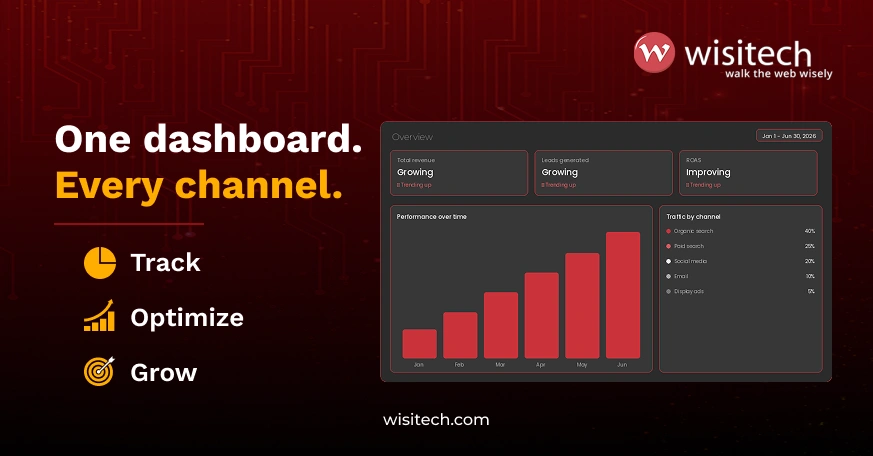
Wisitech has been delivering integrated multi-channel digital marketing strategies for US businesses across ecommerce, B2B, professional services, and local service industries for 27 years, with more than 2,500 projects delivered. We combine SEO services, Google Ads management, and content writing services into a unified strategy instead of managing each channel as a separate retainer.
Our approach starts with ICP definition and channel prioritization before any execution begins. We connect GA4 to your CRM from day one so every channel is measured against qualified pipeline, not vanity metrics. Our strategists, writers, and paid media specialists work from a single channel strategy document, ensuring your brand message stays consistent across every customer touchpoint.
If you want to understand which channels your business should prioritize and what a realistic integrated program looks like within your budget, get in touch with us.
27 years. 2,500+ projects. Fortune 500 experience. Creativity leads, AI amplifies.