
The story is surprisingly common. The proposal looked good. The portfolio screenshots were impressive. The pricing was competitive. Hiring a web development or digital marketing agency felt like the logical next step. You signed the contract, paid the advance, and then waited. And waited. When the first deliverable finally arrived six weeks later, it looked nothing like the brief. The agency went quiet after your follow-up. Sound familiar?
You are not alone, and this is not bad luck. It is a pattern. And knowing what to look for before engaging an agency is the difference between a project that moves your business forward and one that sets it back by months.
Here are the red flags that every serious business owner should know before engaging any web or digital marketing agency.
Why it matters more than most buyers realize
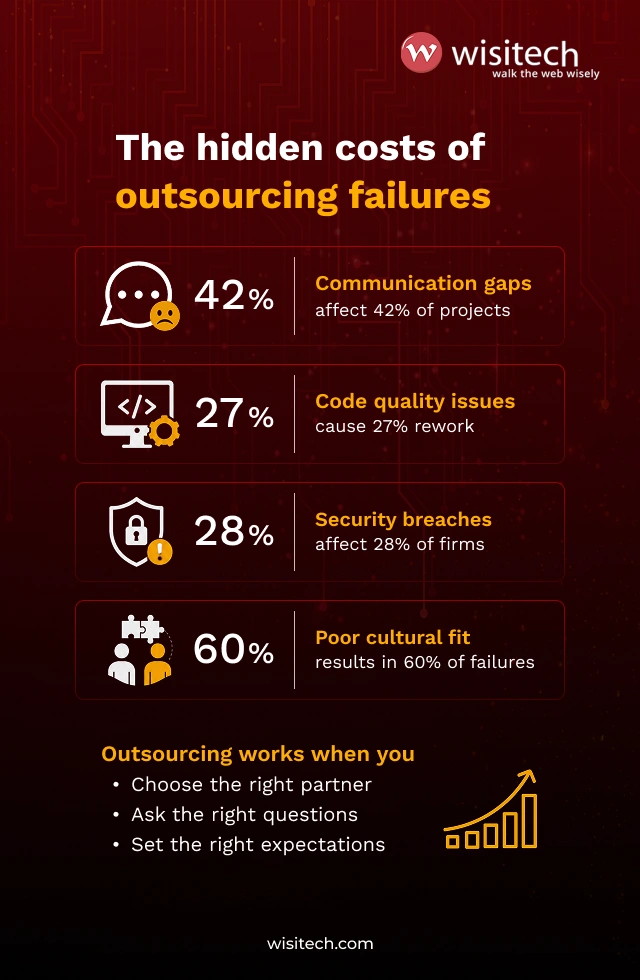
The numbers on outsourcing failures are not reassuring. According to Gitnux’s software development outsourcing statistics, communication problems affect 42% of outsourcing clients. Quality issues in outsourced code lead to a 27% rework rate on average. And 28% of firms have experienced data security breaches through outsourced projects. Last year, Devico had reported that approximately 60% of all outsourced projects fail due to poor cultural compatibility between client and vendor.
12 red flags when hiring a web development or digital marketing agency
1. Unrealistic promises delivered with complete confidence
Any agency that guarantees a specific Google ranking within a set number of days or weeks is either uninformed or dishonest. Search rankings are determined by Google’s algorithm, not an agency’s confidence level. The same applies to promises like “100% campaign ROI in 30 days” or “your site will rank for every keyword in your niche.”
Serious web development services and digital marketing engagements are built on realistic timelines, measurable KPIs, and transparent methodology, not guarantees that no professional can actually stand behind.
2. No live portfolio, only screenshots
This is one of the most common and most costly warning signs. An agency that cannot share live, functioning URLs for its past projects is not a verifiable vendor. Screenshots can be sourced from templates, stock websites, or projects the agency had no actual involvement in.
Before signing any contract, request a minimum of five to ten live URLs. Visit each site, test its load speed and mobile performance, and if possible, contact the listed client to verify the relationship. A credible web development company will share this information without hesitation.
3. Vague or missing contract
A signed contract is not bureaucracy. It is the document that defines scope, timeline, ownership of deliverables, payment terms, and dispute resolution. If an agency sends a one-page email summary and calls it a contract, that is a red flag.
Every engagement for custom web development, SEO, Google Ads management, or content services should include a detailed scope of work document, an NDA where applicable, and a clear clause on intellectual property ownership. You should own your code, your campaign accounts, and your data, not the agency.
4. No discussion of your business goals before proposing a scope
A professional agency asks questions before it proposes solutions. If you receive a detailed proposal within 24 hours of a first inquiry, with no discovery call and no questions about your business model, target audience, or existing infrastructure, the proposal was not built for you. It was a template with your company name inserted.
This pattern is especially common in web application development company pitches, where the complexity of the build makes it impossible to scope accurately without a detailed technical discovery conversation. This is one of the most overlooked mistakes businesses make when hiring a web development or digital marketing agency.
6. Weak or non-existent communication protocols
Time zone differences can cause delays in a significant number of offshore projects. The solution is not a perfectly aligned time zone. It is a clearly defined communication structure: documented response SLAs, a named point of contact, a project management tool with real-time visibility, and an escalation path when issues are not resolved within a defined window.
If a prospective agency cannot describe its communication protocol clearly before you hire it, that protocol does not exist. You will find out what their communication actually looks like at the worst possible moment, when something goes wrong mid-project.
7. No clarity on who actually does the work
Many agencies operate as intermediaries, taking client projects and outsourcing the execution to freelancers or smaller sub-agencies. This is not inherently wrong, but it becomes a problem when the client is unaware, when quality control is absent, and when the person managing your project has never spoken to the person building it.
Ask directly: Who are the developers, designers, or marketers assigned to your account? What is their experience level? Are they employees or contractors? For anything involving complex backend builds, this question is not optional.
8. Pricing that seems too good to be true
If the pricing seems too good to be true, it usually is. Delivering a genuinely custom web development project requires experienced developers, careful planning, thorough testing, and quality assurance. Unrealistically low quotes often rely on inexperienced teams, template code presented as custom development, limited testing, or project scopes that expand after work begins. What appears to be a bargain upfront can quickly become more expensive in the long run.
The agency that won the deal with the lowest quote frequently ends up costing more than the one that quoted correctly at the start.
9. No post-launch support plan
The project does not end at launch. Bugs appear after go-live. Performance issues emerge under real traffic conditions. Integrations break when third-party platforms update their APIs. A professional agency builds a post-launch support plan into every engagement, with a defined warranty period, a process for raising and resolving issues, and clarity on what is included versus what is billed separately.
If an agency has not mentioned post-launch support before you ask, ask directly. If the answer is vague, that is a structural gap you will pay for later.
10. Refusal to give you account access
Your Google Ads account, your Google Analytics property, your Search Console access, your CMS credentials, and your hosting account all belong to you. Not the agency. If an agency insists on managing these under its own login, does not provide you with owner-level access to your own assets, or structures its tools so that leaving requires starting everything from scratch, you are locked in from day one.
This is particularly important when evaluating vendors offering white-label web development or ongoing digital marketing retainers. Account ownership should be explicit in the contract before work begins.
11. No structured reporting
An invoice arriving on time is not a performance report. A proper monthly report for web development covers milestone completion, testing status, and outstanding scope items. A digital marketing report covers spend, conversions, cost per conversion, channel performance, and the next month’s recommended adjustments.
If a prospective agency cannot show you a sample report from a current client, with identifying information removed, that agency does not have a reporting structure. It has a billing schedule.
12. Pressure to decide quickly
High-pressure sales tactics, limited-time offers, urgency created around signing before a “slot fills up,” or any version of “we have another client interested in this slot,” are manipulation tools, not business practices. A professional agency with genuine capacity does not need to pressure buyers into fast decisions.
Take the time you need to verify the portfolio, speak to references, review the contract, and compare options. Any vendor that makes you feel rushed is prioritizing their pipeline over your outcomes.
How to verify an agency before hiring a web development or digital marketing agency
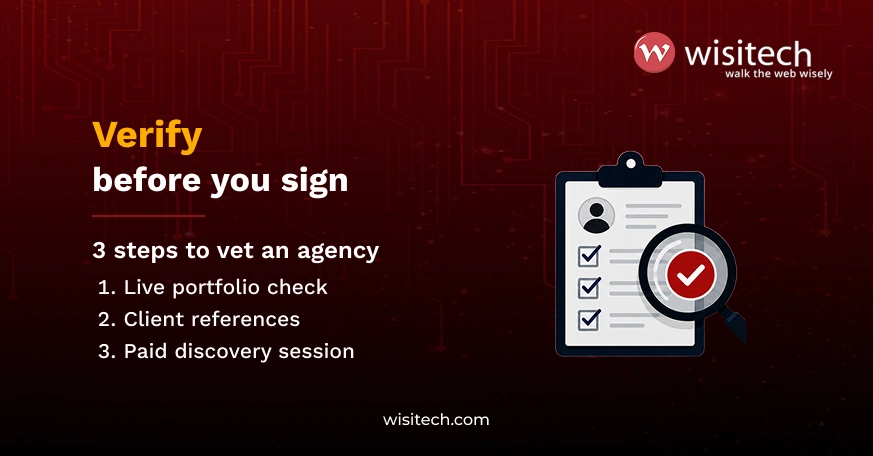
Step 1: Verify the portfolio
Request live portfolio URLs and independently contact at least two listed clients rather than relying solely on references provided by the agency.
Step 2: Audit the agency itself
Run the agency’s website through tools such as Google PageSpeed Insights. An agency that cannot maintain its own site’s performance is unlikely to maintain yours effectively.
Step 3: Review a sample deliverable
Ask for a paid discovery session, technical audit, or strategy workshop before committing to a full engagement. The quality of these initial deliverables often reveals more than any proposal document.
Choose your agency with the same care you choose your strategy
The agency selection process deserves the same level of scrutiny as any other business investment. A strong portfolio, attractive pricing, or a polished proposal may look convincing, but they should never replace proper due diligence. Verifying past work, reviewing contracts carefully, understanding communication processes, and clarifying ownership of deliverables can prevent costly mistakes later.
Most agency relationships succeed or fail long before the project begins. The businesses that take time to evaluate vendors thoroughly are often the ones that experience smoother delivery, better outcomes, and fewer surprises along the way.
If you are comparing proposals or evaluating potential partners, use the points in this guide as a practical checklist before making a decision. If you are currently evaluating agencies or trying to make sense of a proposal that does not feel right, speak to our team here. At Wisitech, we believe informed buyers make better long-term partners, regardless of where they ultimately choose to work.
Disclaimer: All pricing benchmarks referenced in this article are indicative estimates based on published industry data as of June 2026. Actual project costs vary based on scope, complexity, technology stack, and agency tier. All figures exclude applicable taxes.