
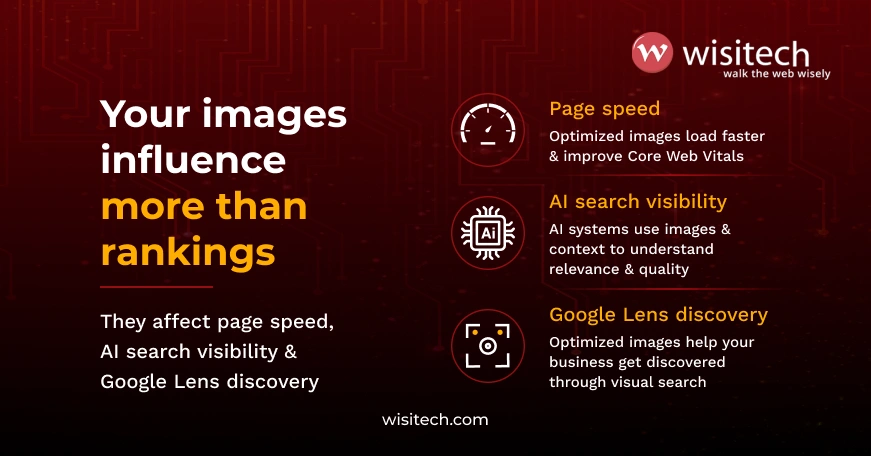
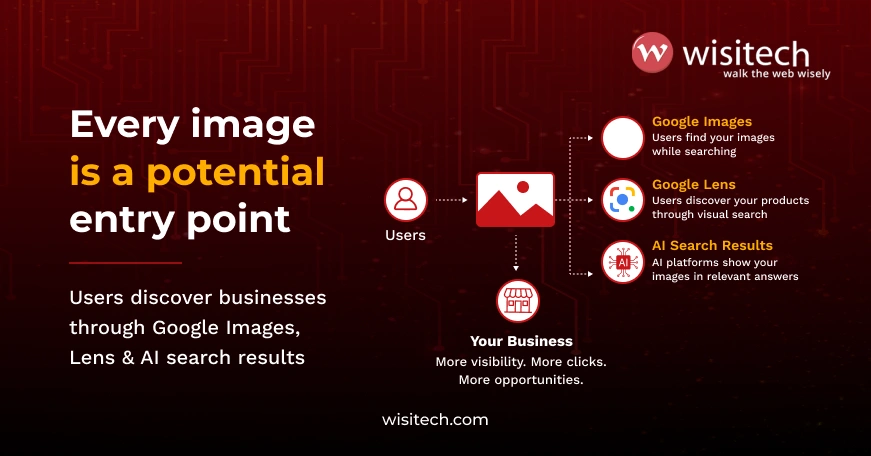
Images drive more search traffic than most website owners realize. Google Images is one of the largest traffic channels on the internet. Google Lens has grown into a full commercial search channel. And AI-powered search in 2026 uses images as signals for quality, relevance, and authority, not just decoration.
Yet image optimization is still one of the most neglected areas of SEO. Most websites are still serving JPEG images uploaded years ago, with generic file names, missing or keyword-stuffed alt text, and no structured data. That is a significant missed opportunity.
This guide covers everything you need to know about SEO image optimization in 2026: the technical standards that have changed, how Google Lens and AI visual search have created new ranking opportunities, how to write alt text that actually works, and how to implement image schema markup that drives rich results and higher click-through rates.
Why SEO image optimization matters more in 2026 than ever before
Search has become multimodal. Users do not only type queries. They photograph products, reverse-search images, and ask AI assistants questions that pull visual content from the web. If your images are not optimized, they are invisible to an entire layer of search that your competitors may already be exploiting.
Images now serve multiple ranking functions simultaneously. They affect page load speed and Core Web Vitals. They create independent ranking opportunities in Google Images and Google Lens. They feed into how AI systems understand your page’s topical relevance. And on product pages, they are a direct commercial signal that shapes buying decisions before a user reads a single line of copy.
Wisitech’s SEO services for small business treat image optimization as a core deliverable, not an add-on. It is one of the highest-return technical improvements we implement, and one most businesses have not addressed properly.
Image formats in 2026: stop using JPEG as your default
The format hierarchy has changed completely since most image optimization guides were written. JPEG and PNG are no longer the best choices for web images. Two formats have replaced them as the 2026 standard.
AVIF: the new performance leader
AVIF delivers significantly smaller file sizes than JPEG at equivalent visual quality, with browser support now broad enough to use as your primary format. AVIF is particularly effective for product images and hero images where high fidelity matters. The smaller file size directly improves Largest Contentful Paint (LCP), one of Google’s three Core Web Vitals signals.
WebP: the safe universal choice
WebP delivers meaningfully smaller files than JPEG with no visible quality loss and near-universal browser support. If your content management system does not yet support AVIF output, WebP is the correct default. Serving original JPEG or PNG files in 2026 is leaving measurable performance gains on the table.
The correct implementation approach
Use the HTML picture element to serve AVIF first, fall back to WebP, and use JPEG or PNG only as a final fallback for legacy browsers. This approach ensures every visitor gets the best format their browser supports without any visible difference in image quality.
Also use the srcset attribute to serve different image sizes based on the visitor’s screen. A mobile user visiting a product page does not need to download a 2,400px wide image. Serving appropriately sized images reduces data transfer, improves load time, and directly improves Core Web Vitals scores.
Writing alt text that actually works in 2026
Alt text is consistently the single highest-impact image SEO action. It serves three functions: it tells Google what the image depicts, it provides context when images fail to load, and it makes content accessible to screen readers. None of these have changed. What has changed is what good alt text looks like in an AI-powered search environment.
What Google’s AI actually reads
Google’s multimodal AI in 2026 reads images and their surrounding text as a single entity. If your page discusses a specific product but your image alt text is generic or missing, it creates a mismatch that reduces the page’s topical authority in Google’s understanding. The alt text, the file name, the surrounding paragraph content, and the page’s structured data all need to tell a consistent story.
How to write effective alt text
Effective alt text in 2026 follows these principles:
- Describe what is actually in the image, specifically and accurately. A photo of a red kitchen faucet being installed should read: ‘plumber installing a brushed nickel kitchen faucet under a white sink’ not ‘plumber image’ or ‘kitchen services’.
- Include your primary keyword naturally when it genuinely describes the image. Do not force it in when the image does not show what the keyword describes.
- Keep alt text under 125 characters. Screen readers cut off longer descriptions.
- Never keyword-stuff alt text. Google’s image search algorithms penalize this, and it harms accessibility.
- Leave alt text empty (alt=”) on purely decorative images. Adding unnecessary alt text to decorative images creates noise for both search engines and screen readers.
AI-assisted alt text generation
AI tools can now generate contextually accurate alt text at scale from image content. For websites with large image libraries, this is a practical solution for addressing gaps in alt text coverage. The key is to review and edit AI-generated alt text rather than publishing it without oversight. AI tools often generate accurate descriptions but may not include the contextual keyword information that makes alt text effective for SEO.
Image file names: the first signal Google reads
Google reads your image file name as one of its first signals about what an image depicts. A file named IMG_4823.jpg tells Google nothing. A file named brushed-nickel-kitchen-faucet-installation.webp immediately communicates subject, product type, and context.
Follow these rules for image file names:
- Use lowercase letters and hyphens to separate words. Never use underscores or spaces.
- Include your primary keyword naturally. Do not repeat it multiple times.
- Be specific. ‘red-mens-running-shoes-size-10.webp’ is better than ‘shoes.webp’.
- Keep file names under 60 to 80 characters.
- Include the correct file extension matching the actual format. A WebP file should end in .webp, not .jpg.
Google Lens and AI visual search: the opportunity most businesses are missing
Google Lens is no longer a novelty feature. It is a full commercial search channel. Users photograph products in stores to find them online, reverse-search images to find similar items, and use visual search to identify businesses, landmarks, and services. For businesses in retail, home services, food, fashion, and local services, this represents a direct revenue opportunity that most competitors have not yet addressed.
Wisitech’s SEO services for small business include Google Lens optimization as part of every visual search audit. Small businesses with well-optimized product and service images can surface in visual search results that larger, slower-moving competitors have not yet claimed.
How to optimize for Google Lens
Google Lens uses computer vision to identify products, patterns, and subjects, and then matches them to relevant web content. Optimizing for it requires:
- High-resolution, high-fidelity images. Google Lens needs detail to identify subjects accurately. Heavily compressed or low-resolution images reduce match accuracy.
- Clean, uncluttered subjects. Product images with clear backgrounds and good lighting perform significantly better in visual search than busy or poorly lit images.
- Multiple angles for product images. Lens matches images based on visual characteristics. Showing your product from multiple angles increases the probability of a match regardless of what angle the user photographs.
- Images that match page intent. Google Lens connects the image it identifies to the most relevant web content. A product image on a product page with complete metadata and structured data is far more likely to surface as a Lens result than the same image on a generic page.
For local businesses, Google Business Profile images are also indexed for Lens. Keeping profile images current, high-quality, and consistent with your website images strengthens your presence across both traditional and visual search.
Are your images showing up where your customers are searching?Wisitech audits image optimization across your entire site, from formats and alt text to schema and visual search performance.
Image schema markup: structured data that drives rich results
Schema markup is how you communicate directly with search engines about what your images depict, who created them, and what they represent. In 2026, properly implemented structured data is a meaningful competitive differentiator. Most small business websites have either no schema or incomplete schema, which means the opportunity is still wide open for businesses that get this right.
ImageObject schema
ImageObject schema provides machine-readable metadata about your images: the content URL, a thumbnail version, caption, creator information, and a flag indicating whether the image is representative of the page. Implementing this correctly helps search engines understand your images in context and makes them eligible for enhanced image results.
Product image schema for ecommerce
For ecommerce websites, Product schema combined with image data is one of the most impactful structured data implementations available. When correctly implemented, it enables rich results that display your product image alongside price, availability, and rating information directly in search results. This makes your listing stand out visually on the results page and drives meaningfully higher click-through rates.
Required properties for Product schema with images include: name, image (a direct URL or array of URLs), description, and offers (including price and availability). Optional but highly recommended: aggregateRating, brand, and SKU.
FAQ schema for image-related content
Editor note: Mark the FAQs section of this blog with FAQ schema (schema.org/FAQPage) before publishing.
FAQ schema in 2026 generates expandable question-and-answer sections directly in Google search results, significantly increasing the space your listing occupies on the page and improving click-through rate. For a technical guide like this one, FAQ schema on the questions at the end is a direct ranking and visibility tool.
Images and Core Web Vitals: the LCP connection
The Largest Contentful Paint (LCP) metric measures how quickly the largest visible element on a page loads. On most pages, that element is an image, typically a hero image, a featured product photo, or a banner. Google’s threshold for a good LCP score is under 2.5 seconds, and most websites still fail to meet it.
For businesses relying on technical SEO services, fixing LCP is often the single most impactful performance improvement available. The most common causes of poor LCP scores related to images are: serving oversized images that need to be scaled down by the browser, using JPEG or PNG instead of WebP or AVIF, lazy loading the LCP image by mistake, and not preloading the LCP image element.
Lazy loading: load what users actually see
Lazy loading tells the browser to defer loading images until they are about to enter the viewport. Adding loading=’lazy’ to image elements below the fold reduces initial page load time and data transfer without any visible impact on the user experience. Only the LCP image, which is the largest visible element on first load, should not use lazy loading. Lazy loading the LCP image actually hurts the metric.
Preloading the LCP image
For your primary hero or banner image, add a preload link hint in the page head. This tells the browser to start fetching that image as soon as it begins parsing the HTML, before it has rendered the full page. For pages where the LCP element is an image, this single implementation consistently delivers the most improvement in LCP score.
Image sitemaps in 2026
An image sitemap tells Google about images on your site that it might otherwise miss, particularly images loaded by JavaScript, images in pop-ups or galleries, and images that are not directly linked from text content. In 2026, image sitemaps have taken on additional importance because AI crawlers use sitemaps to prioritize content discovery.
You can either create a separate image sitemap or add image tags to your existing XML sitemap. The key properties to include are the image URL, title, caption, geo location (if relevant), and license information. For ecommerce sites with large product image libraries, a dedicated image sitemap is worth the implementation effort.
Also ensure your robots.txt file does not inadvertently block AI crawlers such as GPTBot, ClaudeBot, and PerplexityBot from accessing your images. Many sites have legacy robots.txt configurations that block entire directories, including image directories, from crawlers that did not exist when the configuration was written.
SEO image optimization checklist for 2026
Use this checklist to audit where your current image setup stands. Work through it top to bottom before investing in any other SEO improvements.
File format and compression
- All images served in WebP or AVIF format (not JPEG or PNG as primary format).
- AVIF used for hero images and above-the-fold product images.
- srcset attribute implemented to serve appropriately sized images to different screen sizes.
- No image exceeding 500KB for standard content pages. Ecommerce product images ideally under 200KB in WebP or AVIF.
Alt text and file names
- Every non-decorative image has descriptive alt text under 125 characters.
- No keyword stuffing in alt text fields.
- All image file names are descriptive, lowercase, and hyphen-separated.
- No generic file names (IMG_001.jpg, photo.png, image1.jpg).
Technical performance
- LCP image identified and preloaded in the page head.
- loading=’lazy’ applied to all below-the-fold images.
- LCP passes the 2.5 second threshold in Google Search Console.
- No images blocking AI crawlers in robots.txt.
Structured data and sitemaps
- Product schema with image properties implemented on all ecommerce product pages.
- ImageObject schema implemented on key editorial and hero images.
- FAQ schema applied to FAQ sections.
- Image sitemap submitted to Google Search Console.
Google Lens optimization
- Product images are high-resolution, clearly lit, and feature clean backgrounds.
- Multiple angles available for key products.
- Google Business Profile images are current, high-quality, and consistent with website images.
How Wisitech approaches SEO for small businesses
At Wisitech, image optimization is part of a comprehensive SEO strategy, not an afterthought. We audit every dimension of image performance: format and compression, alt text quality and coverage, structured data implementation, Core Web Vitals impact, and visual search visibility.
Our small business SEO services cover the full stack: technical foundations, image optimization, content strategy, AI Overviews, GEO, and local search. Everything your business needs to show up wherever your customers are searching.
Wisitech is an AI-powered local SEO agency with 27 years of experience helping businesses grow through search. We work across traditional SEO, Google AI Overviews, GEO, and visual search, building visibility across every channel your customers use.
27 years. 2,500+ projects. Fortune 500 experience.
Is your site leaving visual search traffic on the table?Wisitech audits your full image SEO setup and builds visibility across Google Images, Google Lens, and AI search.
Final thoughts
Image optimization in 2026 is not the same task it was in 2018. The formats have changed. The ranking signals have expanded. Google Lens has created a new commercial search channel. And structured data has gone from optional to effectively mandatory for competitive performance.
The businesses that treat images as first-class SEO assets rather than page decoration consistently capture traffic and visibility that their competitors leave untapped. Every image on your site is an opportunity to rank in Google Images, appear in Google Lens results, improve your Core Web Vitals score, and drive richer results through structured data.
None of this requires enterprise resources. It requires the right approach, applied consistently.