

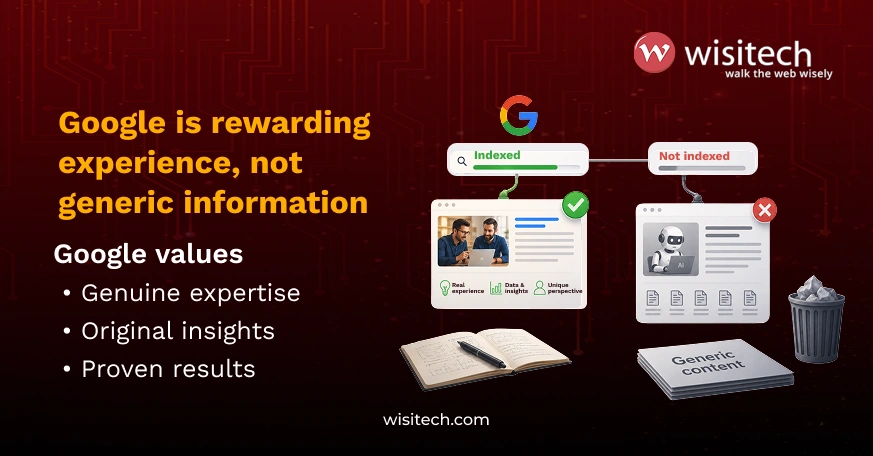
Open Google Search Console for almost any website right now, and there is a decent chance you will find pages sitting in a section called “crawled, currently not indexed.” Not ranked, not indexed, just sitting there, like mail nobody opened. That pattern is what sent us into our own site’s report to check whether we had the same problem. We did. 9 of our blog posts are crawled, currently not indexed.
The answer keeps coming back to the same 2 words: non-commodity content. Google is telling site owners, in plainer language than usual, that it only wants to index and show in search results content nobody else could have written, and everything else can sit in that folder indefinitely.
That is the subject of this post: what non-commodity content actually means, what we found when we dug through our own indexing report, and what we are changing in our content process as a result.
What “crawled, currently not indexed” really means
Open Google Search Console, click Pages under the Indexing tab, and look for “Crawled, currently not indexed.” It means Google visited the page and, for now, chose not to add it to search results. That’s different from “Discovered, not currently indexed,” where Google knows a page exists but hasn’t crawled it yet.
There are 2 reasons a page ends up here. A technical block, like a robots.txt rule or a broken redirect, is rare and usually a quick fix. Far more often, it’s quality. Google’s systems decide the page doesn’t offer anything a searcher can’t already find elsewhere.
Worth noting: not every URL in this report is a problem. If you spot /feed /pages, pagination, or URLs with parameters attached, that’s normal. These are non-canonical variants Google is expected to leave out of the index, not a sign of a content quality issue.
Danny Sullivan, Google’s Search Liaison, drew this line at Google Search Central Live in Toronto in April 2026, and it’s been the industry’s reference point since. His point: quality is not just about the words on the page.
A page can have completely original text and still fail if that content is buried under ads, pop-ups, or filler before the useful part starts. It’s the recipe blog problem most people have run into, a long personal story sitting on top of the actual recipe that most readers just want to scroll past.
The difference between commodity and non-commodity content
Commodity content is the stuff almost anyone could produce with a bit of research and a decent AI tool. It explains the basics, states the obvious, and reads like 50 other articles on the same topic because it was probably written the same way as 50 other articles.
Non-commodity content is the opposite. It comes from someone who has actually done the work, made the mistakes, and can describe a specific project, a specific client, or a specific number that nobody else has access to.
The USP of non-commodity content: Unique, Specific, Authentic
Non-commodity content stands on 3 pillars that make it impossible to replicate without real experience.
- Unique
Brings a viewpoint, an experience, or information that others do not have or cannot easily copy. - Specific
Deals with an actual situation, project, or example instead of general rules or generic advice. - Authentic
Shows first-hand knowledge, something the writer has actually lived through, not just researched.
Google has clearly gotten better at telling the difference. Content generation used to be the bottleneck. Now that anyone can produce fluent, correctly punctuated paragraphs on any subject in seconds, fluency stopped being a signal of quality on its own. What is left as a real signal is whether the person writing actually knows the subject, and that is much harder to fake.
Why domain knowledge matters as much as writing skill
Writing skill alone is no longer enough. While a writer can produce clear, well-structured content, truly valuable articles require domain knowledge. Someone without hands-on experience in areas like design, development, or SEO cannot explain real challenges, practical solutions, or client-specific decisions with the depth that readers and Google now expect.
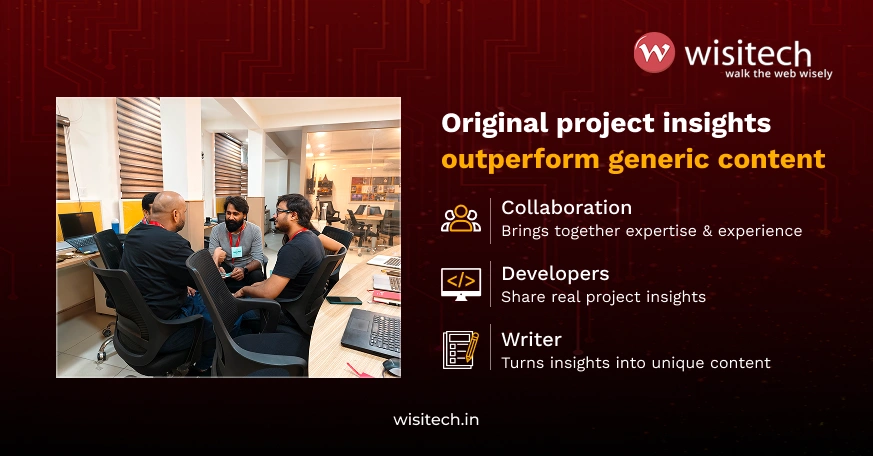
The best content comes from close collaboration between writers and subject matter experts. By speaking with developers, designers, digital marketers, and account leads about real client projects, writers can capture unique insights, practical examples, and first-hand experiences that AI and competitor content cannot replicate. These authentic details transform generic articles into content that is genuinely useful and more likely to be indexed.
What we found when we checked our own website
When we reviewed our own site’s report, the pattern matched almost exactly what Google described. Most pages were indexed, a few were crawled and ignored. The ones getting ignored read like generic explainers rather than grounded in real client work.
One example: a general “benefits of SEO” post that could have run on any agency’s blog. We rewrote it around one client’s actual results: bounce rate down 46%, organic traffic up 32% and leads up 20%. The real work was strategic. Consolidating 3 thin service pages into one and rewriting the homepage around their actual customer objections, backed by the standard technical fixes: updated titles, meta descriptions, alt tags, internal linking, and schema markup.
Take power washing, one of our clients’ industries. It sounds as commodity as service categories get. Yet there is still room to write about a real job, a real surface problem, or a lesson learned on site, not another generic benefits-of-power-washing post.
A lot of our best material is already sitting in Slack threads and internal conversations, not on the blog. Whenever someone solves a real client problem or debates a technical decision with a developer, that conversation has the exact texture Google is now rewarding. And it disappears from everyone’s feed within a day if it only ever lives on LinkedIn.
The fix is not complicated. It just means capturing those conversations and turning them into permanent blog content instead of letting them evaporate.
How we are rebuilding our own non-commodity content process
On the technical side, the basics still matter. SEO optimized title and meta description, correct schema markup, descriptive alt text, image filenames that actually describe the image, visible captions, and a site that loads quickly.
They all play a part in whether Google bothers to look twice. None of that is new advice, but it is worth rechecking because a technically clean page built on generic content will still miss the index.
The bigger shift is editorial. We are reviewing every page in our own and our clients’ crawled-but-not-indexed list and asking one blunt question: could a competitor have written this exact page without ever talking to a client or touching the product? If the answer is yes, we are rewriting the page with an actual example, a specific number, or an opinion attributed to a real person’s name and bio.
To make that call, we lean on 4 questions pulled from Google’s own guidance on creating helpful content:
- Does the page offer original reporting, research, or analysis instead of repeating what is already published elsewhere?
- Does it add insight or interesting information beyond the obvious?
- If it draws on other sources, does it add real value and originality rather than simply restating them?
- Does it offer clearly more value than the pages already ranking for the same search?
How we are writing non-commodity content
For inspiration for our blog posts, we are not relying on LinkedIn, Instagram, X, YouTube, or Facebook. We are taking inspiration from our internal discussions and arguments over how best to implement a particularly challenging work, insights from client calls, random shower thoughts, and the trend everyone else misunderstood.
We are treating AI as a drafting and editing assistant rather than the source of the ideas. It can help structure a page or tighten a paragraph. It cannot hand us a story that only happened to us.
For the brands we write for, this changes how we plan content calendars too. Instead of defaulting to another how-to post the rest of the industry has already published, we push harder for interviews with subject matter experts, real project write-ups, and specific numbers pulled from actual campaigns. It takes longer to produce. It also happens to be the only kind of content Google seems willing to reward right now.
If you want a quick check on your own content, try this: paste a page into your favorite AI platform and ask whether it is likely to be considered commodity content. Then push further and ask it for ideas that draw on your own firsthand experience and details only you have access to, to make the piece more original and more useful than anything else currently ranking for that topic.
This will not replace an editor’s judgment, but it is a fast way to spot where a page is coasting on general knowledge instead of real experience.
Conclusion
Here is the uncomfortable part. There is no shortcut back from crawled, currently not indexed, once quality is the reason a page landed there. You cannot request your way out of it, and you cannot technically SEO your way out of it either.
The only real fix is writing something Google could not have generated itself, which is a strange sentence to type in 2026, but here we are. Non-commodity content was always good practice. It is just no longer optional.
Send us one URL from your site that’s stuck in ‘crawled, currently not indexed,’ and we’ll tell you whether it’s a technical fix or a content problem.