
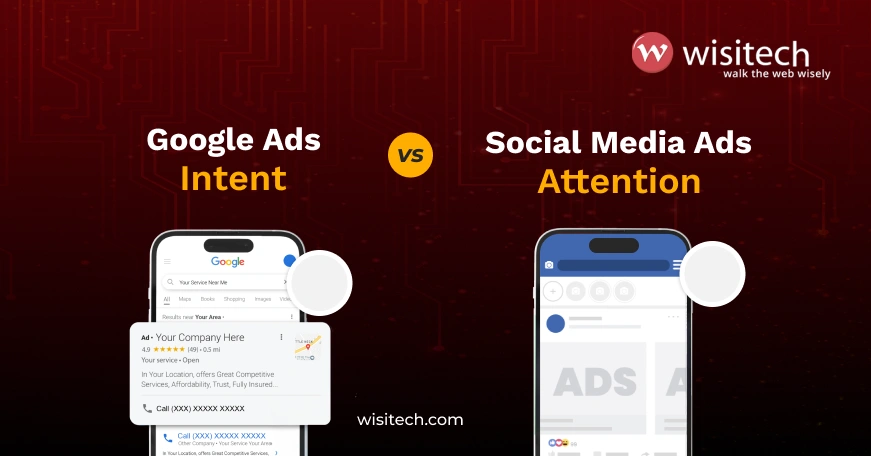
Businesses no longer ask whether digital advertising works. The real question in 2026 is where advertising budgets should go for the strongest return.
For some brands, Google Ads consistently drives qualified leads because users are already searching with intent. For others, social media advertising creates better long-term visibility and customer engagement. The challenge is understanding where your audience is in the buying journey and how they actually make decisions online.
When comparing Google Ads vs social media ads, there is no universal winner. Both platforms influence customer behavior differently, and businesses that understand those differences tend to build stronger advertising strategies over time.
One noticeable shift in 2026 is that businesses are becoming far more selective about ad spend. Rising competition, AI-driven automation, and changing consumer behavior mean campaigns now require smarter targeting and clearer positioning than they did even a few years ago.
What makes Google Ads different?
Google Ads focuses heavily on search intent. People use Google when they are actively looking for something specific, whether that’s a product, a service, pricing information, or a nearby business.
That intent is what makes Google Ads so valuable.
A person searching “emergency plumber near me” behaves very differently from someone casually scrolling Instagram. In most cases, the Google user is already closer to making a decision.
This is one reason many businesses partner with a professional Google Ads management company instead of running campaigns without strategy or optimization.
Why businesses continue investing in Google Ads
Google Ads remains effective because it reaches users during high-intent moments. Businesses can target:
- Search queries
- Geographic areas
- Devices
- Customer behavior
- Purchase intent signals
In 2026, automation has become a larger part of campaign management. Features like performance max campaigns now help advertisers reach users across Search, YouTube, Gmail, Maps, and Display from a single campaign structure.
However, automation alone does not guarantee strong results. Campaign structure, conversion tracking, landing page quality, and audience signals still have a major impact on ROI.
Businesses investing in professional Google Ads management are increasingly focusing on first-party data, conversion quality, and smarter bidding strategies instead of simply maximizing clicks.
What makes social media ads different?
Social media advertising works differently because it creates demand rather than capturing it.
People on Facebook, Instagram, LinkedIn, or TikTok are usually not searching for a product directly. Instead, social platforms influence users through visibility, repetition, content engagement, and audience targeting.
That difference matters.
A well-targeted social campaign can introduce your business to users before they ever search for you on Google.
This is especially important for brands with:
- Longer buying cycles
- Visually driven products
- New product launches
- Lifestyle-focused marketing
- Community-based engagement strategies
Businesses offering social media marketing services for small business often focus on building familiarity and trust over time instead of expecting immediate conversions from every campaign.
Why social media ads continue growing in 2026
In 2026, short-form video content, creator-style ads, and AI-powered audience segmentation continue shaping social media performance.
Users now respond more strongly to content that feels native to the platform rather than highly polished advertisements. This has changed how businesses approach creative strategy across Facebook, Instagram, TikTok, and LinkedIn.
Social ads also give businesses more flexibility for:
- Retargeting website visitors
- Promoting offers visually
- Testing messaging quickly
- Building audience familiarity
- Increasing repeat engagement
For many businesses, social media is no longer just an awareness channel. It now supports remarketing, customer retention, and brand recall throughout the customer journey.
Google Ads vs social media ads: The biggest differences
User intent
The biggest distinction is intent.
Google Ads reaches users who are already searching for something. Social media ads reach users based on interests, behavior, and demographics before they actively search.
That’s why Google Ads often generates faster conversions, while social campaigns may influence earlier stages of decision-making.
Speed of results
Businesses looking for immediate inquiries or purchases often see faster traction through Google Ads.
Social media campaigns usually require more repetition and audience nurturing before producing consistent conversions.
This is particularly noticeable in industries with higher trust requirements, such as healthcare, legal services, B2B software, or high-ticket services.
Cost efficiency
Advertising costs vary significantly by industry.
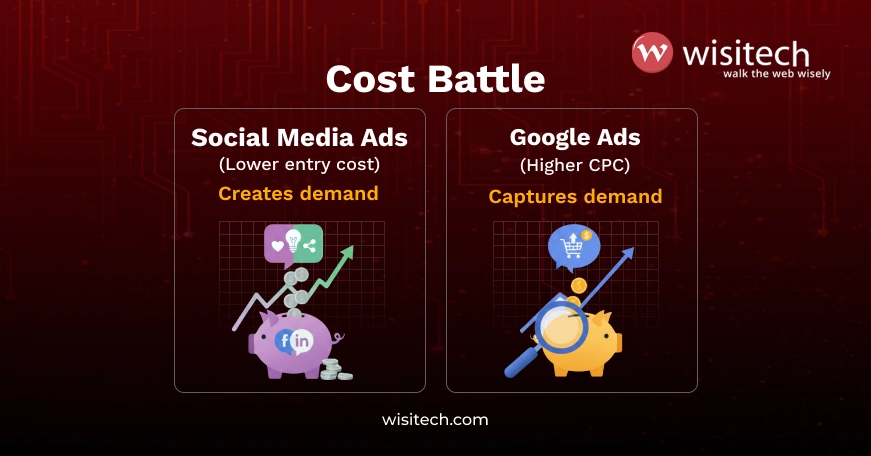
Google Ads can become expensive in highly competitive search markets, especially when multiple businesses target the same keywords aggressively.
Social media advertising may generate lower-cost clicks initially, but lower click costs do not always translate into higher-quality leads.
An experienced ppc agency usually evaluates:
- Cost per lead
- Conversion quality
- Sales cycle length
- Customer lifetime value
- Attribution data
instead of looking only at CPCs or impressions.
Your ads should generate more than clicks.
Wisitech’s Google Ads management services help improve lead quality, targeting, and conversions.
LinkedIn ads vs Google Ads for B2B marketing
For B2B businesses, the comparison becomes more nuanced.
Google Ads captures active demand when decision-makers search for solutions directly. LinkedIn Ads, however, allows businesses to target users based on:
- Job titles
- Company size
- Industry
- Seniority level
- Professional interests
This makes LinkedIn valuable for account-based marketing and longer B2B sales cycles.
Businesses working with a B2B Google Ads agency often combine LinkedIn remarketing with Google search campaigns to stay visible throughout the research and evaluation process.
In 2026, many B2B companies are shifting budgets toward integrated advertising strategies rather than relying entirely on one platform.
Which platform works better for ecommerce businesses?
For ecommerce brands, both platforms serve different purposes.
Google Ads is often stronger for capturing shoppers already searching for products. Shopping campaigns, branded searches, and high-intent keywords continue driving strong ecommerce conversions.
Well-structured ecommerce Google Ads campaigns can help businesses increase:
- Product visibility
- Shopping traffic
- Conversion rates
- Return on ad spend
Social media platforms, however, play a major role in product discovery.
Many ecommerce purchases now begin with:
- Instagram reels
- Facebook retargeting
- TikTok videos
- Influencer collaborations
- User-generated content
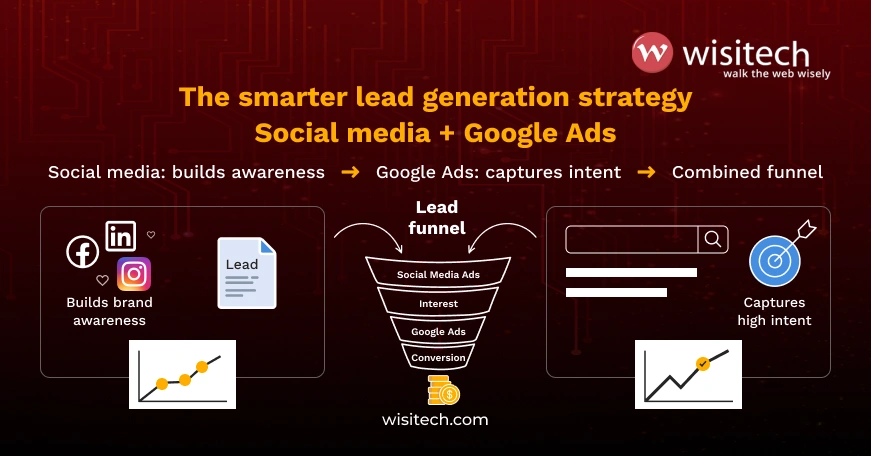
In fact, many ecommerce brands in 2026 are seeing stronger results when Google Ads and social campaigns work together rather than independently.
A common pattern looks like this:
- A customer first discovers a product on Instagram
- Searches the brand later on Google
- Returns through remarketing ads
- Converts after multiple touchpoints
This customer behavior is one reason attribution has become more complex across digital advertising channels.
Should businesses choose Google Ads or social media ads?
The answer depends on the business objective.
Google Ads is usually stronger for:
- Immediate lead generation
- Local services
- Search-driven purchases
- High-intent traffic
- Conversion-focused campaigns
Social media ads are often stronger for:
- Brand awareness
- Audience engagement
- Visual storytelling
- Community growth
- Demand generation
Businesses that rely only on one channel often limit their growth potential unnecessarily.
In 2026, stronger-performing brands are usually integrating search and social strategies instead of treating them as competing platforms.
Getting engagement but not enough sales?
Wisitech builds integrated search and social campaigns focused on measurable growth and ROI.
Final thoughts
The discussion around Google Ads vs social media ads is far more strategic in 2026 than it was a few years ago.
Google Ads still performs exceptionally well for capturing high-intent searches and generating direct conversions. Social media advertising continues influencing discovery, engagement, and customer retention across multiple touchpoints.
The businesses seeing the strongest long-term performance are not necessarily choosing one platform over the other. They are building integrated strategies that align with how customers actually research, compare, and purchase today.
As advertising platforms continue evolving, success will depend less on simply running ads and more on understanding audience behavior, campaign structure, creative strategy, and conversion quality over time.
If you want to understand which advertising approach will work best for your business, Wisitech can guide you every step of the way. Contact us to learn more about our AI-powered Google Ads and social media ads solutions designed to support sustainable growth and better marketing results.