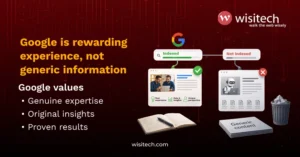

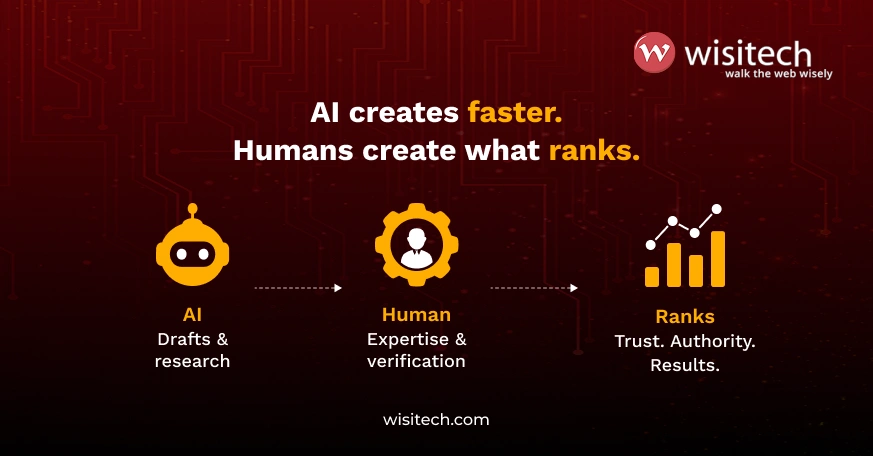
Most businesses get AI content creation wrong in the same direction. They hand a prompt to ChatGPT, publish the output with minor edits, and wonder why it does not rank. The problem is not that AI produced the content. The problem is that AI alone cannot produce the thing Google actually rewards: original perspective, verified data, and the kind of specific expertise that only comes from a human who has worked in the domain.
This guide covers the AI-human content workflow that produces content which ranks, earns AI Overview citations, and converts readers into buyers. If you want content writing services that produce compounding organic results rather than content that looks fine but ranks nowhere, the workflow in this guide is the difference.
What is AI content creation and why does it matter for SEO?
AI content creation is the use of large language model tools (ChatGPT, Claude, Gemini, Jasper) to assist in generating, structuring, or optimizing written content. In 2026, 87% of marketing professionals use AI for content creation. But the way AI is used matters enormously: 64% of SEOs use a human-led, AI-assisted workflow. Only 4% publish pure AI-generated content without human review.
Why it matters for SEO: 86.5% of top-ranking pages contain some amount of AI-generated content. But position 1 results are 8x more likely to be human-written than purely AI-generated. The synthesis: AI is a standard part of the content production infrastructure in 2026, but human expertise, editorial judgment, and original perspective are what determine whether that content reaches page one.
The numbers that define AI content in 2026
- 87% of marketing professionals now use AI for content creation (Ahrefs, 2025)
- 86.5% of top-ranking pages contain some amount of AI-generated content (Ahrefs, 2025)
- 64% of SEOs use a human-led AI-assisted workflow, the most common production model today (Semrush, 2026)
- 8x more likely: position 1 results are 8x more likely to be human-written than purely AI-generated (Semrush, 2026)
- 97% of companies edit and review AI content before publishing. Only 4% publish pure AI output (Ahrefs, 2025)
- 42% more content: marketers using AI publish 42% more content than those who do not (Ahrefs, 2025)
Why pure AI content creation fails to rank
Pure AI content creation without human editorial input fails for a specific and consistent reason: it is statistically average. AI language models predict the most likely next word based on patterns in their training data. The result is content that is grammatically clean, structurally familiar, and factually plausible but that says nothing a reader could not have found in the first ten results already. Google’s Helpful Content system is specifically designed to surface content that demonstrates first-hand experience, expertise, and original perspective. None of those things come from a language model.
What pure AI content looks like to Google in 2026
- Lacks first-hand experience signals (E-E-A-T) that distinguish expert content from aggregated summaries
- Does not contain original data, proprietary observations, or perspectives that cannot be found in existing training data
- Uses predictable structure and phrasing patterns that AI detection systems and Google’s quality evaluators identify
- Fails to answer the specific, nuanced questions that distinguish high-intent commercial buyers from casual researchers
- Cannot cite real client results, project-specific observations, or practitioner-level insights that build topical authority
The evidence from the Semrush analysis of 42,000 blog pages is unambiguous: content classified as purely AI-generated appeared in the top spot just 9% of the time. Human-written content held position 1 eighty percent of the time. AI SEO content strategy in 2026 is built on this reality: AI accelerates production; humans determine whether that production ranks.
The AI content creation workflow that ranks: step by step
The AI content creation workflow that produces ranking content is not ‘write with AI and edit it.’ It is a structured collaboration where AI handles the repeatable and humans handle the irreplaceable. Here is the exact workflow:
Step 1: Human-led keyword and topic strategy
AI is useful for generating keyword clusters and topic ideas at scale, but human judgment determines which topics have genuine commercial intent and which have the right competitive landscape for the domain. SEO content creation services that produce ranking results start with a human analyst evaluating search intent, competitive content quality, and the specific angle that will differentiate the piece from what already ranks.
Step 2: AI-assisted research and structural outline
AI tools are highly effective at accelerating research: summarizing existing literature, identifying the key subtopics a comprehensive piece should cover, and structuring an outline that matches the search intent. The top five uses of AI in content production are generating outlines (92%), idea generation and keyword research (88%), research assistance (80%), writing simple content sections (73%), and generating entire blogs to be edited by humans (52%). The keyword is ‘edited.’
Step 3: Human-written perspective, data, and expertise
This is the step that determines whether content ranks at position 1 or position 8. The human contributor adds: proprietary data or client observations that no competitor can replicate, first-hand practitioner perspective that demonstrates genuine expertise, specific examples and case studies from real project experience, and editorial judgment about what the target buyer actually needs to know versus what makes the piece look comprehensive. B2B content marketing services that move pipeline are built on this layer. The AI can draft sections. Only a domain expert can write the paragraph that makes a buyer trust the source.
Step 4: AI-assisted editing and optimization
Once the human layer is in place, AI is effective for: improving sentence clarity, checking for logical flow, identifying content gaps against competitive pages, and optimizing for readability. Content marketing agency services that use AI at the editing stage consistently produce cleaner, better-structured content in less time than those that rely entirely on human editors. The workflow is additive. AI makes human editors faster and better.
Step 5: Schema and GEO optimization for AI search citation
In 2026, content that ranks well in traditional search also needs to earn citations in AI-generated answers. Generative engine optimization (GEO) requires structuring the final content with FAQ schema, clear H2 and H3 headings, self-contained definition blocks, and numbered lists that AI systems extract preferentially. Every piece of content produced by a serious content marketing company in 2026 should include this layer before publication.
What human expertise adds to AI content creation that AI cannot replicate
The question every business asks when evaluating AI content creation is: where exactly does the human add value that the AI cannot? The answer is specific and testable.
| Content element | AI capability | Human requirement |
| Keyword targeting and structure | Strong — can generate outlines and semantic maps | Judgment on commercial intent and competitive gaps |
| Factual accuracy | Plausible but hallucination-prone | Verification against primary sources |
| Original data and insights | Cannot produce — draws from existing training data | Essential — the primary ranking differentiator |
| Brand voice and tone | Approximates with prompting | Authenticity and consistency require human ownership |
| Buyer empathy and nuance | Generic understanding of buyer pain points | Real client conversations and sales intelligence |
| Schema and GEO optimization | Can suggest structure | Strategic decisions on what to feature in FAQ blocks |
| E-E-A-T signals | Cannot demonstrate first-hand experience | The author bio, byline, and case studies that signal it |
What Google actually says about AI content creation in 2026
Google’s official position on AI content creation is consistent and specific: the search engine does not penalize content because it was produced with AI. It penalizes content that is unhelpful, unoriginal, and not created for people first. The 2024 and 2025 Helpful Content updates targeted ‘AI slop’: high-volume, low-value content that floods search results with plausible-sounding text that does not actually help anyone. The target was the outcome, not the production method.
What this means in practice: a 2,500-word article written entirely by a human expert that is poorly structured, repetitive, and thin on original insight will underperform a 1,500-word AI-assisted article with strong practitioner perspective, verified data, correct schema, and genuine buyer utility. Google evaluates the result. How you produced it is your business.
The practical implication for any business evaluating SEO content marketing services: ask the agency how they add original value to AI-assisted content, not whether they use AI at all. The answer to the second question is almost certainly yes. The answer to the first question determines whether the content ranks.
AI content creation tools that work in 2026
The AI content creation tool landscape has consolidated significantly in 2026. ChatGPT remains the dominant tool, used by 44% of respondents in Ahrefs’ content marketing survey. Gemini follows at 15%, and Claude at 10%. But the tools that produce the best content outcomes are not the generation tools, they are the optimization and research tools that AI powers.
Research and keyword tools
- Semrush Keyword Magic Tool — identifies high-value, low-competition keyword clusters with AI-powered intent classification
- Ahrefs Content Explorer — finds content gaps and the specific angle that will outperform existing rankings
- Perplexity — real-time research with citations, faster than traditional research for verifying data and finding primary sources
Generation and drafting tools
- ChatGPT (GPT-4o) — strongest for structural outlines and initial draft generation with specific prompts
- Claude — strongest for editing, tone consistency, and long-form content with complex reasoning requirements
- Gemini — strongest for Google-ecosystem integration and content that needs to align with Search Console data
Optimization and schema tools
- Surfer SEO — on-page optimization against the top-ranking competitors for any keyword
- Schema App or Rank Math — FAQ, Article, and HowTo schema implementation for AI Overview eligibility
- Microsoft Clarity — session recordings and heatmaps that show how AI-assisted content performs with real users
How AI content creation integrates with generative engine optimization
AI content creation and generative engine optimization are now inseparable disciplines. GEO is the practice of structuring content so that Google AI Overviews, ChatGPT Browse, and Perplexity cite your brand in generated answers. The content structure that earns AI citations is the same structure that produces strong traditional rankings: clear headings, short paragraphs, self-contained definitions, FAQ schema, and numbered lists.
One important 2026 data point: nearly nine in ten queries triggering AI Overviews have informational intent. 80% of keywords triggering AI Overviews fall into the 0 to 40% keyword difficulty range. This means that long-tail, informational content produced with the human-led AI workflow is disproportionately positioned to earn AI Overview citations. The answer engine optimization layer, which adds FAQ schema and self-contained definition blocks, is what converts a ranking page into a cited page.
For businesses, this changes the ROI calculation on blog writing services. A well-optimized blog post in 2026 does not just rank in the traditional SERP. It earns citations in AI Overviews that appear above traditional results, multiplying the visibility of a single piece of content across both search surfaces simultaneously.
AI content creation by content type: what works and what does not
Not all content types benefit equally from AI content creation workflows. Here is an honest assessment based on 2026 ranking data:
| Content type | AI suitability | Human requirement | 2026 ranking potential |
| Blog posts and articles | High for structure and research | Expert layer and original data essential | Very high with correct workflow |
| Product descriptions | High for scale | Brand voice and accuracy review | High for long-tail product queries |
| Thought leadership | Low — perspective cannot be faked | Almost entirely human-authored | Highest when authentically human |
| Press releases | Medium for formatting | Facts, quotes, and strategy decisions | Good for news and brand search |
| Case studies | Low — specific client data required | Heavily human-authored | Very high for E-E-A-T and conversion |
| FAQ and schema content | High for structure | Accuracy and specificity review | Very high for AI Overview citation |
How to measure AI content creation performance
Most businesses measure AI content creation performance against the wrong metrics. Traffic volume and keyword rankings are the floor. The ceiling is measuring how AI-assisted content performs against business outcomes.
- Traditional ranking metrics: Keyword position, organic sessions, and click-through rate from Google Search Console. Baseline performance that every piece should be measured against.
- AI Overview citations: Track which of your pages appear in Google AI Overview answers using the ‘Search Appearance’ filter in Google Search Console. This is a 2026 metric that most businesses are not yet tracking.
- Content ROI: Revenue or pipeline attributed to organic content using GA4 with proper conversion tracking. Content marketing ROI for well-executed programs typically runs at $3 to $10 per $1 invested at 12 months.
- E-E-A-T signals: Author click-through rate from author pages, branded search growth, and backlink acquisition from the piece. These are the compounding signals that determine whether a domain builds topical authority.
- Time-to-rank: AI-assisted content that follows the human-led workflow typically shows initial ranking movement in 4 to 8 weeks for low-competition terms. Pure AI content with no human layer often fails to rank at all, regardless of timeline.
The most common AI content creation mistakes in 2026
Businesses that are not seeing results from AI content creation are almost always making one of these five mistakes:
- Publishing AI output without an expert review layer. The AI draft is a starting point, not a final product. Every piece needs a domain expert to add the specific perspective, verify the data, and ensure the content answers the real buyer question.
- Optimizing for keyword density rather than buyer intent. Feeding keywords into an AI prompt and asking it to ‘naturally include them’ produces exactly the awkward, forced keyword usage that both readers and Google penalize.
- Skipping schema implementation. Most AI-generated content is published without FAQ schema, Article schema, or structured data. Without schema, content that could earn AI Overview citations does not.
- Producing at volume rather than depth. AI makes it easy to publish 30 thin posts per month. Google’s Helpful Content system specifically targets this pattern. One comprehensive, expert-led piece outperforms ten thin ones on every metric.
- Ignoring E-E-A-T signals. Publishing AI content under a generic byline with no author profile, no credentials, and no linking to supporting expertise signals to Google that the content has no verifiable expertise behind it.
Wisitech’s AI-assisted content creation services
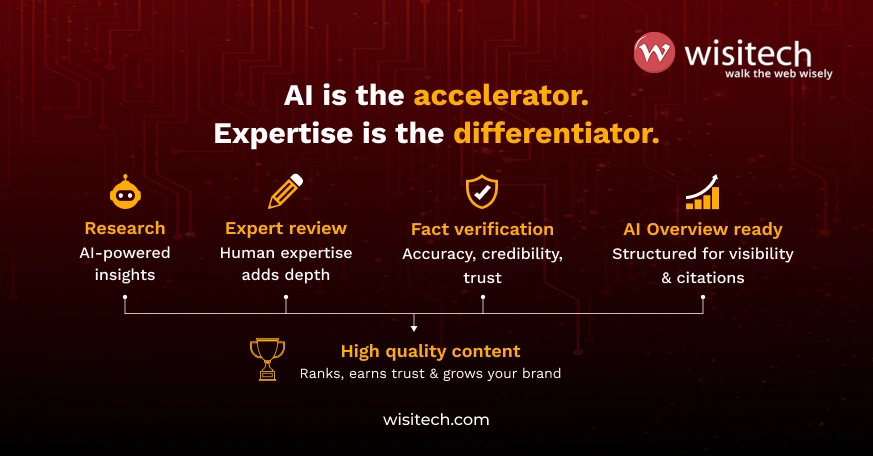
Wisitech delivers AI content creation programs built around the human-led workflow that this guide describes. Our content marketing agency combine AI-assisted research and structural drafting with expert editorial review by writers who specialize in the client’s industry. Every piece includes keyword targeting, GEO optimization with FAQ schema, and AI Overview citation structure before publication.
Our SEO content marketing services ensure every content investment is tied to commercial-intent keywords with verified search demand, not just topics that sound right. Our B2B content marketing services are built around the specific buyer journey dynamics of long sales cycles: thought leadership that builds authority during the evaluation period, commercial-intent content that captures decision-stage searches, and case studies that close the trust gap at the conversion point.
If your current content program is producing traffic but not pipeline, or publishing regularly but not ranking, get in touch with us. We start with a content audit that shows exactly where the gaps are before recommending a scope.
27 years. 2,500+ projects. Fortune 500 experience. Creativity leads, AI amplifies.