
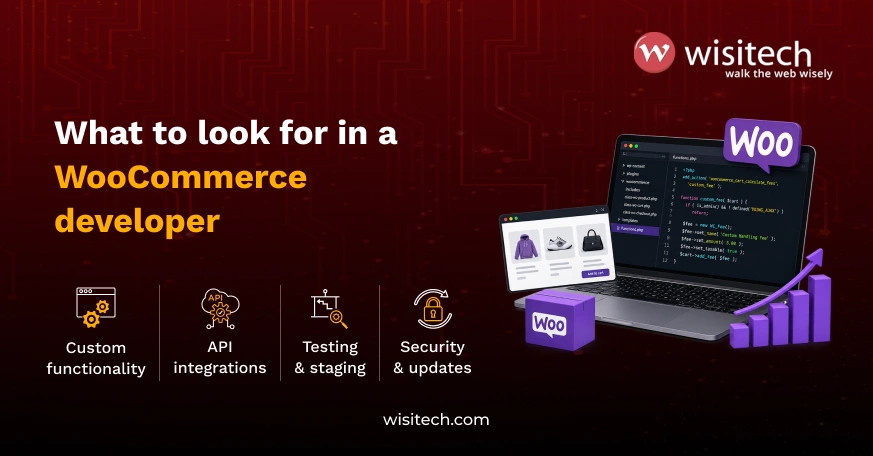
If your business is planning a new WooCommerce store or trying to improve an existing one, hiring the right core PHP and WooCommerce developer can make a major difference to the project’s long-term stability. WooCommerce gives businesses a flexible ecommerce platform, but the moment you need custom workflows, third-party integrations, unusual product rules, or performance improvements, development expertise becomes important.
The challenge is that many developers may describe themselves as PHP or WooCommerce specialists. Their actual experience can vary considerably. Someone who can install WooCommerce and modify a theme may not have the experience needed to troubleshoot a complicated checkout, connect an ERP, optimize a large catalogue, or maintain a heavily customized store.
This guide focuses on what you should actually look for before hiring.
What does a core PHP and WooCommerce developer do?
A core PHP and WooCommerce developer works on the server-side functionality that powers a WooCommerce website. Depending on the project, the role can involve custom features, WordPress development, WooCommerce extensions, database work, API integrations, debugging, security, and performance optimization.
Typical responsibilities may include:
- Developing custom WooCommerce functionality
- Creating or modifying WordPress plugins
- Working with WooCommerce hooks and filters
- Connecting the store with external APIs
- Building custom product, cart, checkout, or order workflows
- Troubleshooting PHP and WordPress errors
- Improving database and application performance
- Testing new functionality before deployment
- Maintaining existing custom code
- Supporting updates and technical improvements
The exact responsibilities should be defined before hiring. A developer working on a simple product catalogue will need a different skill set from someone supporting a store with thousands of products, multiple integrations, and a high volume of orders.
Look beyond PHP experience
A strong PHP background is useful, but PHP alone does not tell you whether someone can handle a WooCommerce project.
A candidate should also understand WordPress and WooCommerce. They should know how themes, plugins, hooks, filters, databases, APIs, payment systems, and order workflows fit together.
Ask candidates about specific projects rather than accepting a list of technologies.
For example, instead of asking, “Do you know WooCommerce?” ask:
- Have you developed custom WooCommerce features?
- What kind of stores have you worked on?
- Have you handled payment or shipping integrations?
- Have you worked with WooCommerce APIs or webhooks?
- Have you optimized a slow WooCommerce store?
- Have you migrated or rebuilt an existing store?
- Have you supported a WooCommerce website after launch?
The answers will give you a clearer picture of their practical experience.
Review relevant WooCommerce experience
The best portfolio for your project is not necessarily the one with the most impressive screenshots. Look for projects that had technical requirements similar to yours.
If you sell physical products, for example, ask whether the developer has worked with inventory, shipping, payment gateways, and order management.
If your business has a complex pricing model, ask whether they have developed customer-specific pricing or custom product rules.
If your store needs to communicate with an ERP or CRM, ask for examples of previous integration work.
This is where the difference between a general PHP programmer and an experienced core PHP and WooCommerce developer becomes easier to see. The experienced candidate should be able to discuss the problem, the approach, the challenges, and the result in practical terms.
Ask how they handle custom development
WooCommerce can be extended in many ways. A developer should know when an existing feature or plugin is sufficient and when custom development is justified.
This matters because adding a plugin is not automatically the best solution.
Before hiring, ask:
“How would you decide between an existing plugin and custom development for this requirement?”
A good answer should consider the importance of the feature, compatibility, maintenance, security, performance, support, and future changes.
For businesses that need tailored functionality, Wisitech provides custom WooCommerce development services designed around specific ecommerce requirements.
Check their approach to plugins
Plugins can save development time, but every additional dependency needs to be evaluated.
A developer should look at:
- Whether the plugin is actively maintained
- Compatibility with your WordPress and WooCommerce versions
- Performance impact
- Security history
- Quality of support
- Whether another plugin already performs a similar function
- Whether the functionality is important enough to justify a long-term dependency
The goal is not to have the fewest possible plugins. The goal is to have a system that remains manageable.
Ask the candidate to review your current plugins if you already have a store. Their comments can reveal whether they understand the technical consequences of plugin choices.
Test problem-solving with a real example
Technical interviews can become too theoretical. A better approach is to give the candidate a situation that resembles something your business may actually face.
Suppose your checkout became slow after several new plugins and integrations were introduced.
Ask:
“How would you find the cause?”
A good candidate should want to investigate before recommending a fix.
They may ask when the slowdown started, whether it affects every page or only checkout, whether the issue occurs on mobile, whether external APIs are involved, what the server response time looks like, and whether recent code or plugin changes coincide with the problem.
You are evaluating their thinking process, not looking for a rehearsed answer.
A capable core PHP and WooCommerce developer should be comfortable breaking a technical problem into smaller parts and testing possible causes.
Ask about integrations
Many ecommerce websites depend on systems outside WooCommerce.
Your store may need to exchange information with:
- ERP software
- CRM platforms
- Payment gateways
- Shipping systems
- Accounting software
- Inventory platforms
- Marketing tools
- Customer portals
- Internal business applications
Ask candidates about integrations they have actually built.
Then give them a scenario.
For example:
“An order is created in WooCommerce, but the external ERP is unavailable. What should happen?”
The answer should cover more than displaying an error. You want to understand how the developer thinks about failed requests, retries, logging, duplicate processing, data consistency, authentication, and recovery.
This is particularly important for stores where an integration failure can interrupt fulfilment or order processing.
Ask about performance
Performance should be considered during development, not treated as a last-minute cleanup task.
Ask the developer how they would approach a store that has become slow.
Their investigation might include:
- PHP execution
- Database queries
- Plugin activity
- Theme code
- API calls
- Caching
- Hosting resources
- Large product catalogues
- Images and other assets
- Third-party scripts
Do not automatically accept a recommendation to install another optimization plugin. First find out whether the developer can identify the actual source of the problem.
For larger ecommerce stores, performance can become closely connected to database structure, application logic, hosting resources, and the number of operations taking place during important customer actions.
Ask how they protect custom code
A WooCommerce store may receive frequent updates. WordPress, WooCommerce, themes, plugins, PHP versions, and external services can all change.
Ask the developer how they make custom functionality easier to maintain.
You should also ask whether they modify core WordPress or WooCommerce files.
Core files should not be changed simply to implement a business requirement. Custom functionality should be developed using appropriate extension methods so that future updates do not overwrite the work.
Ask how the developer handles:
- Custom plugins
- Hooks and filters
- Version control
- Documentation
- Testing
- Staging
- Deployment
- Rollbacks
These details may not seem important during the first interview, but they become very important when the store needs its first major update.
Ask about testing and staging
A live ecommerce store is a poor place to discover that new code does not work.
Ask whether development and testing will take place on a staging environment before changes are pushed to production.
Testing should cover the functions that matter to your business, such as:
- Product pages
- Product variations
- Cart
- Checkout
- Payment processing
- Shipping
- Coupons
- Customer accounts
- Order creation
- Order emails
- Inventory
- External integrations
For a more complex store, you may also need regression testing after changes are made.
A good core PHP and WooCommerce developer should be able to explain what will be tested, when it will be tested, and how problems will be handled before launch.
Do not overlook security
Security is particularly important when a website handles customer accounts, orders, payments, and business information.
Ask candidates how they approach secure development.
The discussion should cover areas such as:
- User permissions
- Authentication
- Input validation
- Data handling
- API credentials
- Plugin and theme updates
- PHP updates
- Backups
- Access control
- Error logging
You should also know who has access to the production website and hosting environment.
Clear access management makes it easier to protect the store and control who can make changes.
Compare freelancer, in-house developer, and agency
The right hiring model depends on your project.
Freelancer
A freelancer may be suitable for a well-defined project or occasional development work.
Ask about availability, response times, previous WooCommerce projects, and what happens if you need urgent support.
In-house developer
An in-house developer can become deeply familiar with your business and website.
This option can make sense when you have a steady stream of technical work and want development expertise available internally.
The limitation is that one person may not have every skill your ecommerce operation needs.
Development agency
An agency can give you access to developers and other specialists within one engagement.
This can be useful when your project involves backend development, design, integrations, QA, performance, SEO, security, or ongoing maintenance.
If you are considering an agency, ask who will actually work on the project and how senior developers will be involved.
Businesses that need broader technical support may benefit from working with a WooCommerce development company rather than relying on one individual for every technical requirement.
What should you ask before hiring?
A good interview should give you enough information to judge both technical capability and working style.
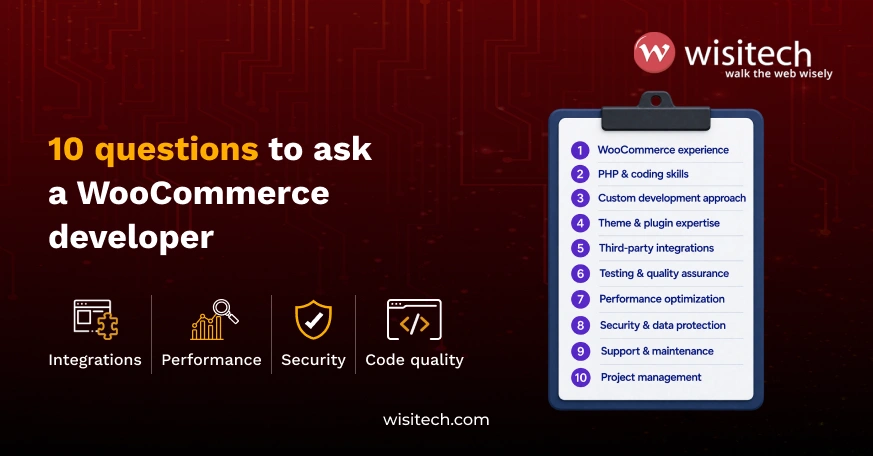
Here are useful questions to ask:
1. Can you show me a WooCommerce project similar to mine?
Ask the developer to explain their role, not just show you the website.
2. What would you build with custom code?
You want to understand how they decide between WooCommerce functionality, plugins, and custom development.
3. How would you diagnose a slow checkout?
Listen for a methodical investigation rather than an immediate list of plugins.
4. How do you test changes before they reach the live website?
Find out whether staging and regression testing are part of the process.
5. How do you handle third-party API failures?
This question can reveal how much real integration experience the developer has.
6. How do you handle WooCommerce and WordPress updates?
Ask about backups, staging, compatibility testing, and rollback procedures.
7. Who will maintain the website after launch?
Clarify whether support is available and what it includes.
8. Who owns the source code?
Make sure ownership and access are clearly defined in the agreement.
9. Will you provide documentation?
Documentation can make future maintenance much easier.
10. How do you estimate additional development work?
Agree on how changes outside the original scope will be evaluated and approved.
Watch for these hiring red flags
Some warning signs are easy to spot.
Be cautious if a developer:
- Cannot explain their role in previous projects
- Promises that every problem can be solved with a plugin
- Suggests modifying core files
- Gives a fixed technical solution before understanding the problem
- Has no clear testing process
- Cannot explain how they handle failed integrations
- Avoids questions about source-code ownership
- Has no plan for documentation
- Cannot explain how post-launch support works
You do not need a developer who knows every possible technology.
You need someone who understands your requirements and can make sound decisions about the technologies that matter to your store.
When should you hire a specialist?
A specialist becomes particularly valuable when your WooCommerce store has requirements that go beyond standard configuration.
Consider specialist development when you need:
- Custom checkout functionality
- Complex pricing
- Product configuration
- Advanced search or filtering
- ERP or CRM integrations
- Custom order processing
- Inventory synchronization
- Custom customer workflows
- Performance improvements
- Migration from another ecommerce platform
For a straightforward store, extensive custom development may not be necessary.
For a complex ecommerce operation, the right specialist can prevent small technical decisions from becoming expensive problems later.
How to make the final decision
Once you have shortlisted candidates, compare them against the same criteria.
Look at:
- Relevant WooCommerce experience
- PHP and WordPress knowledge
- Similar project experience
- Integration experience
- Performance knowledge
- Testing process
- Security awareness
- Communication
- Documentation
- Availability
- Post-launch support
- Overall understanding of your business requirements
Do not choose solely on price.
A low development cost can become expensive if the website later needs major fixes, a rewrite, or a replacement for poorly implemented functionality.
The better choice is usually the developer who gives you confidence that the website will remain manageable after the initial project is complete.
Conclusion
Hiring a core PHP and WooCommerce developer is ultimately about finding someone who can understand your ecommerce requirements and turn them into reliable, maintainable functionality.
Look beyond years of experience and job titles. Review relevant projects, ask practical questions, test problem-solving ability, and understand how the developer approaches integrations, performance, security, testing, updates, and support.
The right developer should not simply make your store work today. They should help you build a WooCommerce setup that your business can maintain and improve as it grows.
If you need WooCommerce website development services, Wisitech can help you plan, develop, customize, and improve your ecommerce website around your business requirements.