
Choosing an ecommerce platform can look easy until the store starts making real money.
At the beginning, almost any platform can handle products, payments, orders, and a basic checkout. The difficult questions appear later. Can the platform support your product structure? Can it handle custom pricing? Will your team need developers for every change? Can it support international payments, complex integrations, subscriptions, multiple sellers, or a growing catalog without turning every new requirement into a workaround?
That is why choosing the best ecommerce platform for small business is less about picking the platform with the longest feature list and more about choosing the one that matches how the business actually operates.
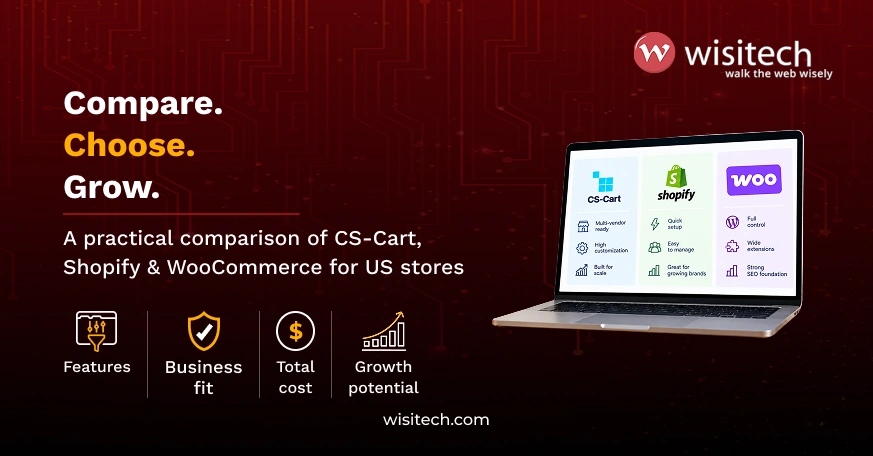
For a US store, Shopify, WooCommerce, and CS-Cart can all be strong choices. But they solve different problems.
The right decision depends on your business model, catalog complexity, operational requirements, internal technical resources, growth plans, and how much control you want over the underlying ecommerce system.
Start with the business model, not the platform
A common mistake is starting with a platform and then trying to make the business fit it.
We have seen the opposite approach work much better. Start by documenting how customers buy, how products are structured, how orders are fulfilled, how payments are processed, what third-party systems are involved, and what the business expects to change over the next two to three years.
Then evaluate the platforms.
For example, a US D2C brand selling 30 standardized products has very different requirements from a distributor selling thousands of SKUs with customer-specific pricing. A multi-vendor marketplace has an entirely different architecture again.
This is why there is no universal best ecommerce platform for small business.
A platform that is excellent for a lean D2C operation may become restrictive for a B2B business with complex workflows. A highly flexible platform may be unnecessary for a company that simply needs a fast, reliable storefront.
The platform should fit the business. Not the other way around.
Shopify: Best when speed, simplicity, and managed infrastructure matter
Shopify is often the easiest option for businesses that want to get selling without taking responsibility for much of the underlying infrastructure.
That makes it particularly attractive to growing consumer brands, retailers, and businesses with a relatively straightforward ecommerce model.
Where Shopify makes sense
Shopify is a strong choice when you need:
- A fast launch
- A polished storefront
- Managed hosting and infrastructure
- A large app ecosystem
- Straightforward product and order management
- Multiple payment and fulfillment integrations
- A platform that non-technical teams can manage
The biggest advantage is operational simplicity.
Your team can concentrate more heavily on merchandising, marketing, customer acquisition, and conversion rather than server management and platform maintenance.
For a business looking for the best ecommerce platform for small business, that reduction in technical overhead can be significant.
Where Shopify can become limiting
The question changes when the business starts asking for workflows that do not fit neatly into the standard Shopify ecosystem.
Custom functionality may require apps, custom development, third-party services, or a combination of all three.
That does not make Shopify a poor platform. It means the cost and complexity of customization need to be considered before the store is built around a particular architecture.
This is where working with a Shopify development company becomes useful. Instead of adding apps one by one, a development team can map the required functionality, determine what Shopify can handle natively, and identify where custom Shopify development is actually justified.
WooCommerce: Best when content, commerce, and control need to work together
WooCommerce is different because it sits inside WordPress.
For businesses already invested in WordPress, that can be a major advantage. Your content, SEO, ecommerce functionality, landing pages, blog, and customer experience can live within one broader ecosystem.
It also provides significant flexibility for businesses that need custom functionality.
Where WooCommerce makes sense
WooCommerce is particularly attractive when you need:
- Strong control over the website
- Deep WordPress integration
- Custom product functionality
- Content-heavy ecommerce
- Custom checkout experiences
- Flexible integrations
- Greater control over hosting and development
- Custom plugin development
This makes WooCommerce a strong contender for the best ecommerce platform for small business when content and commerce are closely connected.
But that flexibility comes with responsibility.
Hosting, security, plugin compatibility, updates, performance, backups, and ongoing technical maintenance need to be managed properly.
A real WooCommerce example
One of the clearest lessons from our US ecommerce work came from QuickTrick Alignment.
The business sells wheel alignment products across different buyer segments, with combinations involving vehicle types, kit sizes, and accessories. Standard WooCommerce variation functionality could not handle the product configuration cleanly.
Instead of abandoning WooCommerce, Wisitech built a custom variation module that allowed customers to navigate the catalog based on vehicle type and kit configuration. The catalog was also reorganized around DIY, fleet, RV, and powersports buyers.
The project included Stripe, PayPal, Google Pay, and Amazon Pay integrations, along with product education and content throughout the shopping experience.
The important lesson is not that WooCommerce is better than Shopify.
It is that the platform was capable of supporting the business once the architecture was customized around the actual buying process.
That distinction matters when evaluating custom WooCommerce development services.
CS-Cart: A different proposition for multi-vendor and complex ecommerce
CS-Cart deserves a different place in the comparison because its strongest use cases are not always the same as Shopify or WooCommerce.
If you are building a conventional single-seller D2C store, Shopify or WooCommerce may be the more natural starting point.
But if the business involves multiple sellers, vendor dashboards, commissions, seller-specific inventory, marketplace administration, or more complex B2B workflows, CS-Cart can become much more interesting.
Where CS-Cart makes sense
CS-Cart is worth considering when you need:
- Multi-vendor marketplace functionality
- Seller onboarding and vendor management
- Vendor-specific inventory
- Marketplace commission structures
- Seller dashboards
- B2B marketplace workflows
- Greater control over marketplace functionality
- Custom marketplace integrations
For businesses comparing the best ecommerce platform for small business, CS-Cart should therefore not be judged using the same criteria as Shopify.
The question is not simply which platform has the easiest setup.
The question is which platform can support the business model without forcing the business into an increasingly complicated collection of workarounds.
What our marketplace projects taught us
Wisitech has worked on CS-Cart marketplaces where the real challenge was not creating product pages.
It was coordinating sellers, inventory, shipping, payments, quotes, commissions, and customer workflows.
In one marketplace project, the platform required seller-specific shipping and inventory functionality, seller dashboards, instant quote capabilities, Stripe payments, and WhatsApp communication.
Another CS-Cart marketplace project connected independent retailers through a shared online marketplace with vendor onboarding, Adyen payments, ClearPay, local shopping experiences, click-and-collect, and a commission-only business model. The marketplace exceeded 100,000 products and achieved more than 400% sales growth by its second year.
That experience changes how we evaluate CS-Cart.
For a simple store, its marketplace capabilities may be unnecessary.
For a business where multiple sellers are central to the model, those capabilities can remove a significant amount of custom architecture that would otherwise need to be built.
Shopify vs WooCommerce vs CS-Cart: The decision comes down to complexity
The easiest way to compare these platforms is to stop asking which one is universally better.
Instead, ask which type of complexity you are prepared to manage.
| Requirement | Shopify | WooCommerce | CS-Cart |
| Fast launch | Strong | Strong | Moderate |
| Managed infrastructure | Strong | Depends on hosting | Depends on setup |
| Content and SEO flexibility | Strong | Excellent | Good |
| Custom functionality | Strong with development | Excellent | Excellent |
| Plugin/app ecosystem | Excellent | Excellent | More specialized |
| Multi-vendor marketplace | Requires additional architecture | Requires additional architecture | Strong fit |
| B2B customization | Good with development | Strong with development | Strong |
| Technical control | Moderate | High | High |
| Ease of management | High | Moderate | Moderate |
| Marketplace workflows | Requires customization | Requires customization | Native platform strength |
The table is useful, but it does not make the decision by itself.
Your operating model does.
When Shopify is probably the better choice
Choose Shopify when your priority is getting a store live quickly and keeping day-to-day management relatively simple.
It is especially suitable when:
- You have a straightforward product catalog
- Your team is marketing-led rather than development-led
- You want managed infrastructure
- Your integrations are already supported
- You want to minimize technical maintenance
- Your primary growth strategy is D2C
A Shopify development company can still play an important role when you need custom theme work, integrations, advanced storefront functionality, or conversion improvements.
But you should not over-engineer a Shopify store simply because custom development is available.
When WooCommerce is probably the better choice
Choose WooCommerce when you need more control over the website and want ecommerce to work closely with a broader content strategy.
It is particularly attractive when:
- WordPress is already central to the business
- SEO and content are major acquisition channels
- Product functionality is unusual
- You need custom plugins or integrations
- You want greater hosting flexibility
- Your team has access to technical support
For businesses that need more than a standard storefront, WooCommerce development can provide a useful balance between flexibility and a mature ecommerce ecosystem.
The important caveat is maintenance.
A WooCommerce store should not be treated as a set-it-and-forget-it website. Performance, updates, security, integrations, and compatibility need ongoing attention.
When CS-Cart is probably the better choice
CS-Cart becomes particularly compelling when the business model itself depends on multiple sellers.
Consider it when you need:
- A multi-vendor marketplace
- Vendor registration and approval
- Seller dashboards
- Seller-specific inventory
- Commission management
- Vendor-specific shipping
- Marketplace administration
- B2B marketplace functionality
- More control over marketplace architecture
A business considering CS-Cart development services should therefore start with its marketplace workflows rather than its visual design.
Ask what happens when a seller joins.
What happens when a seller adds 5,000 products?
What happens when two sellers fulfill the same customer order?
Who collects payment?
How are commissions calculated?
Who handles refunds?
How does the marketplace administrator intervene?
Those questions tell you much more about platform suitability than a list of homepage features.
Don’t choose a platform based on the demo store
Demo stores are designed to make platforms look easy.
Real ecommerce systems are not.
The real test begins when you introduce:
- Multiple payment methods
- ERP or CRM integration
- Customer-specific pricing
- Complex product relationships
- Large catalogs
- Multiple shipping rules
- Subscription products
- Tax requirements
- Marketplace commissions
- Vendor management
- Custom reporting
- International currencies
- Advanced search and filtering
This is where the best ecommerce platform for small business can become very different from the platform that looked best during a 20-minute demo.
A platform should be tested against your highest-risk workflows before development starts.
Not after the store has already been built.
Think about total cost, not just the initial build
A low initial development quote does not necessarily mean a lower-cost ecommerce operation.
Your real cost can include:
- Platform fees
- Hosting
- Apps and extensions
- Custom development
- Payment integrations
- Maintenance
- Security
- Performance optimization
- Migration
- Technical support
- Future feature development
This is why platform selection should be treated as a long-term business decision.
For example, Shopify may reduce infrastructure overhead but introduce recurring app and platform costs. WooCommerce may provide greater control but require more active maintenance. CS-Cart may be a better fit for marketplace functionality but require specialized development expertise.
The best ecommerce platform for small business is the one that produces a sensible total cost of ownership for your business model, not simply the lowest starting price.
Your developer matters almost as much as your platform
A good platform can still produce a poor store if the implementation is weak.
This is particularly important when hiring an ecommerce development partner.
If you are evaluating a Shopify development company, ask how they handle custom integrations and storefront performance.
If you are evaluating a WooCommerce team, ask about plugin architecture, security, performance, and custom development.
If you are considering hire CS-Cart developers, ask specifically about multi-vendor workflows, marketplace integrations, vendor management, and migration experience.
The right development team should be able to tell you when not to build something.
That is often a better sign than a team that says yes to every requested feature.
Platform migration can be more expensive than platform selection
Businesses often think about migration only after deciding they have outgrown their current platform.
By then, the store may contain years of product data, customer accounts, orders, URLs, integrations, analytics data, and operational dependencies.
A migration therefore needs more than a database export. It requires URL mapping, redirects, payment testing, product and customer data validation, integration testing, staging, and a controlled launch.
At Wisitech, our ecommerce migration approach includes auditing dependencies before development begins, mapping data and URLs, reconnecting payment systems, testing integrations, and using staged cutovers to reduce disruption.
That is one reason platform selection should happen with the next few years in mind.
How to choose the best ecommerce platform for small business in the US
Before committing to Shopify, WooCommerce, or CS-Cart, score each platform against six questions.
1. How complicated is the catalog?
If products are straightforward, almost any major ecommerce platform can work.
If products have configurations, dependencies, bundles, customer-specific pricing, or thousands of variations, technical flexibility becomes more important.
2. How complicated is checkout?
A basic D2C checkout is very different from a B2B checkout involving quotes, purchase orders, credit terms, tax rules, or multiple payment methods.
3. Who manages the store?
A small marketing team may value simplicity.
A technically capable ecommerce team may value control.
The platform should reflect that reality.
4. How important is content and SEO?
If organic search and editorial content are central to acquisition, WooCommerce may have an advantage because ecommerce sits within WordPress.
Shopify can also support strong SEO, but the implementation approach is different.
5. Are multiple sellers part of the business model?
If yes, CS-Cart deserves serious consideration.
A marketplace should not be treated as a standard ecommerce store with seller accounts added later.
6. What will the business look like in three years?
Do not build only for today’s order volume.
Think about catalog growth, team size, integrations, international expansion, marketplace functionality, automation, and customer experience.
The best ecommerce platform for small business today should not become an architectural bottleneck tomorrow.
The right platform is the one that creates fewer workarounds
There is a useful way to think about platform selection.
Every business has a set of rules.
The platform should make those rules easier to operate.
If your business needs ten workarounds before a customer can complete a purchase, the platform is probably fighting the business.
If your sellers need manual intervention to perform routine tasks, the architecture needs attention.
If your marketing team cannot update important storefront content without developers, the implementation may be too rigid.
If developers keep adding apps to compensate for missing functionality, the total system may be becoming harder to maintain.
The goal is not to find a platform with every possible feature.
The goal is to build an ecommerce system where the important business processes work naturally.
Our recommendation: Choose based on the store you are actually building
For most US businesses, the decision can be simplified.
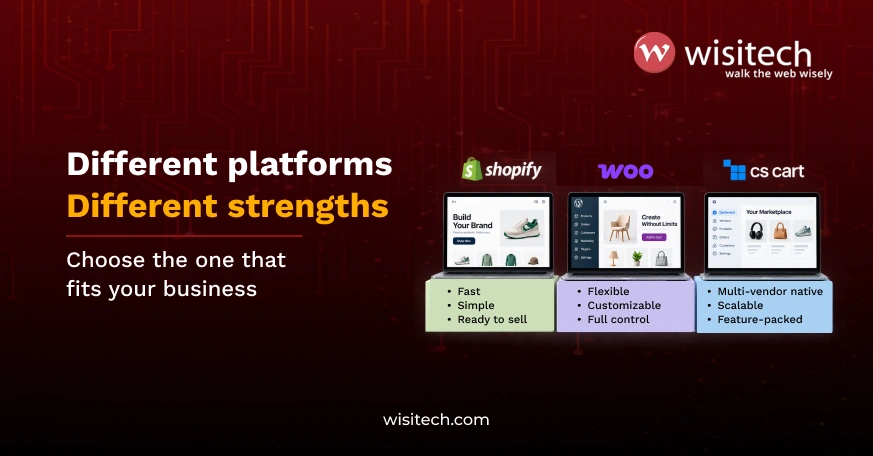
Choose Shopify when speed, simplicity, managed infrastructure, and D2C growth are your priorities.
Choose WooCommerce when content, SEO, customization, and control are central to the business.
Choose CS-Cart when marketplace, multi-vendor, or complex seller workflows are fundamental to the model.
And if none of the three fits the business without significant compromises, a custom ecommerce platform may be the better answer.
Wisitech’s ecommerce work across Shopify, WooCommerce, CS-Cart, and custom Laravel-based systems reflects exactly that approach. We do not treat the platform as the starting point. We start with the business requirements and determine what architecture makes sense.
That is ultimately what makes a platform the best ecommerce platform for small business: not how popular it is, but how well it supports the business behind the storefront.
Conclusion: Don’t buy a platform. Choose an ecommerce architecture
Shopify, WooCommerce, and CS-Cart can all power successful ecommerce businesses.
The mistake is assuming that one of them is automatically the right answer.
The right choice depends on what you sell, how customers buy, how your team operates, how complicated your catalog is, what integrations you need, and where the business is heading.
A platform decision made around those factors can save years of unnecessary redevelopment.
A platform decision made around popularity or the lowest initial quote can create years of workarounds.
If you are still deciding between Shopify, WooCommerce, and CS-Cart, the next step should not be signing a development contract.
It should be mapping your requirements and testing each platform against them.
Need help choosing your ecommerce platform?
Wisitech helps businesses choose, build, customize, migrate, and maintain ecommerce platforms based on their actual business requirements.
With 27 years of experience, 2,500+ projects, and work across 40+ countries, our ecommerce team works with Shopify, WooCommerce, CS-Cart, and custom ecommerce systems. Our approach covers platform selection, architecture, custom development, integrations, performance, migration, and ongoing support.
Our experience includes a US WooCommerce store where complex product configuration required custom development, a global Shopify storefront requiring multi-currency, multilingual functionality, and multiple payment options, and multi-vendor CS-Cart marketplaces involving seller management, commissions, inventory, shipping, and marketplace-specific workflows.
If you are unsure which platform fits your store, we can evaluate your business model, technical requirements, integrations, catalog, and growth plans before you commit to development.
Book a free consultation with Wisitech to discuss your ecommerce platform requirements.