
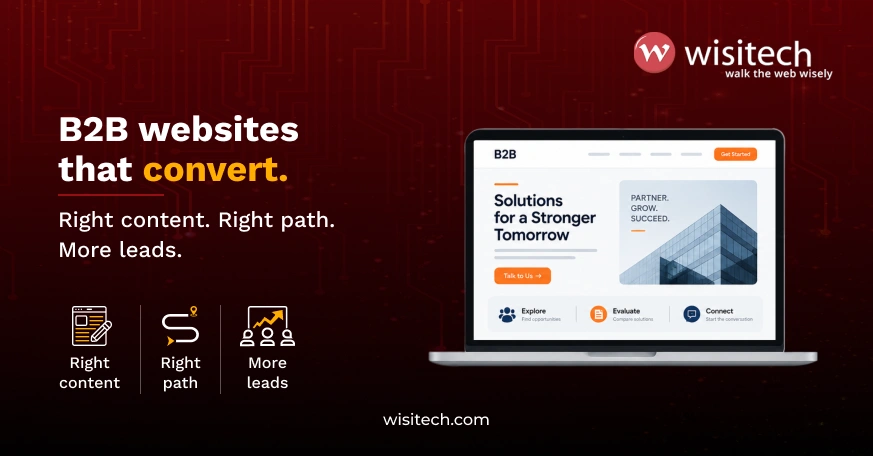
Most B2B websites generate far fewer leads than the traffic numbers suggest they should. The site looks credible, the design is clean, the copy reads fine, and the contact form still barely moves. The businesses that get this right are not doing one clever thing, and they are rarely running on the same template every competitor in their industry uses. Working with a web development company that builds around the actual buyer journey, rather than a generic layout, is usually where the difference starts. This piece breaks down what those sites actually do differently, using real project examples rather than another generic checklist.
Why most B2B websites generate almost nothing
A B2B buyer rarely converts on a first visit. They arrive, look around, leave, come back a week later from a different device, read a case study, check pricing, and eventually fill out a form, often after four or five separate sessions. A site built around a single landing page and one contact form treats every visitor as if they are ready to buy on visit one. Most are not. B2B website lead generation depends on the site serving a visitor at whatever stage they are actually in, not just the final one.
Traffic quality also matters more than most conversion advice admits. Driving the wrong visitors to a well-optimized site produces bad leads no matter how good the form is. Getting B2B website lead generation right starts with who is arriving, not just what happens once they land.
The buyer journey is not a straight line
B2B purchases involve multiple stakeholders: the person who finds the vendor, the person who has to justify the budget, and the person who has to live with the decision afterward. Each one visits the site with a different question. A homepage’s job is to act as a filter, confirming to the right buyer that they are in the right place, not to explain everything to everyone who lands on it.
Internal linking should route each type of visitor through a logical next step, from an awareness-stage blog post to a relevant service page to a case study to a contact option. Treating every page as a standalone destination, with no path forward, is one of the quieter ways B2B website lead generation efforts lose visitors who were actually interested.
Multiple conversion paths outperform a single form
Different buyers are ready for different levels of commitment. A site with only one contact form, aimed at the most committed 2 percent of visitors, leaves the other 98 percent with nowhere to go except leaving. A stronger structure offers a path matched to where a visitor actually is:
- Early research stage: a case study, a guide, or a content download that requires only an email address
- Active evaluation stage: a demo, a pricing framework, or a comparison resource
- Decision stage: a direct consultation request or a proposal request, not buried behind three extra clicks
This is where B2B website lead generation in 2026 diverges most sharply from 2020-era advice. A pricing page that shows at least a tier framework, even a rough one, converts qualified buyers at a higher rate than a page that hides pricing entirely, since buyers who cannot estimate fit simply move on to a competitor who gives them something to work with.
Service pages that read like decisions, not brochures
On a high-converting B2B site, service and solution pages read like documents built for someone about to make a decision: what the outcome looks like, what the process involves, what proof exists that it works, and a direct answer to the objection a buyer is quietly holding. Average B2B sites have pages that read like brochure summaries, and a buyer who came looking for a real answer leaves without one.
This is also where a business’s own case studies do more work than any amount of persuasive copy. A results section that says “we improve your online presence” convinces nobody. A section describing the specific problem a specific client had, and the specific system built to solve it, tells a buyer that a similar problem is not new territory for the team on the other side of the contact form.
Why templates quietly cap B2B website lead generation
A theme or page builder can produce a site that looks credible in an afternoon. What it usually cannot produce is a site structured around a specific business’s actual sales process: a filterable resource that reduces support questions before they are asked, a client portal that removes friction from an existing relationship, or a lead-routing system tied to how the sales team actually works.
This is the point where custom web development stops being a nice-to-have and starts being the thing that actually moves the number. A generic template caps what a site can do at what the template’s author anticipated. A site built by a web development company around the business’s real buyer journey has no such ceiling, since nothing was built that the business does not actually need, and nothing needed is missing because a plugin did not support it.
What a real B2B lead-gen rebuild looks like
What a real B2B website lead generation rebuild actually involves is easier to see in specific examples than in another list of best practices.
A cybersecurity and AI-driven data analytics company needed to explain sophisticated products to government, defense, and enterprise buyers who do not forgive a confusing website. The brief was explicitly a lead-generation and product-showcase build, and the finished platform covered:
- Information architecture organized around company overview, solutions, products, and target industries, rather than a generic “About / Services / Contact” structure
- EngageBay CRM integration handling lead capture, tracking, and nurturing automatically instead of leads landing in an inbox and going stale
- GA4 and Google Tag Manager tracking, so which pages actually influenced a lead was measurable, not guessed at
- A thought-leadership content hub for blogs, press releases, and media coverage, feeding the same content-driven lead generation described above
- Industry-specific pages built separately for law enforcement, defense, retail, and enterprise buyers, since a single generic page could not speak to all four credibly
The result was not just a better-looking site: the marketing team could update content five times faster than on the previous platform, which mattered as much as the lead numbers themselves, since a thought-leadership strategy that takes days to publish a single update quietly dies from its own friction.
A CEO peer group organization in Georgia engaged a development partner to build 5 websites across 2 companies, totaling more than 6,000 hours of custom programming over 3 years, specifically because a templated approach could not keep pace with how the business actually operated. The relationship holds for a reason worth naming directly: every specification submitted comes back with suggestions for a better way to do it, not just a quote for building exactly what was asked for.
A professional association for IP attorneys needed something templates could not offer at all: paid subscriptions, automated renewals, integrated accounting, a searchable, filterable attorney directory, and a full bilingual Hebrew and English experience with right-to-left text throughout. The build included a public IP education hub alongside the directory itself, turning content into part of the lead-generation system rather than a separate blog bolted onto a members-only site.
None of these three results came from a single tactic. They came from web development services scoped around the actual buyer journey, not a checklist of features assumed to be universally useful. That is the pattern worth taking from all three: B2B website lead generation improves when the build reflects a documented sales process, not when a generic list of “conversion best practices” gets applied to a site that was never structured to support them in the first place.
Content and paid traffic feeding the site
A high-converting B2B site rarely earns visits by accident. Content that answers real buyer questions can bring the right people to the site before they are ready to speak to a sales team. The best content focuses on what buyers are actually trying to understand, compare, or solve. It supports the buyer journey instead of simply being created to meet a word count.
Paid search plays a narrower but still useful role. A b2b google ads agency running Google Search campaigns around high-intent commercial terms can put a site in front of buyers when they are actively evaluating vendors. But the landing page needs to deliver what the ad promised. Sending paid traffic to a generic homepage can quickly waste the budget used to attract that visitor.
For businesses managing complex user hierarchies, web portal development services can create value beyond the initial website visit. Client dashboards, vendor portals, and self-service resource centers can make existing relationships easier to manage while creating opportunities for referrals, repeat business, and case studies. The result is another way to support B2B lead generation without relying entirely on paid traffic.
A simple audit: is your website actually built for B2B leads
Most teams already sense where their own site falls short before running a formal audit; the harder part is treating that instinct as a structural problem rather than a copywriting one. A few direct questions surface most of the gap between an average B2B site and a high-converting one:
- Does the site offer more than one way to convert, matched to different buying stages?
- Do service pages answer a buyer’s real objection, or just describe features?
- Is there at least a rough pricing framework, or does pricing require a phone call to find out?
- Does content actually address what buyers are researching, or does it exist to satisfy a publishing schedule?
- Can the marketing team update a page the same week a sales objection comes up, or does every change require a developer?
Two or more honest “no” answers point to a structural problem no amount of traffic will fix on its own.
How Wisitech approaches B2B website lead generation

As a web development company, every project starts with the business’s actual sales process and buyer journey mapped out before any page gets designed, since a site built around an assumed process rather than the real one rarely converts as well as either version planned on paper. If a template or an off-the-shelf tool would genuinely handle a business’s requirements, that gets said upfront, even when it means a smaller engagement.
Our web development services span custom Laravel applications, complex WordPress implementations, and portal and dashboard builds for businesses with the kind of account hierarchies and buyer journeys a generic template was never built to support, scoped individually because no two businesses generate leads through their site in exactly the same way. For B2B companies in the USA, that scoping starts with a direct conversation, not a generic proposal.
Ready to see what your site could be doing for lead generation? Get a free consultation and we’ll map it out together.