
Running an online store is one thing. Running one that actually fits your business, your workflows, your customers, your growth plans, is something else entirely.
CS-Cart is one of the most capable ecommerce platforms available in 2026. It ships with 500+ built-in features, supports complex product catalogs, and handles everything from single-store setups to large multi-vendor marketplaces. But here is the reality most store owners discover after going live, what the platform gives you out of the box is a solid foundation, not a finished building.
CS-Cart customization is what turns that foundation into a store that works precisely the way your business needs it to. Whether you are building from scratch or scaling an existing operation, partnering with the right CS-Cart development company ensures every feature, every workflow, and every integration is built around how your business actually runs, not how a generic template assumes it does.
This guide walks you through what that actually looks like, why it matters, and what becomes possible when you invest in building the right way.
Why CS-Cart handles customization better than most platforms
Before getting into specific benefits, it is worth understanding what makes CS-Cart structurally different, because this is the reason serious customization is possible without the headaches you get on other platforms.
Most popular ecommerce platforms lock their core code. You customize around the edges using third-party apps, many of which conflict with each other, slow your site down, or simply get discontinued. CS-Cart works very differently.
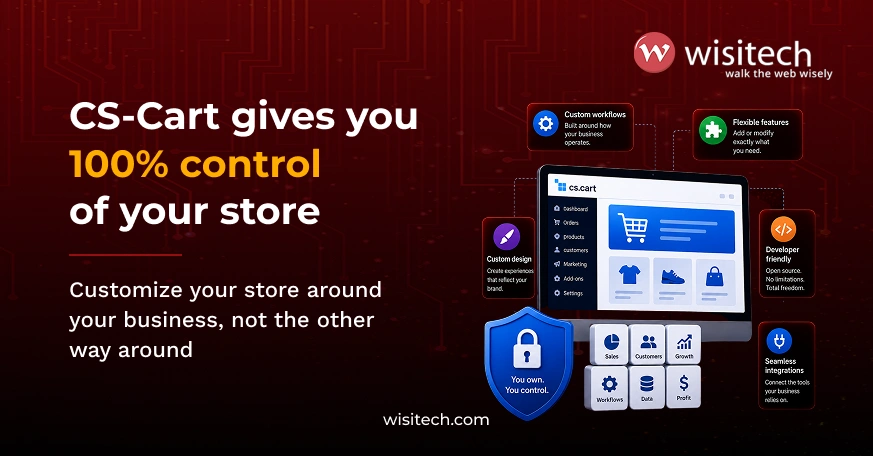
CS-Cart gives you 100% access to its source code. You own what you build. There are no locked features, no transaction fees, and no artificial plan limits forcing you to upgrade just to unlock functionality your business already needs.
How CS-Cart’s addon system works
CS-Cart is built on a modular system. Think of it like a plug socket on a wall, the wall (the platform’s core) stays exactly as it is, and you simply plug in what you need.
When a developer adds a new feature or changes how something works, they create a separate addon. This addon plugs into specific points in the platform, called hooks, to do its job. The original platform code is never touched. The addon sits in its own folder, completely separate.
Why does this matter for you?
- When CS-Cart releases an update, your custom features are not affected, they live separately from the core.
- You can switch addons on and off without breaking anything else.
- Your store stays clean, fast, and easy to maintain as it grows.
This is what update-safe development actually means. It is a very different experience from platforms where every custom tweak gets baked into files that a system update can overwrite overnight.
CS-Cart customization: adding the features your business actually needs
CS-Cart’s addon system means you can build almost any workflow directly into the platform, without creating the kind of messy, fragile code that becomes a problem later.
What this looks like for different business types
Rather than describing this in abstract terms, here is what CS-Cart customization looks like in practice:
For a B2B manufacturer selling to distributors:
- A custom pricing feature that automatically shows the correct price based on who is logged in, no manual price lists, no sales team intervention required
- A bulk order form where buyers can add dozens of products and quantities in one go, instead of clicking through individual product pages
- A quote request flow that sends enquiries to your sales team instead of processing payment immediately, useful for high-value or configurable orders
For a fashion or lifestyle retailer:
- A size guide that appears automatically on relevant product pages, and stays hidden on pages where it is not needed
- A custom returns portal built into the order detail page, so customers can start a return in two clicks instead of sending an email and waiting
For a services marketplace:
- A seller verification step has been added to the registration process, so only approved vendors can list products
- A custom onboarding checklist for new vendors, visible in their dashboard, guiding them through setup without needing support
Every one of these is built as a separate addon. None of them touch the platform’s core. All of them survive a CS-Cart version upgrade. That is the practical value of building properly.
Your CS-Cart store should work for your business, not against it Wisitech builds custom CS-Cart solutions that fit your workflows, your customers, and your growth plans.
CS-Cart theme development: design that does more than look good
Your storefront design is not just about aesthetics. It is about making it easy, and compelling for your specific customers to find what they need and complete a purchase. That is what good CS-Cart theme development delivers.
The right way to build a custom design
CS-Cart’s recommended approach is called theme cloning. Instead of editing the default theme directly, which risks losing your design work when the platform updates, developers create a copy of the theme that sits separately.
Here is how it works:
- The copied theme automatically inherits everything from the original.
- Any page or section you have customized in your copy takes priority over the original.
- When CS-Cart updates the original theme, your changes stay intact.
CS-Cart’s current default theme, Nova (launched in October 2025 with version 4.19.1), is built mobile-first. On mobile it behaves like a native app, with a navigation bar at the bottom of the screen, filters that slide in and out cleanly, and the ability to add to cart directly from the product listing page. This is your starting point.
What a custom-built theme adds on top:
- Different layouts for different product categories, a grid view for fashion, a specification-heavy layout for technical products
- A custom checkout flow, streamlined for high-volume stores, or guided step-by-step for products that need configuration before purchase
- Homepage sections that change based on customer behaviour, featured vendors, personalized recommendations, seasonal promotions, all managed through CS-Cart’s built-in layout editor
Getting your store found in AI search
Search behaviour changed significantly in 2025 and 2026. AI-powered tools like ChatGPT, Perplexity, and Google’s AI Overviews now answer shopping queries directly, without sending users to a list of links. If your store is not structured to be understood by these systems, you are invisible to a fast-growing segment of shoppers.
CS-Cart 4.20.1 (released February 2026) introduced native support for llms.txt, a simple file you place on your website that tells AI systems which pages and content are most important to your store. Think of it as a signpost for AI crawlers, helping them understand your catalog and surface it in AI-generated answers.
Beyond that file, customizing your product page templates to include structured data, clear product names, prices, specifications, and descriptions in a format search engines can read significantly increases your store’s likelihood of appearing in AI-driven product comparisons and recommendations.
Most CS-Cart stores have not done this yet. That is a genuine opportunity right now for businesses willing to move early.
CS-Cart migration: switching platforms without losing your ground
A significant number of businesses considering CS-Cart customization are not starting from scratch; they are coming from somewhere else. Magento stores that have become too expensive to maintain. WooCommerce installations that cannot keep up with catalog size or sales volume. Legacy bespoke systems that cost a fortune every time something needs changing.
Moving from another platform to CS-Cart is called a migration, and when handled properly, it is one of the smoothest transitions in ecommerce.
What a proper migration actually involves
A reliable CS-Cart development company will treat a migration as a structured project, not a rushed data transfer. Here is what that covers:
- Moving your product catalog: every product, variant, and image transferred accurately, with file paths set up correctly so nothing breaks on the new store
- Preserving customer and order history: your customer accounts, past orders, and purchase records move across intact, essential for loyalty programs, CRM tools, and customer service
- Protecting your search rankings: every URL that changes gets a redirect set up, so Google’s understanding of your store transfers to the new one without a traffic drop
- Cleaning up what never worked: a migration is the right moment to restructure product categories, fix naming inconsistencies, and remove outdated content, rather than copying problems across
- Testing before going live: everything runs in a test environment first, with a rollback plan ready, before a single change touches the live store
Upgrading between CS-Cart versions
If you are running an older version of CS-Cart, such as 4.15.x or 4.16.x – upgrading to the current 4.20.1 release is also a migration project when your store has significant customizations. Add-ons that were not built according to CS-Cart’s recommended approach may not survive an upgrade. A thorough pre-upgrade audit identifies which ones need rebuilding before the update runs, so there are no surprises on the other side.
Scaling with CS-Cart Multi-Vendor and multi-storefronts
For businesses building marketplace models or managing both retail and wholesale operations, CS-Cart’s multi-vendor and multi-storefront features are where the platform’s scalability truly shines.
Building a multi-vendor marketplace
CS-Cart Multi-Vendor is one of the most established marketplace platforms in the world in 2026, powering live marketplaces across retail, food, services, and B2B. What it gives you out of the box:
- Unlimited sellers, each with their own dashboard to manage their products, orders, and promotions
- Each seller gets their own mini-storefront within your marketplace, with their own categories, filters, and search.
- You, as the marketplace owner, get a master control panel: set commission rates, approve products before they go live, manage seller subscription plans, and monitor all transactions in one place.
- A mobile app for shoppers, available on iOS and Android
What multi-vendor marketplace development adds on top:
The out-of-the-box setup gets you a working marketplace. Custom development is what makes it your marketplace. A good company will build the specific logic your model requires, including advanced multi vendor marketplace development features such as custom seller verification workflows, commission structures that change by product category or seller tier, integrations with logistics platforms for automated shipping, and automated payout systems.
On payouts specifically, splitting payments between multiple sellers automatically requires custom development and integration with a payment processor that supports it. CS-Cart 4.20.1 expanded PayPal Complete Payments support to 30+ new countries, making it easier to implement globally than ever before. But it is still a custom build, not something that runs out of the box.
Running B2B and B2C from a single backend
CS-Cart’s multi-storefront feature lets you operate multiple, completely separate stores, each with its own web address, design, language, currency, and pricing, all managed from a single admin panel.
A practical example: a manufacturer running a consumer-facing retail store and a password-protected wholesale portal for trade customers. Both share the same product database and inventory. The retail store shows standard pricing. The wholesale portal shows bulk pricing, minimum order quantities, and is invisible to regular consumers. One backend. Two completely different buying experiences. No duplicated catalog management.
Efficiency gains through smart integrations
One of the less visible but most impactful benefits of proper CS-Cart customization is what happens to your team’s workload when your store talks to the rest of your business systems.
CS-Cart’s REST API, essentially a standardized way for different software systems to exchange data, supports clean, two-way connections with external tools. When these are built correctly:
- Stock management: your inventory levels update in CS-Cart automatically as warehouse movements happen, no more manual stock adjustments or overselling
- Accounting: orders trigger invoices in your accounting software automatically, no data entry, no delays
- CRM and marketing: every new order pushes customer data into your CRM instantly, enabling automated follow-up emails, loyalty triggers, and customer segmentation without anyone lifting a finger
- ERP systems: for manufacturers and distributors, CS-Cart can feed order and product data directly into your ERP, so everything stays synchronized across your business
The result is a smaller margin for human error, faster order fulfillment, and a team that spends its time growing the business rather than manually moving data between systems.
What to look for in a CS-Cart development partner
Understanding what CS-Cart customization makes possible is the first step. Finding a partner who can execute it properly is the next, and arguably more important, one.
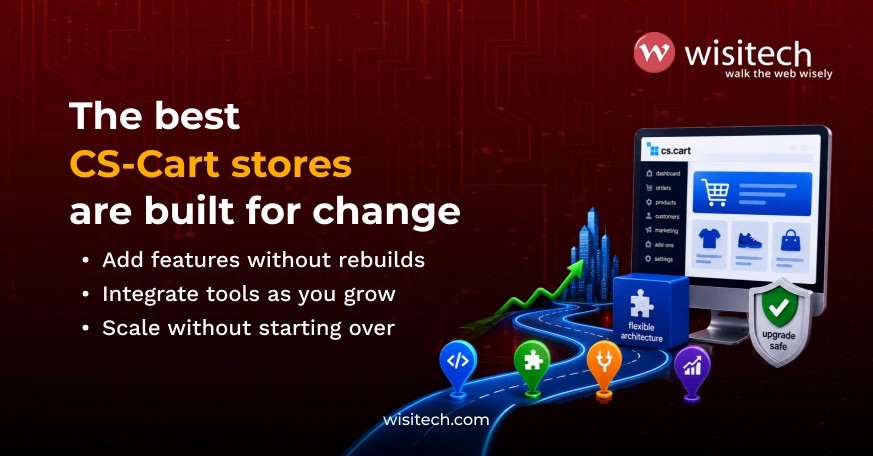
The reason this matters, technically: CS-Cart’s add-on system stays clean and up-to-date only if developers follow the platform’s proper conventions. Building directly into core files instead of using separate addons, for example, works until the next platform update, then it breaks. That kind of technical shortcut creates problems that cost significantly more to fix than they saved to create.
Ready to build a CS-Cart store that grows with your business?With 27+ years of experience and 2,500+ projects delivered, Wisitech turns CS-Cart into a platform built around you.
When you work with a CS-Cart development company that builds correctly:
- Your custom features are automatically updated with every platform update.
- New addons do not interfere with existing ones.
- Your store remains straightforward to maintain and audit as it grows.
- You do not accumulate hidden technical problems that surface at the worst possible moments.
When evaluating a CS-Cart development company, look for:
- Developers who build using CS-Cart’s addon and hook system, not direct core edits
- A staging environment as standard practice, all changes tested before touching the live store
- Experience across the full CS-Cart project lifecycle: new builds, migrations, version upgrades, and ongoing maintenance
- Transparent communication about what requires custom development versus what the platform handles out of the box
Why Wisitech
With 27+ years in digital commerce and 2,500+ projects delivered, Wisitech brings the technical depth and the business understanding to make CS-Cart work for you. Our CS-Cart development services cover the complete project lifecycle:
- Custom addon development using CS-Cart’s proper hook architecture
- CS-Cart theme development is built on the Nova cloning workflow
- Platform migrations and version upgrades
- Multi-vendor marketplace builds
- Third-party integrations and API connections
- Ongoing maintenance, security, and performance work
We do not just write code. We align what we build with where your business is heading.
Ready to build a CS-Cart store that works on your terms?
CS-Cart customization is not a luxury reserved for large enterprises. It is the right decision for any business that has outgrown the limitations of a generic ecommerce setup or wants to make sure they never reach those limitations in the first place.
Whether you are starting fresh on CS-Cart, moving from another platform, expanding into a multi-vendor marketplace, or upgrading to the latest version from an older release, the quality of your development partner determines the quality of your outcome.
Talk to the Wisitech team. We will give you an honest assessment of what your store needs, and build it properly.