

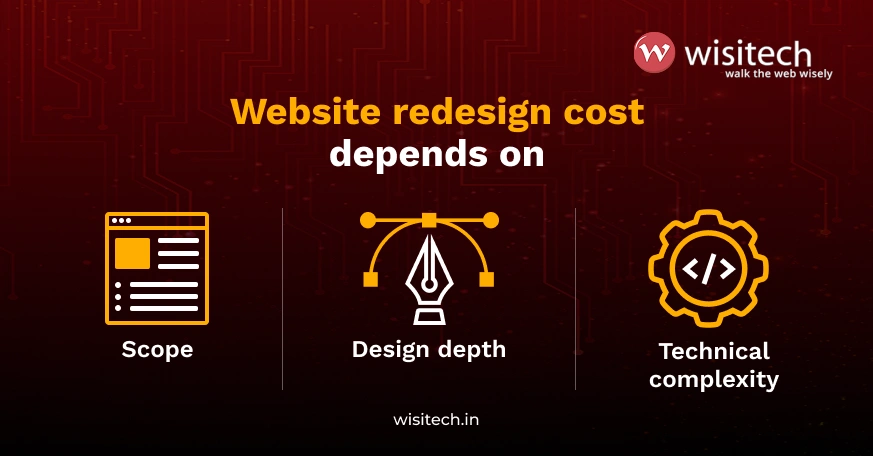
A website redesign in the US can cost anywhere from $300 to $250,000, and the gap between those numbers has almost nothing to do with negotiation and everything to do with what “redesign” actually includes. A $300 job swaps a template. A $35,000 job rebuilds your information architecture around how real visitors behave, tests it, and hands off a design system your developers can build against without guesswork.
This guide breaks down website redesign cost in 2026 using pricing tiers we actually work from, not numbers pulled from a rate-card PDF. You will see what drives the cost up or down, what each budget level realistically buys you, and where real pricing sits so you have a concrete anchor instead of a guess.
What actually determines website redesign cost in 2026
Before you can evaluate any quote, you need to understand what you are paying for. Four factors move the number more than anything else:
Page count and complexity. A five-page consultancy site and a 200-page e-commerce catalog are not the same job, even if both are called a “redesign.” Every unique template needs its own design pass, responsive testing, and QA cycle.
Design approach. A theme-based refresh is faster and cheaper than a custom design built from research and user testing. Custom design costs more upfront but tends to convert better because every decision is backed by data instead of a stock template’s assumptions.
Technical scope. Are you only changing the look, or are you rebuilding navigation, migrating to a new CMS, adding e-commerce functionality, or fixing Core Web Vitals issues along the way? Technical scope, not visual scope, is usually what pushes website redesign cost in 2026 from the low end to the high end.
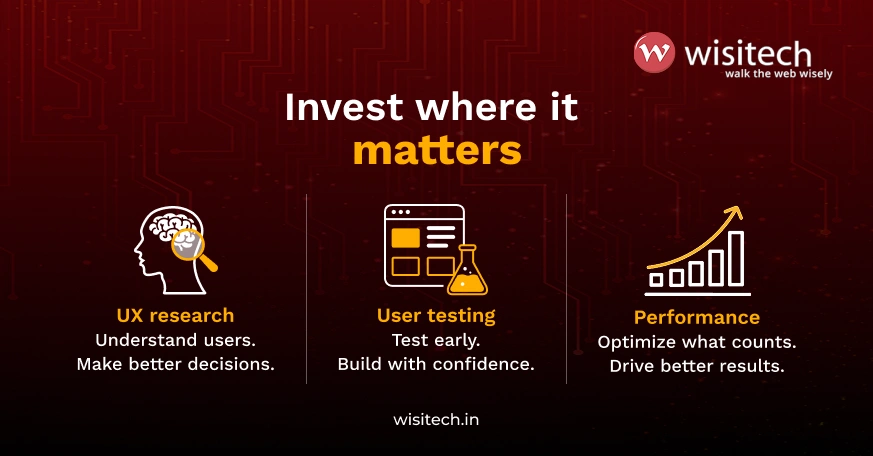
Research and testing depth. A redesign built on user research, usability testing, and behavioral data costs more than one built on opinion. It also tends to outperform it. This is the single biggest difference between a $10,000 redesign and a $12,000 one that actually moves your conversion rate.
What a UI UX design company charges for a redesign (the starting point)
Rather than quote you an industry-wide range that tells you nothing about your specific project, here is where pricing from a working UX design agency actually starts. These are the real entry points our UX/UI design team works from, not marketing numbers designed to look impressive in a table.
UX audit and discovery: starting at $2,500–$8,000
If you are not sure a full redesign is even the right move, this is where to start. A scoped discovery brief begins at $2,500. A full UX audit services package, including heatmap analysis, session recording review, conversion funnel mapping, and an accessibility scan, runs $3,000 to $8,000 and takes one to two weeks. You leave with a prioritized list of what is actually broken before a single wireframe gets drawn.
Website or app redesign: starting at $12,000
This is where most website redesign cost in 2026 conversations land. A full website or app redesign at this tier starts at $12,000 and typically runs through $35,000 depending on page count, custom functionality, and CMS complexity. The engagement includes information architecture, wireframing, interactive prototyping, usability testing, UI design, and a fully annotated developer handoff. Most projects are delivered in four to eight weeks.
Full product design with research and testing: $25,000 and up
For SaaS platforms, complex e-commerce builds, or businesses that need ongoing user research baked into the process, full engagements start at $25,000 and can extend past $100,000 depending on scope. This tier includes everything in the redesign package plus dedicated user research, multiple testing rounds, and design system documentation for engineering teams to build against.
We’ve priced this tier at $25,000 and up because that’s roughly the point where skipping user research stops being a shortcut and starts being expensive. Across 27 years and more than 2,500 delivered projects as a UI UX design company, we’ve seen that redesigns which skip testing are almost always the ones that need a second redesign within a year, once real usage data shows the assumptions were wrong. The extra cost at this tier buys the testing rounds that catch that before launch, not after.
Average website redesign cost in 2026 across the US market
Zoom out to the broader US market and the picture is wider, because it includes everyone from solo freelancers to enterprise agencies. Here is roughly where the market sits by segment:
| Business size | Typical range | What it usually includes |
| DIY / template-based | $300–$2,000 | Pre-built theme, minor customization, no custom UX work |
| Small business | $3,000–$15,000 | Template customization or light custom design, 5–20 pages |
| Mid-market business | $15,000–$80,000 | Custom design, UX research, CMS work, 20–75 pages |
| Enterprise | $80,000–$250,000+ | Full custom build, complex integrations, multi-stakeholder review |
Notice that this redesign tier starting at $12,000 sits at the upper end of the small business bracket and the entry point of mid-market work, which is intentional. It is priced for businesses that need a custom, research-backed outcome rather than a template swap, without paying enterprise-level fees for a mid-sized project.
Small business website redesign cost in 2026
If you run a small business, the range that matters most to you is $3,000 to $15,000. Within that bracket, the difference between the low and high end usually comes down to one thing: whether the redesign is based on a template or built around your actual users.
A small business website redesign cost at the lower end typically buys you a customized template with basic branding applied. At the higher end, closer to where full UX design agency engagements begin, you are paying for a team to actually study how your visitors behave before changing anything. That distinction matters more than it sounds, because a redesign that ignores user behavior tends to need a second redesign within eighteen months.
E-commerce, SaaS, and WordPress: cost by platform
Website redesign cost in 2026 varies significantly by platform, because each comes with its own technical baggage.
E-commerce redesigns run $15,000 to $50,000 or higher, driven by product catalog size, payment gateway integrations, and checkout flow optimization. Ecommerce UX design work in particular has an outsized effect on revenue here: a redesigned checkout flow, better product page hierarchy, and mobile cart optimization routinely deliver measurable conversion gains that a purely visual refresh never touches.
SaaS product redesigns tend to start around $25,000 because they involve dashboard architecture, onboarding flow design, and multi-user permission structures that a marketing site never has to account for. This is squarely saas UX design services territory, and it is one of the highest-value categories in this guide because a confusing SaaS dashboard directly drives support tickets and churn.
WordPress redesigns are generally the most cost-flexible, ranging from $5,000 for a theme-based refresh to $40,000+ for a fully custom build with a headless front end. The CMS itself is rarely the cost driver; the number of custom page templates and plugin integrations is.
Website redesign cost breakdown: where the money actually goes
A useful way to sanity-check any quote is to break it into its components. Here is roughly how a $20,000 mid-tier redesign gets allocated:
- Discovery and UX research (15–20%): stakeholder interviews, competitor benchmarking, user research
- Information architecture and wireframing (15%): sitemap, user flows, low and high-fidelity wireframes
- UI design (25–30%): visual design system, component library, responsive layouts
- Development and CMS build (25–30%): front-end and back-end implementation, CMS configuration
- Testing and QA (10%): usability testing, cross-device testing, accessibility checks
- Content migration and launch (5–10%): copy placement, redirects, final SEO checks
If a quote skips discovery and testing entirely and goes straight from a kickoff call to a Figma file, that is usually a sign you are buying a visual refresh, not a redesign that will actually change performance.
Redesign or rebuild: getting this decision wrong is the expensive mistake
Before you commit to a number, make sure you are solving the right problem. A redesign refreshes the front-end experience on your existing foundation. A rebuild replaces the underlying architecture, CMS, or tech stack entirely.
Choose a redesign if your site converts reasonably well but looks dated, loads slowly on mobile, or has a navigation structure that confuses new visitors. Choose a rebuild if your current CMS cannot support new functionality, your technical debt is slowing every future update, or you are fundamentally changing your business model (adding e-commerce, launching a SaaS product, and so on).
Getting this wrong is where website redesign cost in 2026 budgets blow past their original scope. A business that budgets $15,000 for what turns out to be a rebuild will either run out of money mid-project or ship a redesign bolted onto a foundation that cannot support it.
Hidden costs most agencies do not mention upfront
A handful of costs consistently get left out of the initial quote and then show up as change orders later:
SEO migration risk. Redesigning URLs, navigation, or content structure without a redirect and metadata plan can tank organic rankings that took years to build. This should be included in the base scope, not billed as an add-on discovered mid-project.
Content and copywriting. Most agencies price the design and development, then discover the client expected them to write the copy too. Budget $100–$300 per page if new copy is needed.
Photography and custom graphics. Stock imagery is free to license but rarely fits a brand precisely. Custom photography runs $3,000–$15,000 depending on scope.
Post-launch support. A redesign is not finished at launch. Most digital products need ongoing design attention, whether that is A/B testing, responsive fixes for new devices, or feature expansion, as user expectations shift.
Ask any agency you are evaluating whether these are included before you compare their number to any other quote you receive.
How to get an accurate website redesign cost in 2026 for your project
Generic ranges are useful for setting expectations, but the only number that matters is the one scoped to your actual site, your actual page count, and your actual goals. That requires a real conversation, not a calculator.
If you are ready to move past research mode, here is what that process typically looks like:
- A scoped discovery call to understand your current site, your goals, and whether you need a redesign or a rebuild
- A fixed-price estimate within 48 hours, broken down by phase, not billed hourly with open-ended surprises
- A UX audit first, if needed, so your redesign is based on data about how your actual visitors behave, not assumptions
Whether you want to hire a UX designer for a single audit or bring in a full UI UX design company for an end-to-end redesign, our UX/UI design services scopes every engagement around a fixed price before work begins, so the number you agree to at the start is the number you pay at the end.
The bottom line on website redesign cost in 2026
There is no single honest answer to “how much does a website redesign cost.” It depends on your business size, your platform, and how much real user research goes into the work versus guesswork. For most small and mid-market businesses, website redesign cost in 2026 lands between $12,000 and $35,000 for a redesign built on real data.
Why Wisitech
Wisitech has delivered 2,500+ UX/UI projects across 40+ countries over 27 years. That’s why these numbers hold up: they come from doing this work at scale, not from guessing what sounds reasonable.
Here’s what you actually get: Fortune 500-level process at small business pricing, NDA-ready confidentiality, on-time delivery, and a full design team instead of one freelancer stretched across five projects.
If you want a number scoped to your actual site, get in touch with Wisitech’s UX/UI design team for a free consultation and a fixed-price estimate within 48 hours.