
Choosing a CMS is easy when you are building a simple website.
It becomes much harder when that website starts becoming part of how the business operates.
That distinction comes from what we have seen across 27 years of web development and more than 2,500 projects. Businesses rarely run into problems because their CMS could not create a page. They run into problems when the website needs to handle requirements that were never considered when the platform was chosen.
A website that starts with 20 pages may eventually need hundreds of pages, CRM integrations, ecommerce, custom forms, multiple locations, multilingual content, membership functionality, custom APIs, or multiple websites managed together.
That is the perspective we bring to WordPress vs Webflow vs Squarespace.
Rather than asking which CMS has the most features, we look at which platform gives the business enough room to handle what comes next.
The real CMS question is about architecture
Most CMS comparisons focus on templates, pricing, SEO tools, and ease of use.
Those things matter.
But when we evaluate a website, we ask a different question:
What will this website need to do two or three years from now?
That question has changed how we approach platform selection.
A small consultancy with ten pages has very different requirements from a growing business with multiple locations, hundreds of content pages, complex lead routing, ecommerce, and several external systems.
Both may be looking for a “business website.”
They are not solving the same problem.
Our experience has also shown us that businesses rarely outgrow a CMS because of one missing feature. They outgrow it because multiple requirements begin interacting with each other.
A CRM integration affects lead forms.
Lead forms affect workflows.
Content structures affect SEO.
Templates affect publishing.
Plugins affect performance.
And suddenly, the website is no longer just a website.
It has become a system.
| Requirement | WordPress | Webflow | Squarespace |
| Initial setup | Moderate | Easy to moderate | Easy |
| Design control | Very high | Very high | High |
| Content flexibility | Very high | High | High |
| Custom functionality | Excellent | Moderate to high | Moderate |
| SEO control | Very high | High | High |
| Integrations | Extensive | Strong | Strong for common needs |
| Multisite | Strong | More limited | More limited |
| Maintenance | Higher | Lower | Lower |
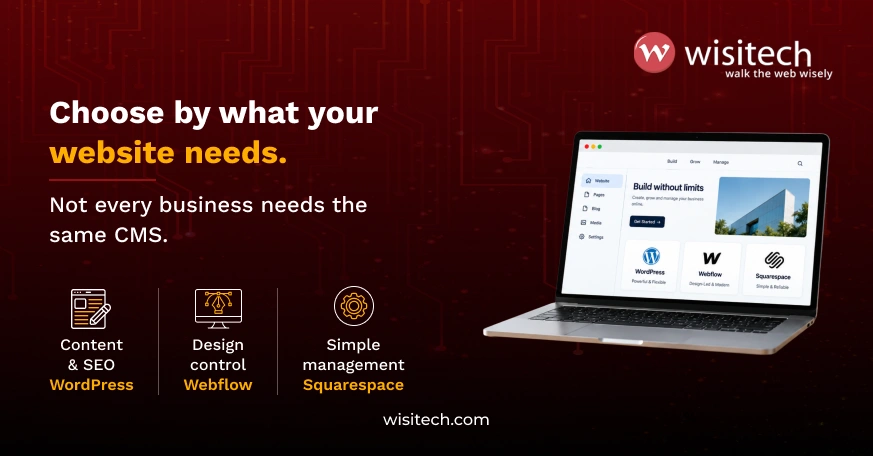
| Best suited to | Complex, evolving websites | Design-led marketing sites | Simpler business websites |
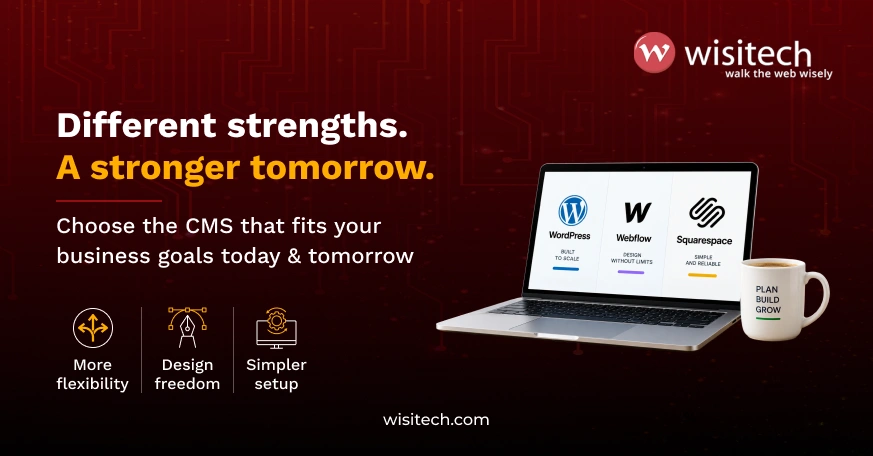
The important point is that none of these platforms is automatically the right answer.
They make different tradeoffs.
Webflow and Squarespace can reduce technical complexity.
WordPress provides more room for customization, but that flexibility also requires stronger architecture and ongoing maintenance.
WordPress vs Webflow: when control starts to matter
The WordPress vs Webflow comparison often comes down to visual development versus extensibility.
Webflow is attractive for businesses that want strong visual control and a managed website environment. For a design-led marketing website with relatively controlled requirements, it can be an excellent choice.
Our recommendation changes when the website needs increasingly specialized business logic.
Consider a lead-generation website.
A basic contact form is simple.
Now imagine the business needs to collect different information from different users, route leads based on specific conditions, synchronize that information with a CRM, trigger marketing automation, and provide different reporting to different teams.
The challenge is no longer creating the form.
The challenge is designing what happens around it.
This is where custom wordpress development can become valuable.
WordPress gives developers a broader environment in which to build custom functionality, APIs, content structures, integrations, and workflows.
When Webflow makes sense
We would consider Webflow when:
- Design is central to the project.
- The website is primarily marketing-focused.
- Content structures are relatively controlled.
- Integrations are straightforward.
- The business wants a more managed environment.
When WordPress makes more sense
We lean toward WordPress when the website requires:
- Complex integrations
- Custom workflows
- Advanced ecommerce
- Custom APIs
- Membership functionality
- Specialized content structures
- Multiple websites
- Custom plugins
- Advanced lead-routing logic
The decision is therefore less about which platform is “better” and more about how much architectural freedom the business needs.
WordPress vs Squarespace: simplicity versus flexibility
The WordPress vs Squarespace comparison is especially relevant to small and midsize businesses.
Squarespace can be a sensible choice when a company needs a polished website, standard content, basic lead generation, and minimal technical involvement.
We would not recommend WordPress simply because it has more capabilities.
If a business does not need those capabilities, the additional complexity may not be worthwhile.
The situation changes when the website starts growing.
A company might begin with a few service pages and later need location pages, resource content, CRM integration, customer accounts, ecommerce, or specialized publishing workflows.
That is where a platform’s underlying flexibility starts to matter.
Custom WordPress website development allows the website structure to be designed around those requirements rather than forcing every new requirement into an existing template structure.
Webflow vs Squarespace: the design-led choice
The Webflow vs Squarespace decision is generally more straightforward.
Both can support professional marketing websites, but they appeal to different working styles.
Webflow is attractive when designers need detailed control over layouts, interactions, and responsive experiences.
Squarespace is attractive when the business wants to launch and manage a polished website with less technical involvement.
For either platform, we would ask:
Who will manage the website, how frequently will it change, and how complicated is the next version likely to become?
Those answers matter more than comparing template galleries.
What our portfolio has taught us about WordPress
This is where our experience differs from a typical CMS comparison.
Across our portfolio, we have worked on websites where the visible interface was only one layer of a much larger system.
A visitor might see a form, but behind it could be CRM synchronization, routing logic, validation, automation, notifications, and reporting.
A visitor might see a product page, while behind it sits ecommerce functionality, integrations, account management, and marketing workflows.
A visitor might see a location page, while the business needs a structured system capable of managing hundreds of similar pages consistently.
These projects taught us a simple lesson:
The complexity of a website is not determined by how complicated it looks.
It is determined by what has to happen behind it.
Plugins are not architecture
WordPress’s plugin ecosystem is powerful.
It can also become a problem when every new requirement results in another plugin.
We have seen how quickly a website can become difficult to maintain when plugins overlap, create conflicts, add unnecessary scripts, or become dependencies for critical functionality.
Our approach is not to avoid plugins.
It is to use them deliberately.
When a requirement is standard, an established plugin can be the right solution.
When a requirement is central to the business, WordPress plugin development may be a better long-term approach.
The difference is architectural judgment.
The theme should not contain everything
Another principle we follow is separating the website’s presentation from its business logic.
A business may redesign its website several times.
The underlying functionality should not have to be rebuilt simply because the visual layer changed.
That is why custom WordPress theme development needs to be approached differently from modifying a generic template.
The theme should handle presentation.
Business-specific functionality should have an appropriate architectural foundation.
That makes future redesigns and upgrades easier.
SEO: the CMS does not create the strategy
The WordPress vs Squarespace seo and WordPress vs Webflow seo debates are often oversimplified.
All three platforms can support the fundamental requirements of SEO.
The difference becomes more important when SEO architecture becomes complicated.
A larger website may require:
- Custom content types
- Specialized templates
- Structured data
- Advanced internal linking
- Programmatic metadata
- Complex taxonomies
- Large-scale redirects
- Location-based content
- Custom publishing workflows
Our experience has taught us that SEO should be considered during architecture, not added after development.
Content structure affects SEO.
URL structure affects SEO.
Templates affect SEO.
Internal linking affects SEO.
Performance affects SEO.
That is one reason WordPress can be attractive for businesses where organic search is expected to become a major acquisition channel.
The CMS does not rank the website.
It determines how much control the team has over the environment in which the SEO strategy is implemented.
WordPress vs Squarespace pricing: look beyond the subscription
The wordpress vs squarespace pricing comparison can also be misleading.
Comparing monthly subscriptions tells only part of the story.
We prefer to think about total website cost:
Platform + development + integrations + maintenance + content operations + future changes
WordPress software is open source, but a professional implementation can involve hosting, development, custom functionality, security, plugins, integrations, performance work, and ongoing maintenance.
That does not automatically make it more expensive.
It means the cost structure is different.
A low-cost website that needs a major rebuild after two years may cost more than a carefully planned website that was designed to accommodate growth.
The right question is therefore not:
“Which CMS costs less?”
It is:
“Which CMS is likely to cost less for what we actually need to build?”
What is the best CMS for a small business?
There is no universal best CMS for small business.
A small business with ten pages and straightforward requirements may be perfectly served by Squarespace.
A design-focused marketing business may prefer Webflow.
A small company with complex integrations, ecommerce, multiple locations, or a rapidly expanding content operation may still benefit from WordPress.
We recommend looking at the business requirements first.
If simplicity is the priority, choose the platform that minimizes unnecessary technical work.
If flexibility is the priority, choose the platform that gives the development team enough control to build what the business actually needs.
When a redesign should become an architectural rebuild
One of the most important lessons from our portfolio is that redesigning the interface does not necessarily fix the website.
We have encountered websites where the visible problems were only symptoms.
The deeper issues were:
- Poor content architecture
- Excessive plugins
- Difficult integrations
- Outdated code
- Inconsistent templates
- Performance bottlenecks
- Fragile dependencies
In those cases, changing the design alone would simply create a better-looking version of the same problem.
A wordpress website redesign should therefore begin by asking whether the underlying architecture still makes sense.
What should stay?
What should be rebuilt?
What should be removed?
What should be automated?
What should the marketing team control?
Those questions should come before choosing the new visual design.
Why we often recommend WordPress for complex businesses
After 27 years of web development, our preference for WordPress in complex projects is not based on popularity.
It comes from seeing what happens when requirements grow.
WordPress gives teams room to build:
- Custom functionality
- Complex integrations
- Advanced content structures
- Ecommerce experiences
- Multisite environments
- Custom APIs
- Specialized publishing systems
- Custom themes and plugins
- Advanced SEO architectures
That flexibility is particularly useful for organizations considering enterprise wordpress development or businesses whose websites are becoming central to marketing, sales, ecommerce, or operations.
But there is an important caveat.
WordPress flexibility does not replace good engineering.
It makes good engineering more important.
A poorly planned WordPress website can become a collection of plugins and workarounds.
A properly architected WordPress website can become a flexible digital foundation.
The CMS provides the possibilities. The architecture determines whether those possibilities become an advantage or a problem.
What we would ask before choosing a CMS
Before recommending WordPress, Webflow, or Squarespace, we would ask:
How important is the website to revenue?
Is it a brochure, a lead-generation engine, an ecommerce channel, or part of the company’s operations?
How complicated will the content become?
Ten pages and 1,000 structured pages require very different approaches.
What systems need to connect to it?
CRM, ERP, marketing automation, analytics, payment systems, or internal applications?
Who will manage the website?
Marketing, developers, content teams, an agency, or some combination?
What is likely to change over the next three years?
This may be the most important question of all.
Because the biggest CMS mistake is not choosing the wrong platform for today’s website.
It is choosing a platform that makes tomorrow’s website unnecessarily difficult.
Final verdict
The WordPress vs Webflow vs Squarespace decision should not be reduced to a winner.
Choose Squarespace when simplicity and minimal technical involvement are the priority.
Choose Webflow when visual control and a design-led workflow are central to the project.
Choose WordPress when the website needs extensive customization, complex integrations, advanced content structures, ecommerce flexibility, or room to evolve.
Our strongest advice is to stop thinking about the website you are launching and start thinking about the website your business is likely to need next.
Because after years of building digital platforms, this is what we have learned:
The easiest CMS today is not necessarily the easiest CMS to live with tomorrow.
And when the website becomes a serious business system, the freedom to build around the business can matter more than the convenience of staying inside a predefined structure.
Need WordPress development built around your business?
Wisitech has 27 years of web development experience, with more than 2,500 projects delivered across 40+ countries.
Our WordPress work covers complex implementations, custom functionality, ecommerce, integrations, multilingual websites, multisite environments, redesigns, performance optimization, and ongoing support.
We approach projects from the business requirements backward.
That means considering strategy, UX, content architecture, SEO, integrations, performance, scalability, and maintenance before deciding how the website should be built.
For businesses that need more than a standard template, wordpress development company experience matters because the biggest decisions often happen before development begins.