
If you are a founder in the US, the first MVP question is usually simple: how much will it cost to turn the idea into something real? The harder question is what you are actually paying for. Two products can both be called an MVP while having completely different technical requirements, user flows, integrations, security needs, and delivery timelines.
That is why MVP development cost in USA cannot be reduced to a single hourly rate or a generic price-per-feature formula. A focused SaaS product, a two-sided marketplace, and a complex B2B application can require very different levels of engineering and product work.
For startups planning a pre-seed or seed round, the goal should not be the cheapest possible build. It should be the smallest reliable product that can generate evidence about demand without creating avoidable technical debt.
What does MVP development cost in USA look like in 2026?
For a practical planning range, Wisitech currently prices startup MVP engagements according to scope and complexity. A simple SaaS MVP such as a CRM, dashboard, or focused business tool is typically in the $18,000 to $28,000 range. A standard marketplace or platform is typically $28,000 to $45,000. A complex B2B application can fall in the $45,000 to $65,000 range.
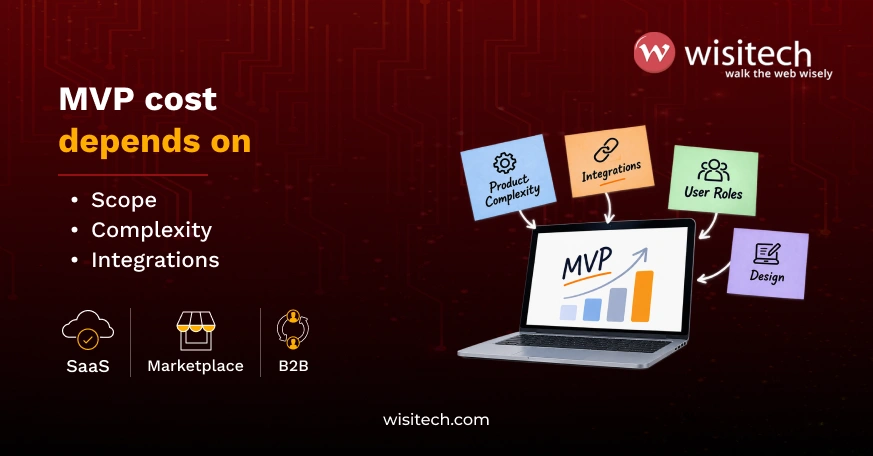
These are planning ranges, not a universal price list. The final MVP development cost in USA depends on the product’s workflows, integrations, user roles, data model, design requirements, infrastructure, and validation goals.
| MVP type | Typical scope | Indicative cost | Typical timeline |
| Simple SaaS MVP | CRM, dashboard, focused business tool | $18K-$28K | 6-8 weeks |
| Marketplace/platform | Two-sided workflows, matching, vendor or buyer logic | $28K-$45K | 8-10 weeks |
| Complex B2B application | Multi-tenant workflows, integrations, advanced permissions | $45K-$65K | 10-14 weeks |
Why MVP pricing varies so much
The biggest mistake founders make is counting screens instead of systems. Ten simple screens can be easier to build than five screens connected to complex business rules.
1. Product complexity
A dashboard that displays information is relatively straightforward. A platform that calculates pricing, manages multiple user types, handles approvals, sends notifications, records transactions, and synchronizes data across systems requires much more engineering.
This is where MVP development services should begin with product discovery rather than jumping directly into development. The team needs to identify the smallest set of workflows that can test the business assumption.
2. Integrations
Payment gateways, CRMs, analytics platforms, email services, identity providers, shipping systems, and third-party APIs can change both the architecture and timeline. An integration is rarely just a button on the front end. It can involve authentication, webhooks, error handling, data mapping, retries, logging, and security.
For that reason, founders comparing an MVP development company should ask which integrations are genuinely necessary for validation and which can wait until after launch.
3. User roles and permissions
A product with one user type is different from a product with customers, vendors, administrators, managers, and support teams. Every additional role can introduce permissions, dashboards, workflows, and edge cases.
4. Product design
Good MVP design is not about making a product look expensive. It is about reducing friction around the behavior you are trying to validate. Wireframes, clickable prototypes, usability checks, and focused user flows can prevent expensive development mistakes before engineering starts.
The cheapest MVP is not always the lowest-cost MVP
A low initial quote can become expensive when the first build has to be rebuilt after launch. Poorly structured code, undocumented decisions, weak authentication, tightly coupled modules, and missing analytics can make iteration harder precisely when the startup needs to move fastest.
The better target is controlled scope with an architecture that can support the next stage. This does not mean building every future feature today. It means making sensible technical decisions around the core product.
In practice, this is one of the most important differences between a budget freelancer and a mature MVP development agency. The latter should be able to explain what belongs in version one, what should wait, and why.
What startups are actually paying an MVP team to do
When a startup hires an MVP software development company, it is paying for more than coding. A strong engagement can include product discovery, technical feasibility, UX/UI design, architecture, engineering, quality assurance, deployment, analytics, documentation, and post-launch iteration.
A startup software development company should also reduce the amount of engineering management the founder has to perform. Structured sprints, reviews, documentation, and clear ownership allow founders to spend more time on users, fundraising, partnerships, and go-to-market work.
What Wisitech’s Project Experience Teaches About MVP Scope
Wisitech’s experience across marketplaces, web applications, ecommerce platforms, and internal business systems shows an important reality of product development: the visible interface is often only a small part of the actual product. The complexity usually sits in the workflows, data relationships, permissions, integrations, and business rules behind it.
Building a Multi-Seller Marketplace
Wisitech has developed a multi-seller marketplace with complex relationships between sellers, products, users, and administrative operations. The key lesson for an MVP is that a marketplace does not need every possible feature at launch. The first version should focus on the core transaction or interaction that proves the marketplace model, while secondary seller tools, advanced automation, and additional workflows can follow as usage grows.
Developing a Healthcare Web Application
Wisitech has also worked on a specialized healthcare web application where user-facing workflows and structured information had to work together. For an MVP, this highlights why product design and data architecture cannot be treated as separate concerns. The interface needs to make the primary user journey clear, while the underlying structure should support secure data handling and future product iterations.
Creating an Internal Research Platform
Another Wisitech project involved an internal research organization where access control, information organization, and operational workflows were central to the platform. The lesson for MVP development is straightforward: functionality should be prioritized according to business value, not visual complexity. A well-defined workflow that solves a real operational problem can be more valuable than a product packed with secondary features.
These projects reinforce a common principle: successful MVP development starts by identifying the functionality that must work exceptionally well for the product to prove its business case. Everything else can be evaluated against that objective.
MVP development timeline: what happens in 6 to 10 weeks
A realistic MVP development timeline depends on scope, but a focused SaaS MVP can often be planned across four stages.
Week 1: Discovery and scope
The team aligns on the founder’s vision, target users, core workflows, feature priorities, technical feasibility, and the validation question. The output is a defined MVP scope and roadmap.
Weeks 2-3: UI/UX and prototype
Wireframes and clickable flows are created and reviewed before the full build. This is where usability assumptions can be tested early and unnecessary features can be removed.
Weeks 3-8: Agile development and QA
Engineering focuses on the prioritized workflows, secure authentication, user management, integrations, and quality assurance. AI-assisted development can compress repetitive implementation and testing cycles, but it does not replace product decisions or engineering review.
Weeks 8-10: Launch and validation
The product is deployed, analytics and tracking are connected, performance is checked, and early feedback is used to create the next iteration roadmap.
More complex products can take longer. A marketplace MVP may require 8 to 10 weeks, while a complex B2B platform with multiple integrations can take 10 to 14 weeks or more.
How to hire an MVP developer without creating unnecessary risk
If you are deciding whether to hire an MVP developer directly or work with a full team, evaluate the delivery model rather than the job title alone.
A single developer can be a good fit for a narrowly defined product with limited dependencies. A team becomes more useful when the product requires UX, backend architecture, frontend development, QA, deployment, analytics, or multiple integrations.
Before you hire, ask for evidence of shipped products, not only design mockups. Clarify who owns the intellectual property, how changes are handled, how the team communicates across time zones, what happens after launch, and whether the architecture is documented.
MVP development outsourcing: when it makes sense
MVP development outsourcing can make sense when the startup needs experienced engineering capacity without building an internal team before product-market validation. The key is choosing a delivery partner with a structured process rather than treating outsourcing as a way to buy the cheapest possible development hours.
For US founders, a distributed team can work well when communication, project coordination, documentation, sprint reviews, and service-level expectations are clearly defined.
Prototype vs MVP: they answer different questions
A prototype helps validate a concept, interface, or user flow. It can answer, “Does this experience make sense?” An MVP is a production product used by real users. It can answer a harder question: “Will people actually use or pay for this?”
If the business assumption is still unclear, a proof of concept or clickable prototype may be a better first investment. Wisitech’s current approach includes a Proof of Concept Sprint that can produce a clickable prototype in roughly 2 to 3 weeks.
Can an MVP be investor-ready?
Yes, but investor readiness should be considered during product planning rather than added at the last minute. A useful investor-ready MVP can include a live demo, user analytics, technical architecture documentation, a scalability roadmap, and a recorded walkthrough.
The important point is that investors do not need a product with every possible feature. They need credible evidence that the team understands the problem, can execute, and is learning from real usage.
How to control MVP development cost in USA without cutting the wrong things
The smartest way to manage MVP development cost in USA is to reduce unnecessary scope while protecting the parts that create evidence.
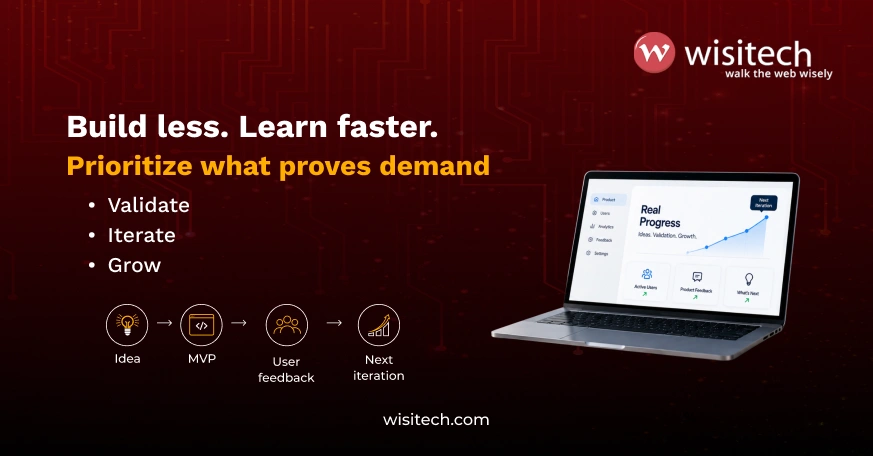
Start by defining the single business hypothesis the product must test. Then identify the smallest user journey that can produce meaningful data. Remove secondary dashboards, complex settings, automation that can initially be handled manually, and features that do not affect the validation question.
At the same time, do not remove security, basic analytics, error handling, documentation, or architectural discipline simply because they are less visible. Those are the foundations that make the next iteration faster.
Why the MVP partner matters as much as the price
The right MVP development company should challenge the scope when necessary. If a founder asks for a feature that does not contribute to validation, a good team should explain why it can wait. If an integration introduces disproportionate technical risk, the team should propose a simpler path where possible.
That product judgment is part of what you are paying for. The objective is not to produce the most software in the shortest time. It is to learn enough from a real product to make the next investment decision with better information.
Why startups choose Wisitech for MVP development
Wisitech positions its MVP development services around pre-seed and seed startups, with a process covering discovery, UX/UI, engineering, QA, deployment, analytics, and investor-ready documentation. Its current service offering targets focused SaaS products, marketplaces, B2B platforms, and internal operational tools.
The company has delivered more than 2,500 projects and has 27 years of delivery experience. Its MVP approach emphasizes modular architecture, enterprise-grade security, performance optimization, and a defined path from validation to future scale.
For founders comparing an MVP development company in USA with overseas delivery, the practical question should be less about geography and more about process, communication, engineering quality, ownership, and the ability to support iteration after launch.
MVP development services built around validation
If your product idea is ready to move from concept to evidence, Wisitech can help define the MVP scope, identify the technical requirements, plan the architecture, and build the product around measurable validation goals.
Explore Wisitech’s MVP development service to see the current engagement model, pricing ranges, timelines, and startup-focused process.
Ready to validate your product?
A good MVP starts with a clear validation question. If you know what you need to prove, the next step is defining the smallest reliable product that can produce that evidence.
Book a free 30-minute strategy call with Wisitech to discuss your product scope, timeline, architecture direction, validation roadmap, and funding-stage goals.