

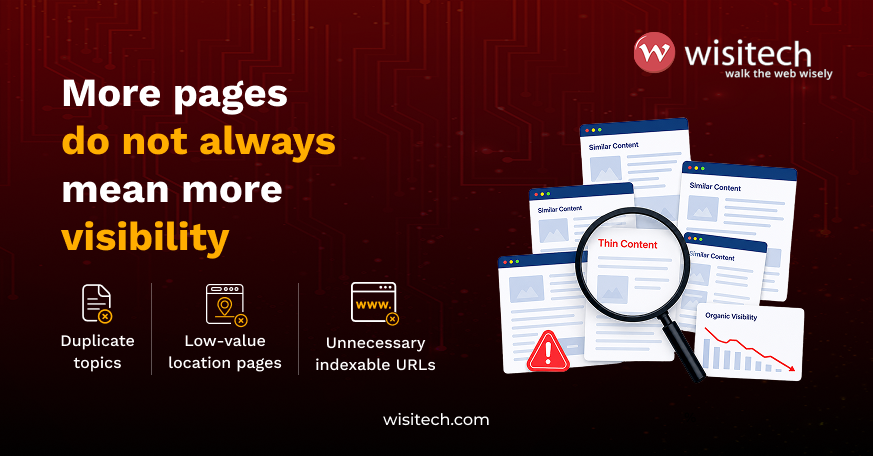
Publishing more pages does not automatically create more search visibility. A website can contain hundreds of blog posts, service pages, and location pages while offering very little information that helps users make decisions or solve problems. In 2020, following SEO best practices means paying closer attention to the usefulness, originality, and purpose of each page rather than treating content volume as a measure of SEO progress.
Thin content is often discussed as a word-count problem, but that explanation is incomplete. A short page can be useful, while a long article can repeat information available on dozens of competing websites. The more important question is whether a page deserves to exist as a separate search result.
What thin content actually looks like
Thin content provides limited original value to the person visiting the page.
Some examples are obvious, such as pages containing only a few sentences, automatically generated text, or product descriptions copied directly from manufacturers.
Other forms of thin content are more difficult to identify.
A website may publish multiple articles that answer nearly identical questions. A business may create hundreds of location pages by replacing city names while leaving the rest of the content unchanged. Ecommerce websites may allow search filters and product attributes to generate large numbers of indexable pages with little unique information.
Long-form articles can also be thin.
An article containing 2,000 words may repeat general advice without providing examples, explanations, evidence, or practical guidance. Length does not automatically create usefulness.
Businesses should therefore evaluate pages according to search intent and informational value rather than relying on minimum word-count requirements.
1. SEO best practices start with deciding which pages deserve to be indexed
One of the most overlooked content decisions is whether a page should appear in search results at all.
Websites frequently accumulate low-value pages over time. Tag archives, outdated promotions, internal search results, duplicate product variations, old announcements, and automatically generated URLs may become accessible to search engines.
Individually, these pages may appear harmless. Collectively, they can make the website harder to manage and reduce the overall quality of the content search engines encounter.
Businesses should regularly review the pages included in search engine indexes.
The objective is not to remove every page with limited traffic. Some pages serve important purposes even if they attract small audiences. Instead, businesses should identify pages that duplicate other content, have no clear search purpose, provide outdated information, or exist only because the content management system created them automatically.
Depending on the situation, these pages can be improved, consolidated, redirected, removed, or excluded from indexing.
Content management is therefore as important as content production.
2. Thin pages can compete with stronger pages from the same website
Publishing several pages about closely related topics can create an unexpected SEO problem.
Search engines may struggle to determine which page is the most relevant result for a particular query. Rankings may shift between pages, backlinks may be distributed across multiple URLs, and internal links may point to different pages addressing the same intent.
This is commonly known as keyword cannibalization.
The solution is not always to delete content.
Businesses should first determine whether the pages serve genuinely different search intentions. If two pages answer essentially the same question, combining them into a more complete resource may create a stronger result.
Older URLs can then be redirected where appropriate, internal links can be updated, and external links can point toward a clearer primary resource.
This approach can be particularly useful for service-based businesses that publish overlapping pages over several years.
For example, a local SEO company might have separate articles discussing local search rankings, Google My Business optimization, local citations, and improving visibility in nearby searches. These pages can coexist if each addresses a distinct question. Problems arise when several articles provide nearly identical advice without offering a clear reason for each page to exist.
3. Thin location pages can weaken a local search strategy
Location pages are valuable when they help users understand how a business serves a particular geographic area.
Problems occur when businesses create large numbers of pages by changing only the city name, title tag, and a few sentences.
A page targeting a specific location should provide information relevant to customers in that area. Depending on the business, useful information may include service availability, delivery areas, project examples, customer questions, directions, local regulations, service response considerations, or differences between locations.
Businesses investing in local SEO services should review whether each location page provides a useful experience for someone searching from that area.
Creating more pages is not necessarily the answer.
A single detailed regional page may perform a clearer function than ten nearly identical city pages. The correct structure depends on the business model, physical locations, service coverage, and how customers search.
Working with a local SEO agency can help businesses evaluate location-page strategies, but companies should still ask a fundamental question before approving new pages: what useful information will this page provide that is not already available elsewhere on the website?
4. Following SEO best practices requires improving existing content, not only publishing new pages
Content calendars often prioritize production. Teams measure how many articles are published each month, while older content receives little attention after publication.
This approach can create increasingly large websites filled with outdated or underperforming pages.
Content maintenance should be part of an SEO strategy.
Businesses can begin by identifying pages that receive impressions but few clicks, pages that once attracted traffic but have declined, and articles ranking just outside prominent search positions.
Each page should then be reviewed according to its original purpose.
Does the page still answer the search query accurately? Are important questions missing? Has the industry changed since publication? Does the article contain outdated statistics, screenshots, product information, or recommendations? Are there newer pages on the website that should be linked internally?
Updating content does not mean changing the publication date and adding several paragraphs.
Meaningful updates improve the usefulness, accuracy, organization, and completeness of the page.
In some situations, the correct decision is consolidation rather than expansion. Two average articles may become a stronger resource when combined around a single search intent.
5. Original value is difficult to create when every article follows the same formula
Search results often contain dozens of articles that provide the same definitions, tips, and conclusions.
Businesses sometimes reproduce this structure because competing pages rank well. However, repeating existing information with slightly different wording gives users little reason to choose one website over another.
Original value does not necessarily require conducting expensive research.
Companies can use information they already have.
Customer service teams know which questions customers repeatedly ask. Sales teams understand common objections and decision criteria. Website analytics reveal how visitors navigate content. Internal search data can show what users struggle to find. Project teams can provide examples of problems, solutions, and unexpected lessons.
These insights can turn a generic article into a useful resource.
For example, instead of publishing another article listing basic ranking factors, a company could analyze why several important pages receive traffic but fail to generate inquiries. The article could explain how the problem was identified, which changes were prioritized, and what businesses should measure before rewriting content.
Specific experience makes content more difficult to replicate.

How to audit thin content without deleting valuable pages
A thin-content audit should begin with evidence rather than assumptions.
Create an inventory of indexable URLs and review organic traffic, search impressions, backlinks, conversions, publication dates, and topic overlap.
Pages can then be grouped according to the most appropriate action:
- Keep pages that already serve a clear purpose and provide useful information.
- Improve pages that target valuable search intent but lack sufficient depth, accuracy, or differentiation.
- Consolidate pages that compete for the same queries or repeat substantially similar information.
- Redirect URLs when another page provides a better destination for users.
- Remove or exclude pages from indexing when they have no meaningful search purpose and cannot be improved.
Changes should be implemented carefully. A page with limited traffic may still have valuable backlinks, conversions, or relevance to a small but important audience.
The objective of the audit is not to reduce the number of pages. It is to make the website easier for users and search engines to understand.
Building a stronger SEO foundation with better content
Thin content becomes a serious SEO problem when websites continue publishing pages without considering whether each URL provides unique value, serves a clear search intent, or supports the broader website structure.
Applying SEO best practices in 2020 requires businesses to manage their existing content as carefully as they plan new articles. Reviewing indexable pages, consolidating overlapping topics, improving location content, updating older resources, and incorporating original insights from your business can create a stronger foundation for sustainable organic visibility.
Before publishing your next batch of content, talk to us to review your website’s content structure and uncover thin, overlapping, or underperforming pages that may be limiting your organic search potential.