
A landing page can attract thousands of visitors and still fail to generate meaningful business results. Traffic alone does not tell you whether a campaign is working. What matters is how effectively the page turns qualified visitors into leads, trial users, enquiries, or customers.
Understanding your landing page conversion rate can help you identify whether the page is supporting business growth or creating friction that prevents potential customers from taking action.
Conversion benchmarks can provide useful context, but they should not become universal targets. Industry, traffic source, offer complexity, audience intent, device type, and the action you are asking visitors to complete can significantly influence conversion performance.
In 2021, businesses were paying closer attention to conversion rate optimization, mobile usability, page speed, audience research, and experimentation as digital competition increased. These priorities remain important because effective landing pages must connect visitor intent with a clear value proposition and an easy path to conversion.
This guide explains how to evaluate landing page performance, understand conversion benchmarks, and use UX principles to improve results.
What is a conversion rate?
A conversion rate is the percentage of visitors who complete a desired action on a webpage.
The basic calculation is:
Conversion rate = (Number of conversions ÷ Total visitors) × 100
For example, if 1,000 people visit a landing page and 50 complete the desired action, the conversion rate is 5%.
The desired action depends on the purpose of the page.
It may include:
- Purchasing a product
- Submitting a lead generation form
- Requesting a consultation
- Booking a demonstration
- Starting a free trial
- Registering for an event
- Downloading a resource
- Creating an account
Not every conversion immediately produces revenue.
For B2B businesses and companies selling complex products or services, a landing page may generate qualified leads that move into a longer sales process.
This is why conversion rates should be evaluated alongside lead quality, customer acquisition cost, sales conversion rates, and revenue generated.
A page producing 100 low-quality leads may be less valuable than one generating 30 enquiries from decision-makers who are ready to buy.
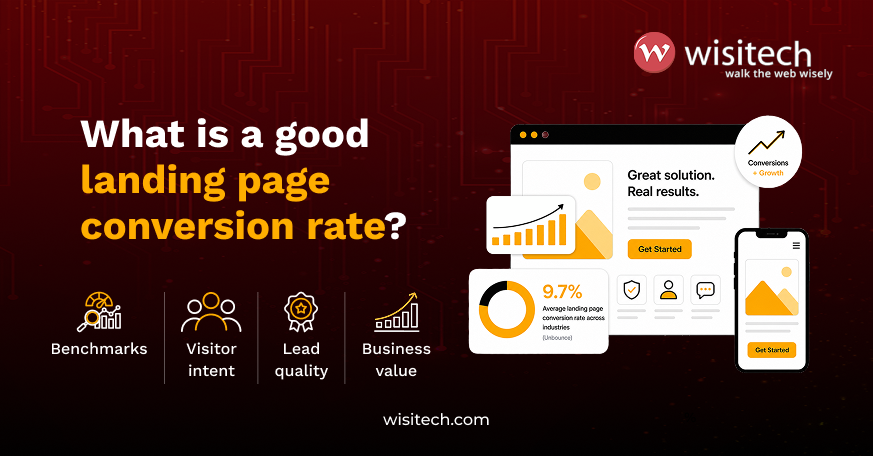
What is a good landing page conversion rate?
There is no single conversion rate that defines a successful landing page.
Industry benchmarks can help businesses understand the broader market, but your target should reflect the type of offer, traffic source, audience, conversion action, and economics of the campaign.
A page asking visitors to download a free guide may convert at a much higher rate than a page asking them to purchase an expensive product or schedule a consultation for a complex B2B service.
Conversion rates can also differ based on:
- Industry
- Product price
- Sales cycle length
- Brand awareness
- Visitor intent
- Traffic source
- Device type
- Geographic market
- Page speed
- Offer relevance
- Form complexity
For example, branded search traffic from visitors already familiar with your company may convert differently from cold social media traffic.
Instead of asking only, “Is our conversion rate above the industry average?” businesses should ask:
“Are we converting more qualified visitors than before?”
“Are conversion improvements generating better leads or more revenue?”
“Which traffic sources produce the highest-value conversions?”
“Where are visitors abandoning the journey?”
“Can we improve performance without reducing lead quality?”
These questions provide a more commercially useful framework for evaluating landing pages.
Why conversion benchmarks need context
Benchmark data can help identify whether performance is unusually high or low, but averages can hide significant differences between businesses.
Two landing pages in the same industry can produce very different results because they target different audiences, promote different offers, and receive traffic from different channels.
Consider two B2B landing pages.
The first offers a free industry report and asks only for an email address.
The second promotes a high-value software platform and asks visitors to schedule a sales demonstration.
The first page may produce a higher conversion rate because the commitment required from visitors is much lower.
However, the second page may generate greater revenue from fewer conversions.
Conversion rate should therefore be considered alongside:
- Lead quality
- Revenue per visitor
- Cost per acquisition
- Customer lifetime value
- Sales-qualified leads
- Completed purchases
- Return on advertising spend
The goal is not to produce the highest possible conversion percentage.
The goal is to generate valuable business outcomes from the traffic you already receive.
How to optimize landing page conversion rates
Landing page conversion rate optimization, or CRO, is the process of improving a page so more qualified visitors complete the desired action.
Effective optimization should combine quantitative data, qualitative research, UX analysis, and controlled experimentation.
Start with audience and intent research
Before changing headlines, buttons, forms, or page layouts, understand why visitors arrive on the page.
Review:
- Search queries
- Advertising campaigns
- Referral sources
- Audience segments
- Customer interviews
- Sales team feedback
- On-site surveys
- Previous conversion data
A visitor searching for pricing information has different expectations from someone researching a problem for the first time.
The landing page should reflect the visitor’s level of awareness and provide the information required to make the next decision.
An experienced UX design agency can use audience research, behavioral data, usability testing, and journey analysis to identify the obstacles preventing qualified visitors from converting.
Identify where visitors experience friction
Analytics can tell you that visitors are leaving.
UX research can help explain why.
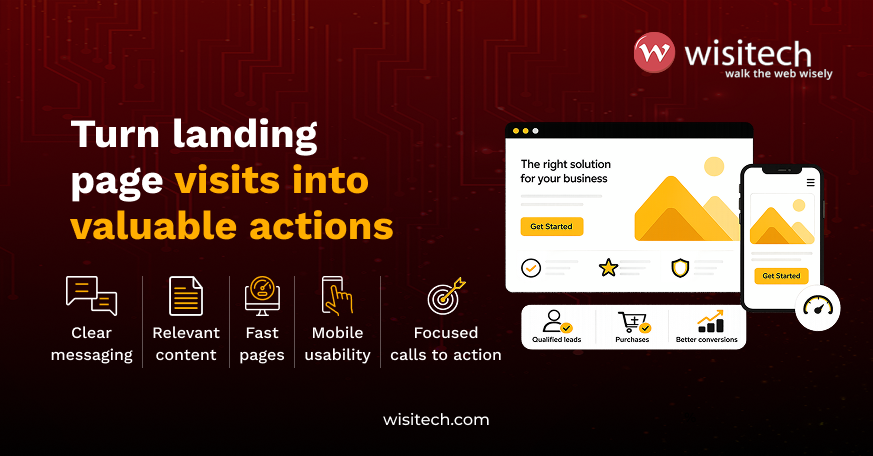
Common sources of landing page friction include:
- Unclear headlines
- Weak value propositions
- Slow page loading
- Poor mobile usability
- Confusing navigation
- Long forms
- Unnecessary form fields
- Weak calls to action
- Insufficient product information
- Missing trust signals
- Distracting page elements
- Unclear pricing or next steps
Businesses should prioritize these problems based on potential impact rather than making arbitrary visual changes.
For example, reducing form fields may improve conversion rates, but it may also reduce the information available to qualify leads.
The right decision depends on the sales process and business objectives.
Use A/B testing to validate landing page improvements
A/B testing compares different versions of a landing page to determine which performs better against a defined objective.
Businesses can test elements such as:
- Headlines
- Value propositions
- Calls to action
- Page layouts
- Product imagery
- Form length
- Social proof
- Pricing presentation
- Navigation options
However, testing random changes without a clear hypothesis can waste traffic and produce misleading conclusions.
A useful hypothesis might be:
“Visitors are abandoning the form because it requests information that is not necessary at this stage. Reducing the number of required fields will increase completed submissions without significantly reducing lead quality.”
The test then evaluates a specific business question.
In 2021, CRO teams increasingly combined experimentation with analytics and user research instead of relying solely on design preferences.
That approach remains valuable because conversion optimization works best when businesses understand the problem before testing the solution.
How product complexity affects landing page design
The amount of information required on a landing page depends largely on the complexity of the offer and the visitor’s decision-making process.
A customer ordering a familiar food item may need only images, pricing, delivery information, and an easy ordering process.
A visitor evaluating enterprise software, professional services, technical equipment, or an expensive product may require significantly more information before taking action.
Complex offers may benefit from longer landing pages that include:
- Problem definition
- Product or service benefits
- Key features
- Use cases
- Product demonstrations
- Technical specifications
- Customer testimonials
- Case studies
- FAQs
- Pricing information
- Implementation details
- Clear next steps
Long pages are not automatically better.
The page should provide enough information to address important questions and reduce uncertainty without adding unnecessary content.
This is where user experience design services can provide commercial value. UX research, information architecture, wireframing, prototyping, and usability testing can help businesses determine what information users need and how that information should be presented.
Build a clear conversion path
A landing page should make the next step obvious.
Visitors should not have to determine what the business wants them to do.
The conversion path should connect:
Visitor intent → Value proposition → Supporting information → Trust → Action
Every major section of the page should help visitors move toward the next decision.
For example, a B2B software landing page may follow this structure:
Problem → Business impact → Solution → Product capabilities → Proof → Implementation process → FAQ → Demo request
An ecommerce landing page may use:
Product category → Key benefits → Product selection → Reviews → Shipping information → Purchase action
The structure should reflect the buyer’s questions rather than an internal company presentation.
Reduce unnecessary cognitive load
Landing pages often underperform because they ask visitors to process too much information at once.
Competing calls to action, excessive navigation options, dense copy, inconsistent layouts, and unnecessary visual elements can make decisions more difficult.
Effective UI design should establish a clear visual hierarchy.
Important information should be easy to identify.
Related content should be grouped logically.
Buttons should look interactive.
Forms should be understandable.
Errors should be easy to correct.
A capable UI design company should support the conversion strategy by making the interface easier to understand and use, rather than adding visual complexity that distracts visitors from the primary action.
Optimize landing pages for mobile users
Mobile responsiveness alone does not guarantee a good landing page experience.
Businesses should test the complete conversion journey on smaller screens.
Review:
- Headline readability
- Content hierarchy
- Button size and placement
- Form usability
- Page speed
- Image loading
- Sticky elements
- Pop-ups
- Error messages
- Payment or booking processes
Mobile users may also have different intent and behavior from desktop visitors.
Analyze conversion rates by device type before deciding which improvements should be prioritized.
Improve page speed without compromising the experience
Slow pages can increase friction before visitors have an opportunity to evaluate the offer.
Common performance problems include:
- Oversized images
- Unnecessary JavaScript
- Excessive third-party scripts
- Poor hosting performance
- Unoptimized fonts
- Inefficient code
- Heavy animations
Use performance tools and real-user data to identify the problems affecting important landing pages.
Prioritize changes according to commercial impact.
A performance issue affecting a high-traffic paid campaign landing page should usually receive more attention than an issue affecting a low-traffic informational page.
Measure conversions that matter to the business
Conversion rate is an important metric, but it should not be optimized in isolation.
Consider a landing page that increases its conversion rate from 5% to 8%.
That improvement looks successful.
But what happens if the additional leads rarely become customers?
Or if a promotional offer increases conversions but makes customer acquisition unprofitable?
Businesses should connect landing page performance with downstream outcomes.
Depending on the business model, track:
- Marketing-qualified leads
- Sales-qualified leads
- Lead-to-customer rate
- Revenue per visitor
- Customer acquisition cost
- Average order value
- Completed purchases
- Trial-to-paid conversion rate
- Customer lifetime value
This prevents optimization teams from improving surface-level metrics while ignoring profitability and revenue.
When should you redesign a landing page?
A complete redesign is not always necessary.
Sometimes a landing page can be improved through focused changes to messaging, forms, page speed, content hierarchy, or calls to action.
A broader redesign may be appropriate when:
- The page no longer reflects the current audience or offer
- Mobile usability is consistently poor
- The underlying page structure limits experimentation
- Conversion paths are confusing
- The visual hierarchy makes important information difficult to find
- The design system creates inconsistent experiences
- Technical limitations prevent meaningful optimization
- Multiple campaigns require scalable landing page templates
Before redesigning, establish baseline performance data.
Without reliable benchmarks, it becomes difficult to determine whether the new experience actually improves business outcomes.
Improve your landing page conversion rate with evidence, not guesswork
A good conversion rate is not simply a number that exceeds an industry average.
The right benchmark depends on your audience, traffic sources, offer complexity, conversion action, sales process, and the value generated by each customer.
Businesses should combine analytics, UX research, experimentation, mobile optimization, performance improvements, and downstream revenue data to understand what is preventing qualified visitors from converting.
Wisitech helps businesses evaluate and improve landing pages through UX strategy, UI design, development, performance optimization, and conversion-focused implementation.
Send us your landing page URL, primary traffic source, current conversion rate, and the action you want more visitors to complete, and our team can identify the UX and conversion barriers that should be prioritized first.